Influenza Activity and Estimated Vaccine Effectiveness During the 2025-2026 Influenza Season - Summary - MDSpire

Influenza Activity and Estimated Vaccine Effectiveness During the 2025-2026 Influenza Season

  • By

  • Eduardo Azziz-Baumgartner

  • Alicia Budd

  • Justin S. Lee

  • A. Danielle Iuliano

  • Sascha R. Ellington

  • Min Z. Levine

  • Xiao-yu Zheng

  • Larisa Gubareva

  • Katherine Adams

  • Jennifer DeCuir

  • Catherine H. Bozio

  • Carrie Reed

  • Marie K. Kirby

  • Benjamin Rambo-Martin

  • Jefferson M. Jones

  • Matthew Biggerstaff

  • Shikha Garg

  • Charles Todd Davis

  • Tom T. Shimabukuro

  • Erin Burns

  • Rebecca Kondor

  • Sonja J. Olsen

  • Vivien G. Dugan

  • VISION Coauthors

  • Stephanie A. Irving

  • Allison L. Naleway

  • Kristin Dascomb

  • Tamara Sheffield

  • Malini B. DeSilva

  • Sara Y. Tartof

  • Lina S. Sy

  • Nicola P. Klein

  • Ousseny Zerbo

  • Shaun J. Grannis

  • Brian E. Dixon

  • Melissa S. Stockwell

  • Ashley B. Stephens

  • Toan C. Ong

  • Michelle A. Barron

  • Sarah W. Ball

  • Zachary A. Weber

  • Emily L. Reeves

  • Caitlin S. Ray

  • June 17, 2026

  • 0 min

Share

Objective:

To provide US virologic, immunologic, and epidemiologic findings regarding influenza A(H3N2) viruses and vaccine effectiveness during the 2025-2026 season.

Approach:
    Key Findings:
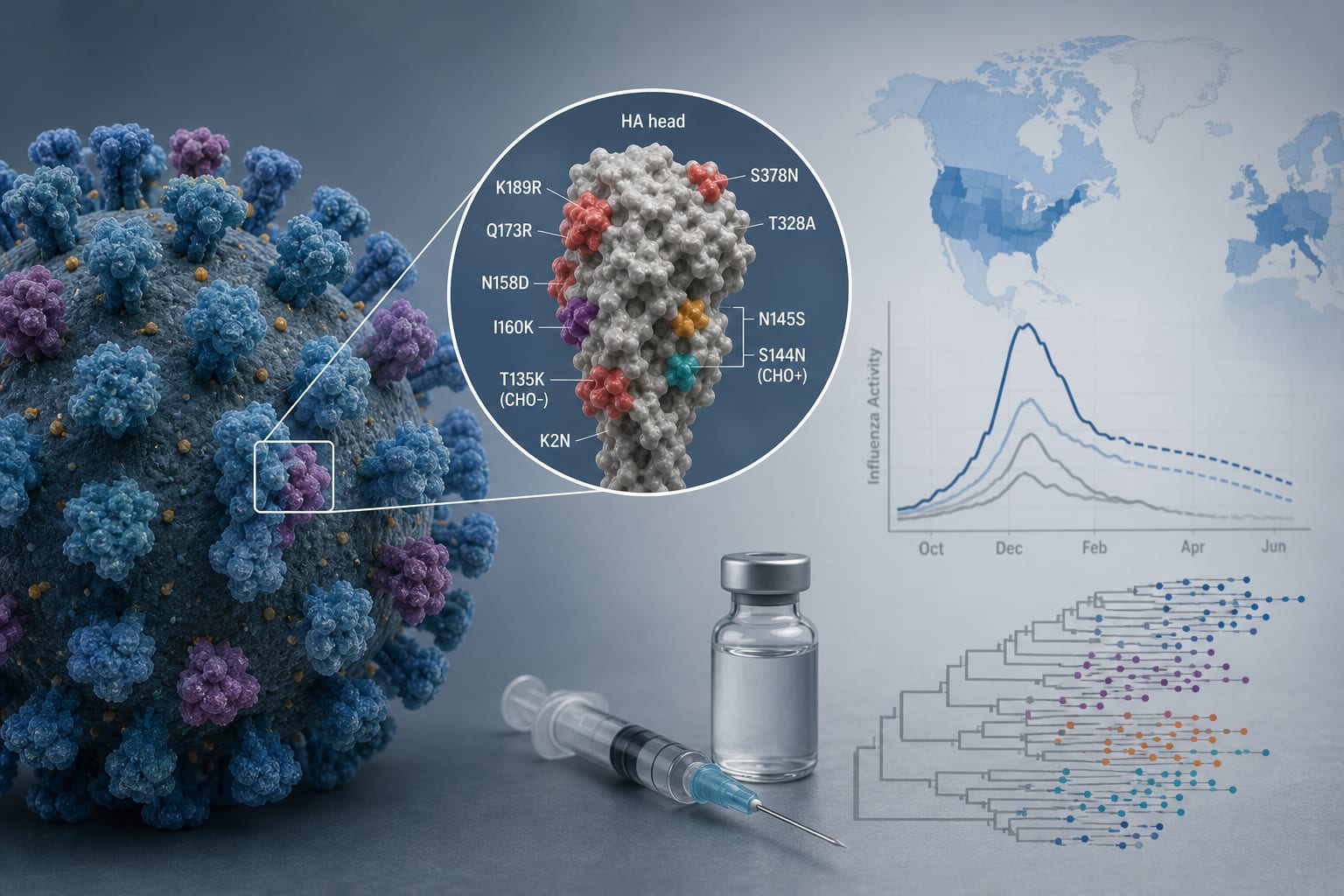
    • Ten mutations in the HA protein of influenza A(H3N2) viruses were identified, indicating potential vaccine escape.
    • The emergence of subclade K viruses led to a protracted epidemic in Australia and an early severe season in Japan.
    • Antigenic drift was observed in circulating A(H3N2) viruses compared to the vaccine reference virus.
    Interpretation:

    The findings indicate significant changes in circulating influenza A(H3N2) viruses that may affect vaccine efficacy.

    Limitations:
    • The study is based on data collected from specific regions and may not represent the entire US population.
    • Ethical considerations limited the scope of certain data collection methods.
    Conclusion:

    The study highlights the need for ongoing surveillance and assessment of influenza virus changes to inform vaccine development.

    Sources:

Original Source(s)

Related Content