Medium-sized follicle proportion on the trigger day may be associated with higher live birth rate in fresh embryo transfer cycles among low-prognosis patients: a retrospective cohort study - Summary - MDSpire
Advertisement
Medium-sized follicle proportion on the trigger day may be associated with higher live birth rate in fresh embryo transfer cycles among low-prognosis patients: a retrospective cohort study
To investigate the association of medium-size follicle proportions (MFP) on the trigger day with pregnancy outcomes in low prognosis patients undergoing GnRH antagonist protocol.
Approach:
Study Design: Retrospective analysis of 1084 oocyte-retrieval cycles from 765 low prognosis patients based on POSEIDON criteria.
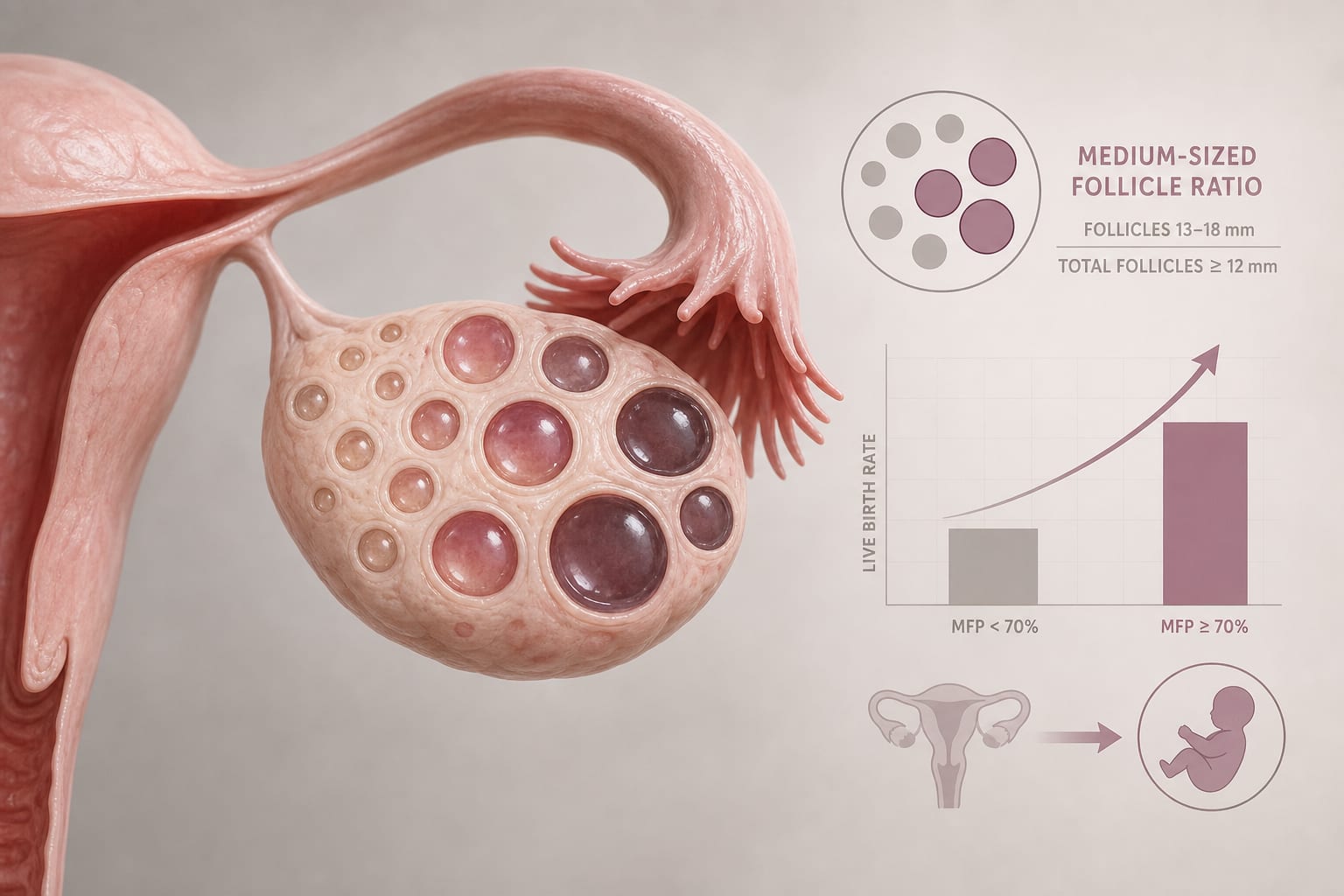
MFP Definition: MFP defined as the ratio of follicles sized 13–18 mm to those ≥ 12 mm on trigger day.
Group Division: Cycles divided into MFP < 70% and MFP ≥ 70% groups for comparison.
Statistical Analysis: Multivariate logistic regression used to identify MFP as an independent predictor of live birth.
Key Findings:
Live birth rate (LBR) was significantly lower in the MFP < 70% group (20.75%) compared to MFP ≥ 70% group (31.88%, P = 0.003).
Significant differences in LBR were observed in both age groups: ≤ 35 years (28.18% vs 43.28%, P = 0.0148) and > 35 years (14.50% vs 23.66%, P = 0.0444).
MFP < 70% group required a higher GnRH-antagonist dose (0.91 mg vs 0.78 mg, P < 0.0001) and longer duration (3.61 days vs 3.11 days, P < 0.0001).
No significant difference in LBR was observed in frozen-thawed embryo transfer (FET) cycles.
Interpretation:
MFP is associated with live births in fresh transfers, highlighting the role of medium-sized follicle development in low prognosis patients.
Limitations:
Retrospective design may introduce selection bias.
Study focused only on fresh embryo transfer cycles; findings may not apply to all patient populations.
Conclusion:
Higher MFP is associated with improved live birth rates in fresh embryo transfers for low prognosis patients.