Serial lactate–procalcitonin interaction identifies a high-risk phenotype in 24-h conditional survivors of post-cardiac arrest syndrome: a CART-based analysis - Summary - MDSpire
Advertisement
Serial lactate–procalcitonin interaction identifies a high-risk phenotype in 24-h conditional survivors of post-cardiac arrest syndrome: a CART-based analysis
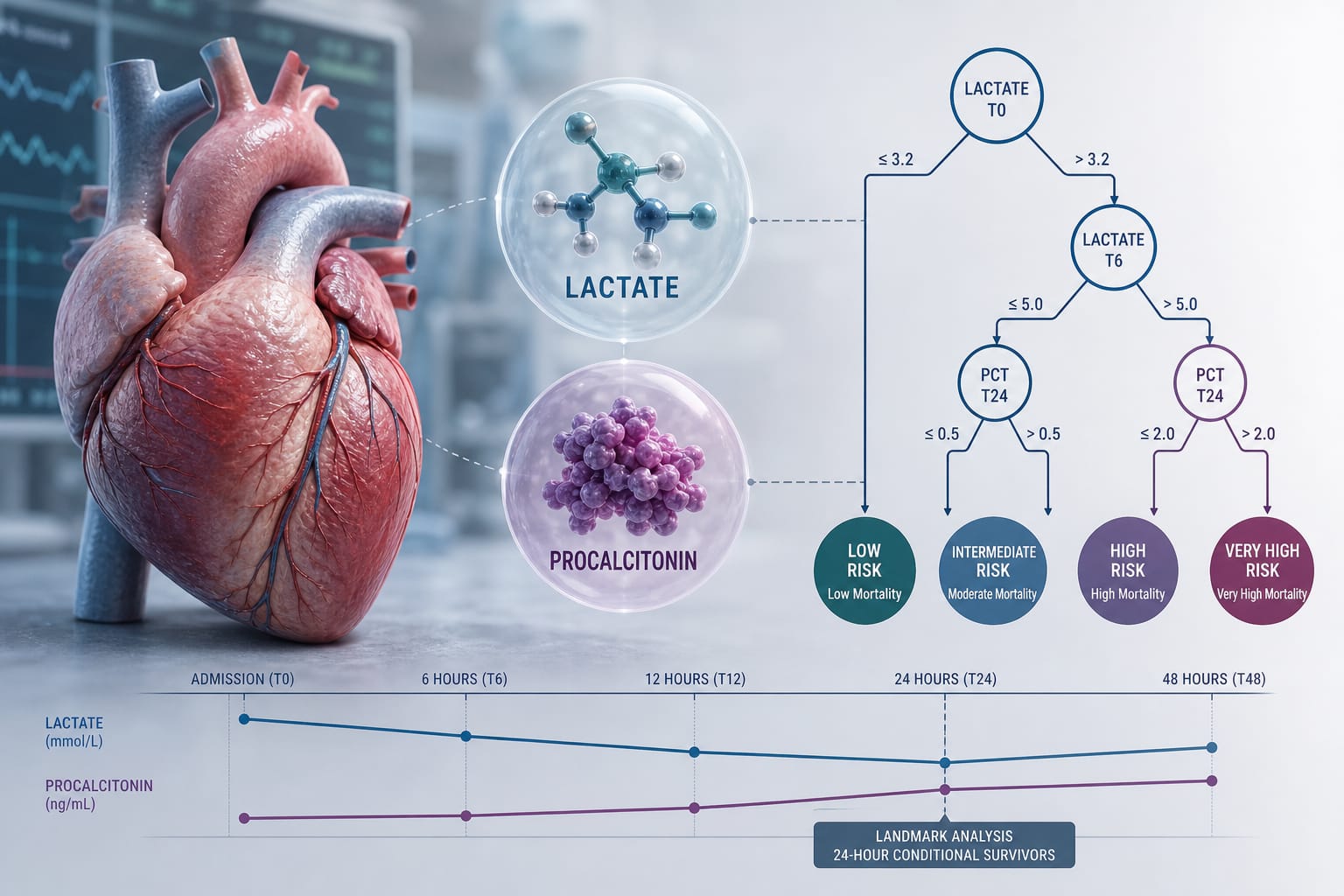
To investigate the time-dependent interplay between early metabolic failure and delayed systemic inflammatory response in 24-h conditional survivors of post-cardiac arrest syndrome (PCAS) and to develop a non-linear risk stratification tool using CART analysis based on serial lactate and procalcitonin (PCT) kinetics.
Approach:
Study Design: Retrospective cohort study including 158 24-h conditional survivors of PCAS, monitoring arterial lactate and PCT levels at specified time points.
Data Handling: Missing data were managed using multiple imputation by chained equations (MICE).
Primary Endpoint: In-hospital mortality was the primary endpoint, with a landmark analysis performed at 24 h to address immortal time bias.
Key Findings:
In-hospital mortality rate was 70.9%.
Non-survivors had higher rates of non-shockable rhythms, longer CPR durations, and higher APACHE II scores.
Persistent hyperlactatemia at 48 h was a significant independent predictor of mortality (OR: 1.92; 95% CI: 1.22–3.01).
CART analysis identified a high-risk phenotype (T0 lactate >5 mmol/L AND T24 PCT > 5.5 ng/mL) associated with a 92% mortality risk.
Interpretation:
Persistent metabolic debt at 48 h is an independent biochemical indicator of poor outcome in 24-h conditional survivors of PCAS, and integrating serial lactate and PCT kinetics through CART analysis identifies a high-risk phenotype.
Limitations:
Retrospective nature of the study may introduce bias.
Single-center study limits generalizability of findings.
Conclusion:
The CART model may assist in identifying high-risk patients.
New studies separate host and microbial metabolites, trace secreted proteins, identify a pro-regenerative cardiomyocyte state, and map macrophage lipid metabolism