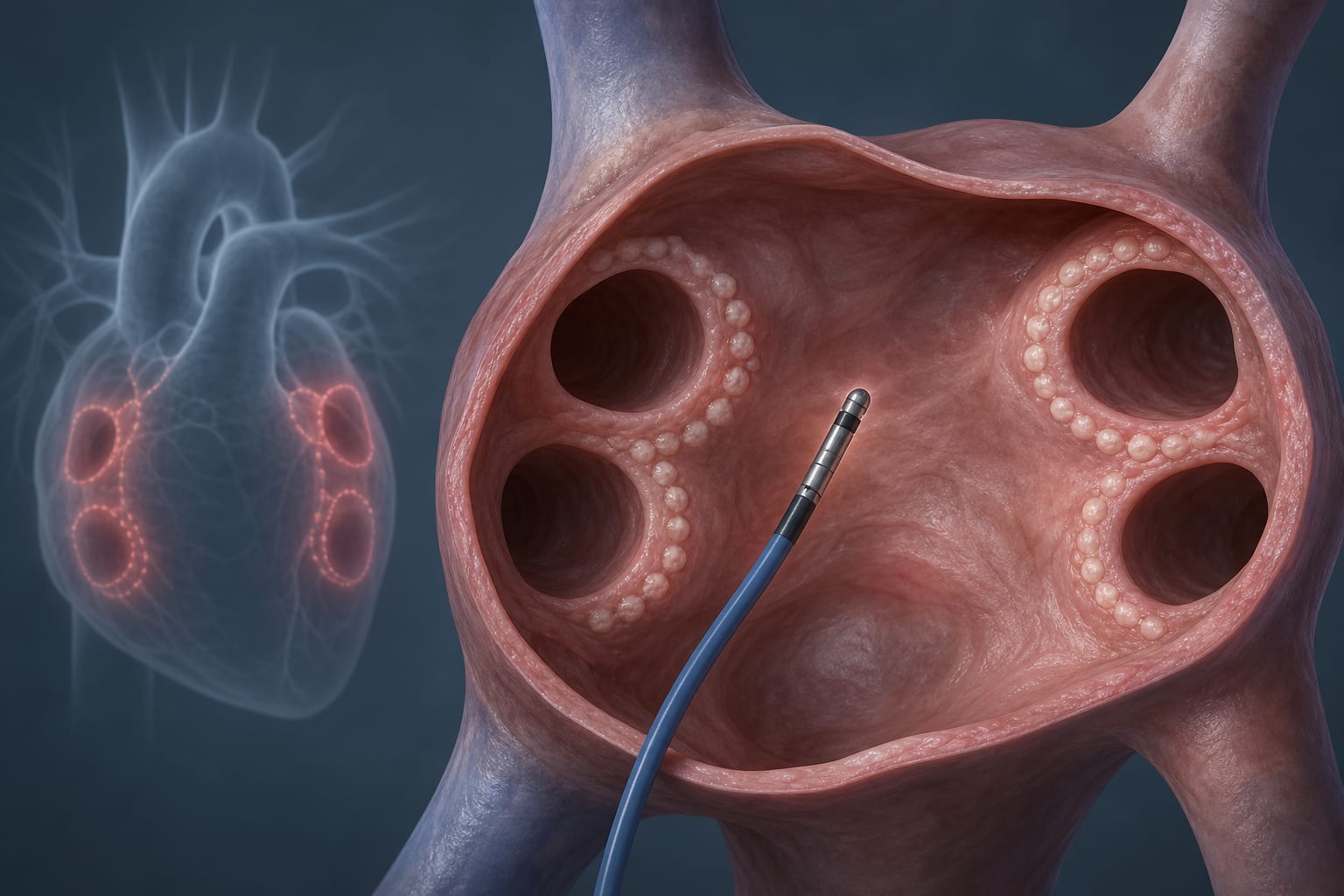
To evaluate whether omitting the circular mapping catheter (CMC) preserves efficacy and improves efficiency in first-time pulmonary vein isolation (PVI) during radiofrequency (RF) ablation for atrial fibrillation (AF), addressing a gap in current clinical practices.
Approach:
Key Findings:
CMC-free cases had shorter procedures (105 vs. 120 min, p < 0.001), indicating improved efficiency.
Lower fluoroscopy time in CMC-free cases (4 vs. 6 min, p < 0.001), which may reduce patient exposure to radiation.
Reduced radiation dose in CMC-free cases (150 vs. 220 cGy·cm2, p < 0.001), enhancing safety.
RF time and energy were lower in CMC-free cases (2083 vs. 2343 s, p = 0.026; 71582 vs. 77335 J, p = 0.035), suggesting a more efficient procedure.
12-month efficacy was comparable between groups (adjusted HR: 1.03, 95% CI: 0.58–1.84; p = 0.92), supporting the non-inferiority of the CMC-free approach.
Recurrences did not differ significantly (adjusted IRR: 0.61, 95% CI: 0.30–1.21; p = 0.16), indicating similar long-term outcomes.
Interpretation:
In CLOSE-style first-time RF PVI, a CMC-free workflow improved procedural efficiency without significant differences in 12-month arrhythmia outcomes, suggesting potential for broader application in clinical practice.
Limitations:
The study was non-randomized, which may introduce selection bias; future studies should consider randomized designs to validate findings.
Findings are hypothesis-generating and require confirmation through prospective randomized studies to establish safety and efficacy.
Conclusion:
The CMC-free approach may enhance efficiency in RF PVI for AF without compromising efficacy, warranting further investigation to confirm its impact on patient care.
A consensus statement called for immediate adoption of enhanced radiation protection devices, although evidence of long-term health benefits and effectiveness across procedural settings remains limited.