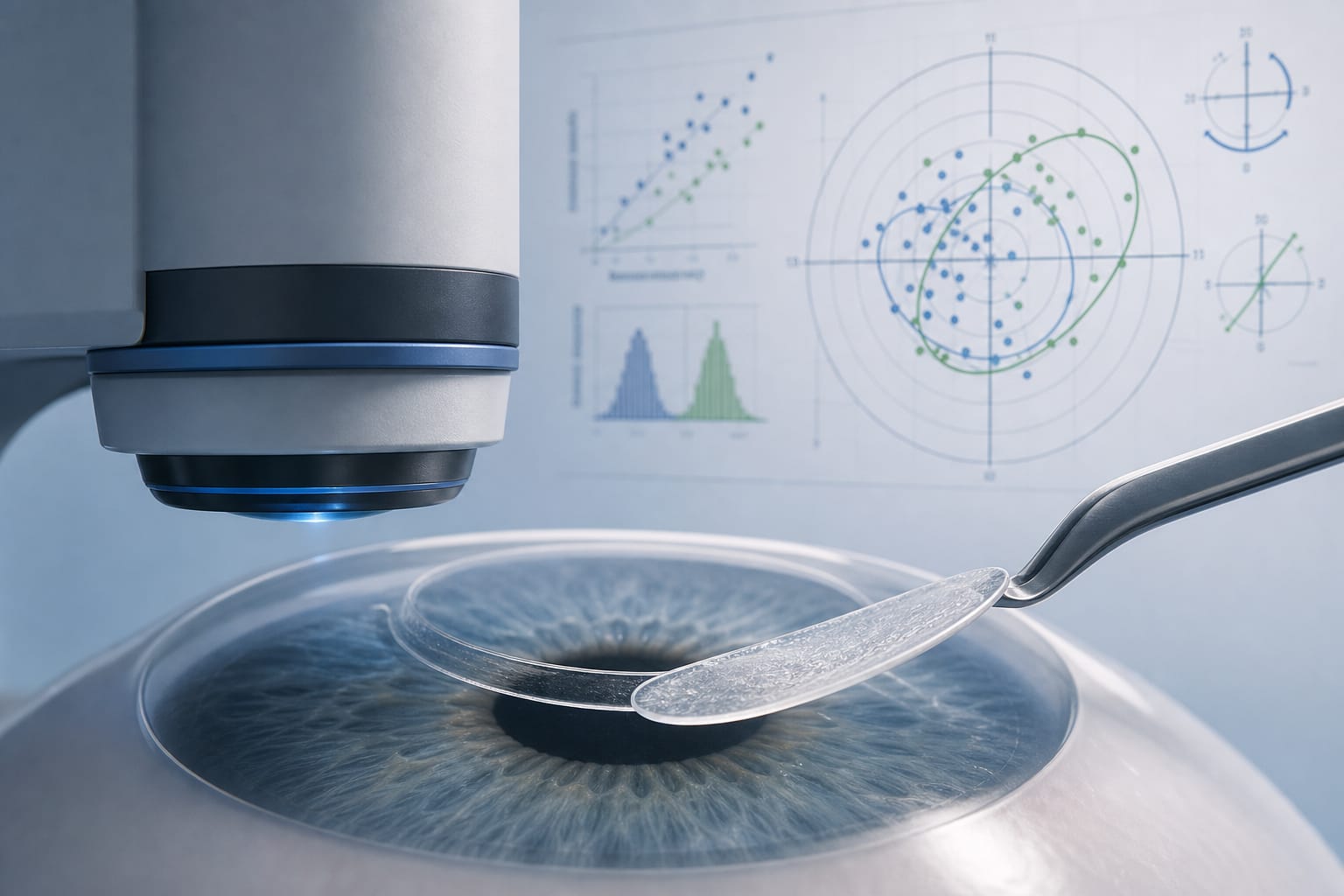
VISULYZE-assisted nomogram optimization enhances astigmatism correction accuracy in keratorefractive lenticule extraction: a stratified retrospective analysis
By
Yanfen Liao
Nian Guan
Bin Zhang
Zhengwei Shen
July 2, 2026
Objective: To compare VISULYZE-assisted nomogram optimization with empirical nomogram adjustment for spherical and astigmatic correction in KLEx, focusing on the differential effectiveness across astigmatism severities.
Approach: Study Design: Retrospective case-control study including 206 eyes undergoing KLEx, assigned to VISULYZE group or control group with empirical adjustments.Outcome Measures: Primary outcomes included uncorrected distance visual acuity (UDVA), best-corrected distance visual acuity (BCVA), spherical equivalent (SE) accuracy, and residual astigmatism.Statistical Analysis: Stratified analyses for low-to-moderate and high astigmatism, using two-way ANOVA for interaction effects.Key Findings: 100% of VISULYZE group achieved UDVA of 20/20 or better compared to 98% in control group. 87% of VISULYZE group achieved 20/16 or better vs. 73% in control group (P = 0.045). SE within ±0.50 D was achieved in 100% of VISULYZE eyes vs. 94.4% of control eyes (P = 0.017). Residual astigmatism of 0.50 D or less was observed in 99% of VISULYZE eyes vs. 93.5% in control (P = 0.042). Both low-to-moderate and high astigmatism subgroups showed significantly better SE accuracy and lower residual astigmatism with VISULYZE (P < 0.05). Interpretation: VISULYZE-assisted nomogram optimization improved accuracy in astigmatism correction across different severities.
Limitations: Retrospective design may introduce selection bias. Single-center study limits generalizability. Conclusion: VISULYZE-assisted optimization enhances the accuracy of spherical and astigmatic correction in KLEx.