Unmasking the “targetless” illusion: branched clonal evolution of TERT and KIT in acral melanoma revealed by sequential multi-site biopsies- a case report - Summary - MDSpire
Advertisement
Unmasking the “targetless” illusion: branched clonal evolution of TERT and KIT in acral melanoma revealed by sequential multi-site biopsies- a case report
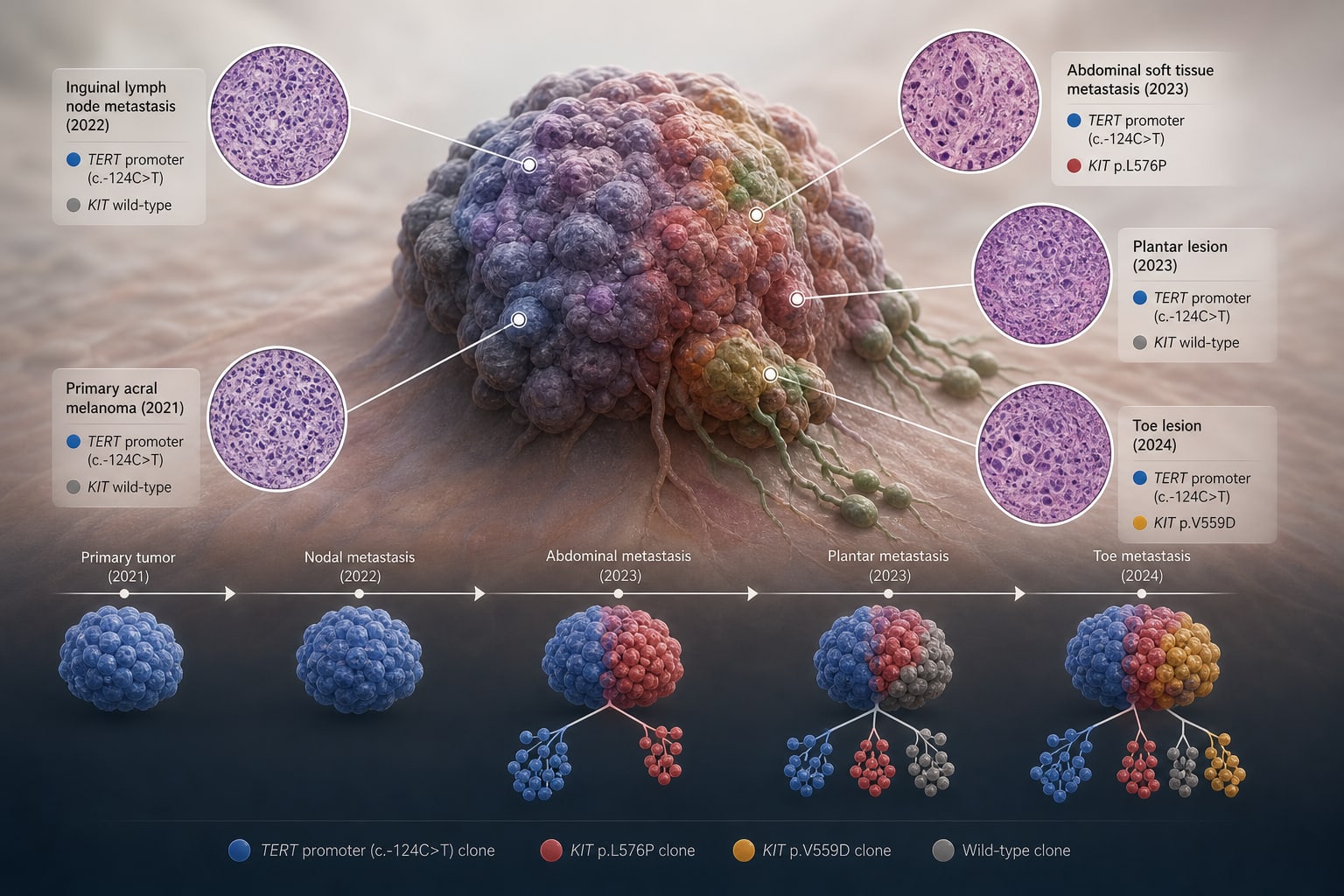
To illustrate the dynamic branching clonal evolution of TERT and KIT mutations in a case of metastatic acral melanoma and highlight the importance of serial biopsies in understanding tumor heterogeneity and informing treatment strategies.
Key Findings:
Initial genetic testing revealed only a TERT mutation in the inguinal lymph node metastasis, with no KIT mutation detected, indicating limited initial treatment options.
Subsequent testing of an abdominal skin metastasis identified a rare KIT mutation, which was pre-existing and selected for under treatment pressure, suggesting the need for adaptive treatment strategies.
The KIT p.Ala829Pro mutation demonstrated inherent resistance to imatinib, explaining treatment failure and highlighting the importance of understanding mutation profiles.
Interpretation:
The findings underscore the complexity of tumor evolution in acral melanoma, emphasizing the need for multiple biopsies to capture the full mutational landscape and inform treatment strategies, potentially guiding personalized therapy.
Limitations:
The study is based on a single case, limiting the generalizability of the findings and necessitating further research to validate results.
Potential biases in mutation detection due to the varying sensitivity of genetic testing methods may affect the reliability of the findings.
Conclusion:
This case study highlights the significant spatiotemporal heterogeneity in acral melanoma and the critical role of serial biopsies in guiding precision oncology, suggesting that similar approaches could be beneficial in broader clinical contexts.