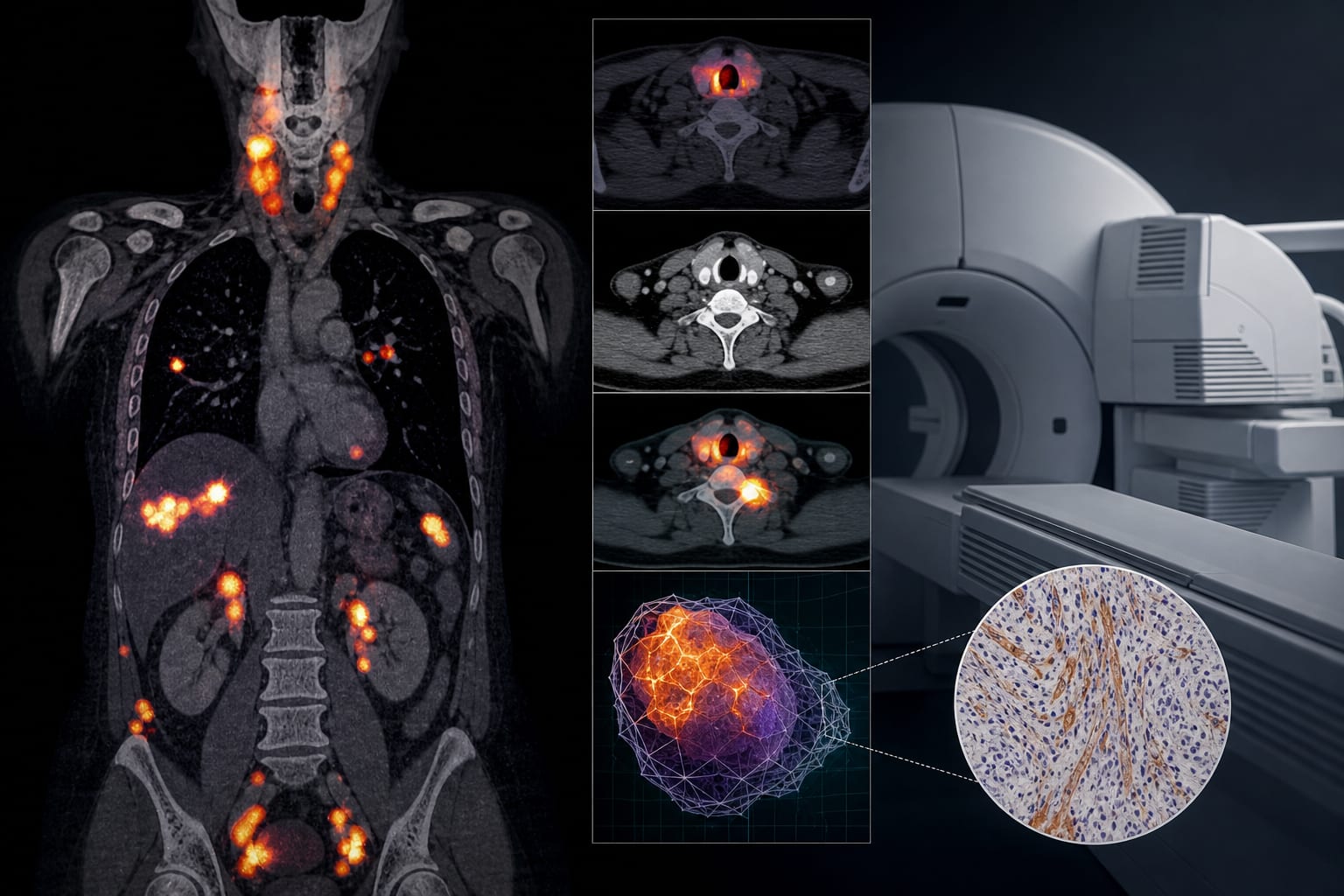
99mTc-FAPI-YQ3 SPECT/CT for characterizing FAPI uptake phenotypes and metabolic-stromal heterogeneity in advanced differentiated thyroid carcinoma: a prospective single-center imaging-radiomics study - Summary - MDSpire
Advertisement
99mTc-FAPI-YQ3 SPECT/CT for characterizing FAPI uptake phenotypes and metabolic-stromal heterogeneity in advanced differentiated thyroid carcinoma: a prospective single-center imaging-radiomics study
To evaluate 99mTc-FAPI-YQ3 SPECT/CT for characterizing FAPI uptake phenotypes and metabolic-stromal imaging heterogeneity in advanced differentiated thyroid carcinoma (DTC).
Approach:
Study Design: A prospective observational study enrolling patients with pathologically confirmed advanced DTC from June 2024 to February 2025.
Imaging Techniques: Patients underwent whole-body 99mTc-FAPI-YQ3 SPECT/CT and 18F-FDG PET/CT within one week.
Analysis: Lesion detection, biodistribution, tumor-to-background ratio (TBR), dual-tracer concordance, and exploratory radiomics classification of FAPI uptake phenotypes were analyzed.
Key Findings:
Seventeen patients with 103 lesions were included.
Mean TBR of 99mTc-FAPI-YQ3 was 6.8 +/- 2.3.
Dual-tracer phenotypes included 52.4% concordant FDG-positive/FAPI-positive lesions, 42.7% FDG-positive/FAPI-negative lesions, and 4.9% FDG-negative/FAPI-positive lesions.
99mTc-FAPI-YQ3 showed high detection rates for thyroid-bed lesions (19/21) and bone lesions (7/8).
Exploratory lesion-level radiomics analysis showed AUC values of 0.951 in the training set.
Interpretation:
99mTc-FAPI-YQ3 SPECT/CT is feasible for evaluating FAPI uptake phenotypes in advanced DTC.
Limitations:
The study was exploratory with no formal sample-size calculation.
Findings should be interpreted as imaging phenotypes rather than validated tissue-based FAP expression.
Conclusion:
Further prospective studies with histopathologic, immunohistochemical, multi-omics, and patient-level validation are required.