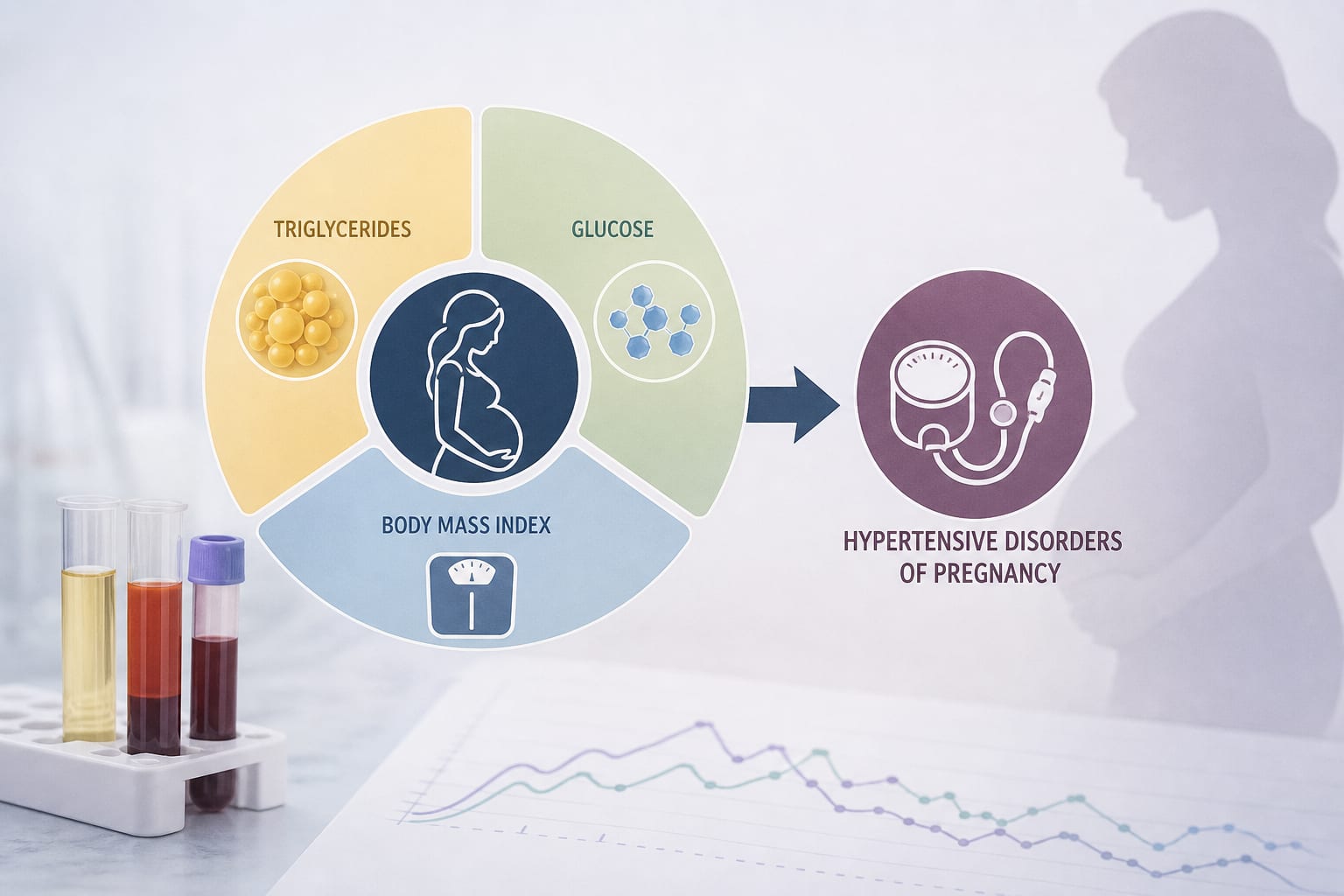
To investigate the association between triglyceride-glucose body mass index (TyG-BMI) and the risk of hypertensive disorders of pregnancy (HDP), and to compare the discriminative ability of TyG-BMI with triglyceride-glucose index (TyG) and body mass index (BMI) for HDP.
Approach:
Study Design: A case-control study involving 346 pregnant women hospitalized at Fuyang Women and Children's Hospital from January 2021 to December 2025.
Data Collection: Participants were divided into HDP group (n = 168) and control group (n = 178). Clinical data, physical examinations, and hematological parameters were collected.
Statistical Analysis: Multivariable logistic regression was used to analyze the association between TyG-BMI and HDP. RCS curves explored dose-response relationships, and ROC curves compared discriminative performance.
Key Findings:
TyG-BMI was significantly higher in the HDP group compared to the control group (228.4 ± 44.6 vs. 196.8 ± 36.2, P < 0.001).
Each 10-unit increase in TyG-BMI was associated with a 30% increase in HDP risk (adjusted OR = 1.30, 95%CI: 1.16–1.46, P < 0.001).
ROC analysis showed TyG-BMI had an AUC of 0.782 for discriminating HDP, superior to TyG index (AUC = 0.708, P = 0.005) and BMI (AUC = 0.694, P < 0.001).
The association between TyG-BMI and HDP was consistent across all subgroups.
Interpretation:
TyG-BMI is independently and positively associated with HDP.
Conclusion:
TyG-BMI may be useful for identifying and assessing metabolic abnormalities in HDP patients.