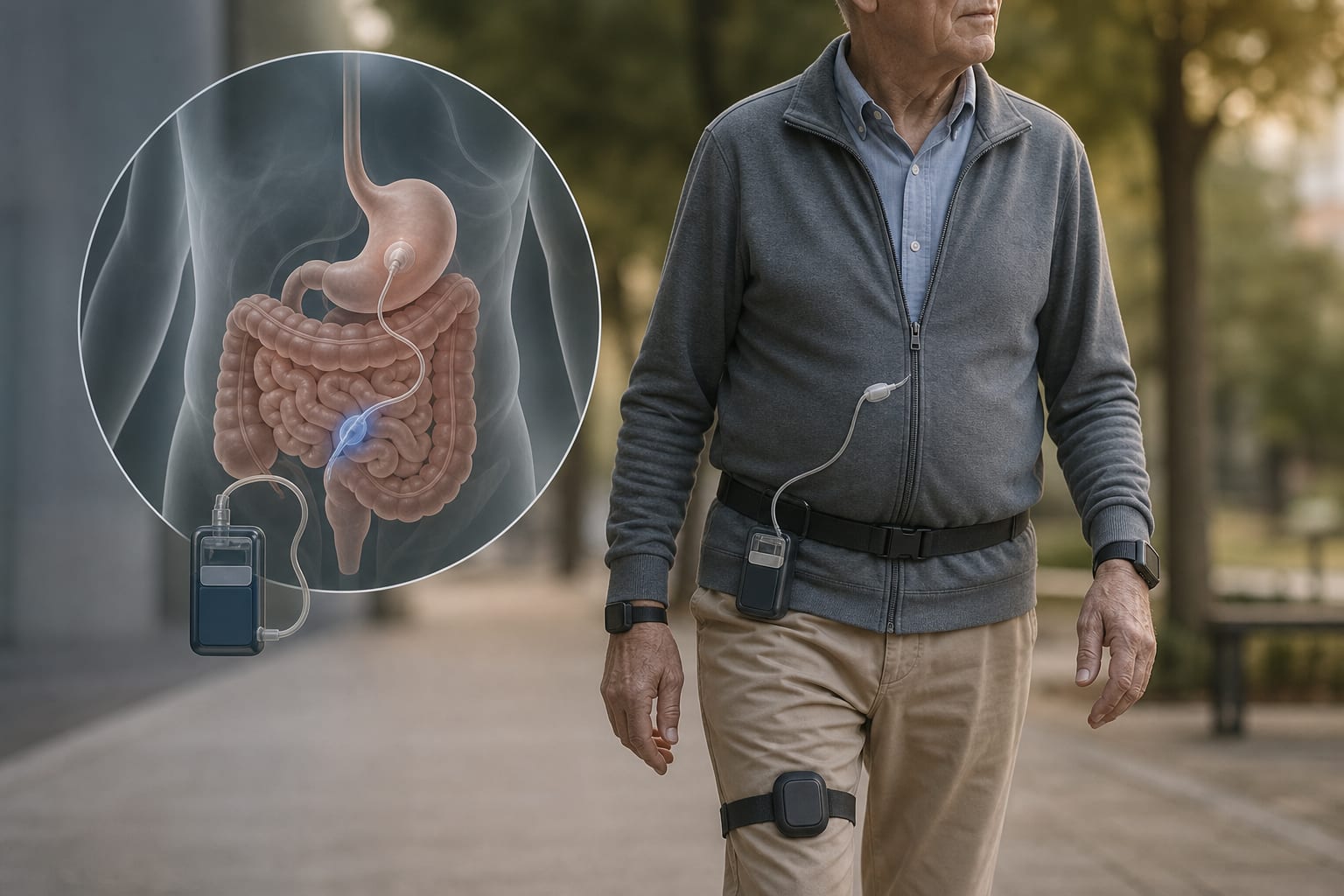
To quantitatively evaluate the impact of L-Dopa/Carbidopa intestinal gel (LCIG) on motor performance in advanced Parkinson's disease (APD) patients in real-world settings using wearable sensors.
Key Findings:
APD patients on LCIG showed less severe motor fluctuations compared to those on oral therapy, with specific metrics indicating the degree of fluctuation.
Lower intra-day variability in gait parameters was observed in the LCIG group, quantified by specific metrics.
Dyskinesia duration was similar between both groups, with no significant differences in mean gait parameters or FOG duration, supported by statistical analysis.
Interpretation:
LCIG provides a more stable gait pattern than optimized oral dopaminergic therapy, indicating more consistent motor control throughout the day, which has significant implications for clinical practice.
Limitations:
Small sample size limits generalizability, affecting the applicability of findings to a broader population.
Cross-sectional design does not allow for causal inferences, which may limit the understanding of long-term effects.
Conclusion:
Wearable sensor technology may enhance clinical management of LCIG by supporting patient selection and monitoring treatment efficacy, with potential future applications in personalized medicine.
by Alessandro Zampogna, Luigi Borzì, Domiziana Rinaldi, Gabriele Imbalzano, Martina Patera, Marco Falletti, Carlo Alberto Artusi, Edoardo Bianchini, Leonardo Lopiano, Gabriella Olmo, Antonio Suppa
Dizziness is one of the most common yet complex complaints encountered across primary care, neurology, otolaryngology, and cardiology. It can present as vertigo, imbalance, or nonspecific lightheadedness. It can leave both patients and physicians searching for clear answers.