Associations of mental health symptoms and triglyceride-glucose index with incident cardiovascular disease: a cohort study from the UK Biobank - Summary - MDSpire
Advertisement
Associations of mental health symptoms and triglyceride-glucose index with incident cardiovascular disease: a cohort study from the UK Biobank
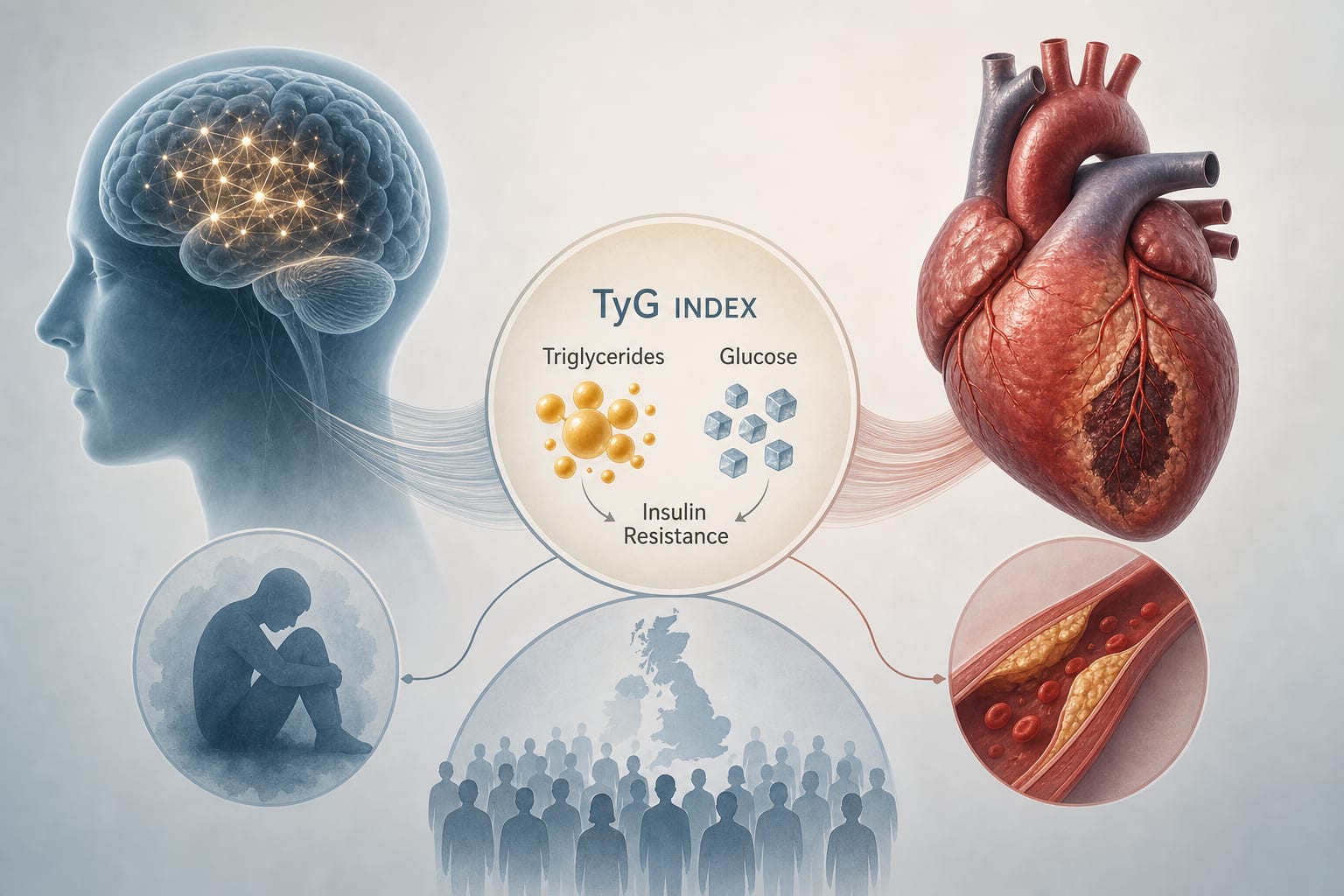
To examine the independent and joint associations of mental health symptoms and insulin resistance (IR) with incident cardiovascular disease (CVD) and myocardial infarction (MI), and to quantify the mediating role of IR in this relationship.
Approach:
Study Population: Included 250,716 adults from the UK Biobank free of prevalent CVD at baseline.
Assessment Methods: Mental health symptoms assessed using the 4-item Patient Health Questionnaire (PHQ-4); IR reflected by the triglyceride-glucose (TyG) index.
Statistical Analysis: Used Cox proportional hazards models to assess associations and interactions between TyG and PHQ-4 with incident CVD and MI.
Key Findings:
Participants with PHQ-4 ≥ 2 had higher risks of incident CVD (HR 1.35) and MI (HR 1.30) compared to those with PHQ-4 = 0.
The proportions mediated by TyG were 5.3% for CVD and 9.3% for MI.
Significant multiplicative and additive interactions were found between TyG tertile 3 and PHQ-4 ≥ 2 on incident CVD and MI.
Those with PHQ-4 ≥ 2 and TyG tertile 3 had the highest risks of incident CVD (HR 1.80) and MI (HR 2.17).
Interpretation:
Limitations:
The study is observational, which limits causal inferences.
Potential residual confounding despite adjustments for covariates.