Reliability and reproducibility of the modified thoracolumbar injury classification and severity score and the thoracolumbar AO spine injury score for guiding surgical decision-making in thoracolumbar fractures - Summary - MDSpire
Advertisement
Reliability and reproducibility of the modified thoracolumbar injury classification and severity score and the thoracolumbar AO spine injury score for guiding surgical decision-making in thoracolumbar fractures
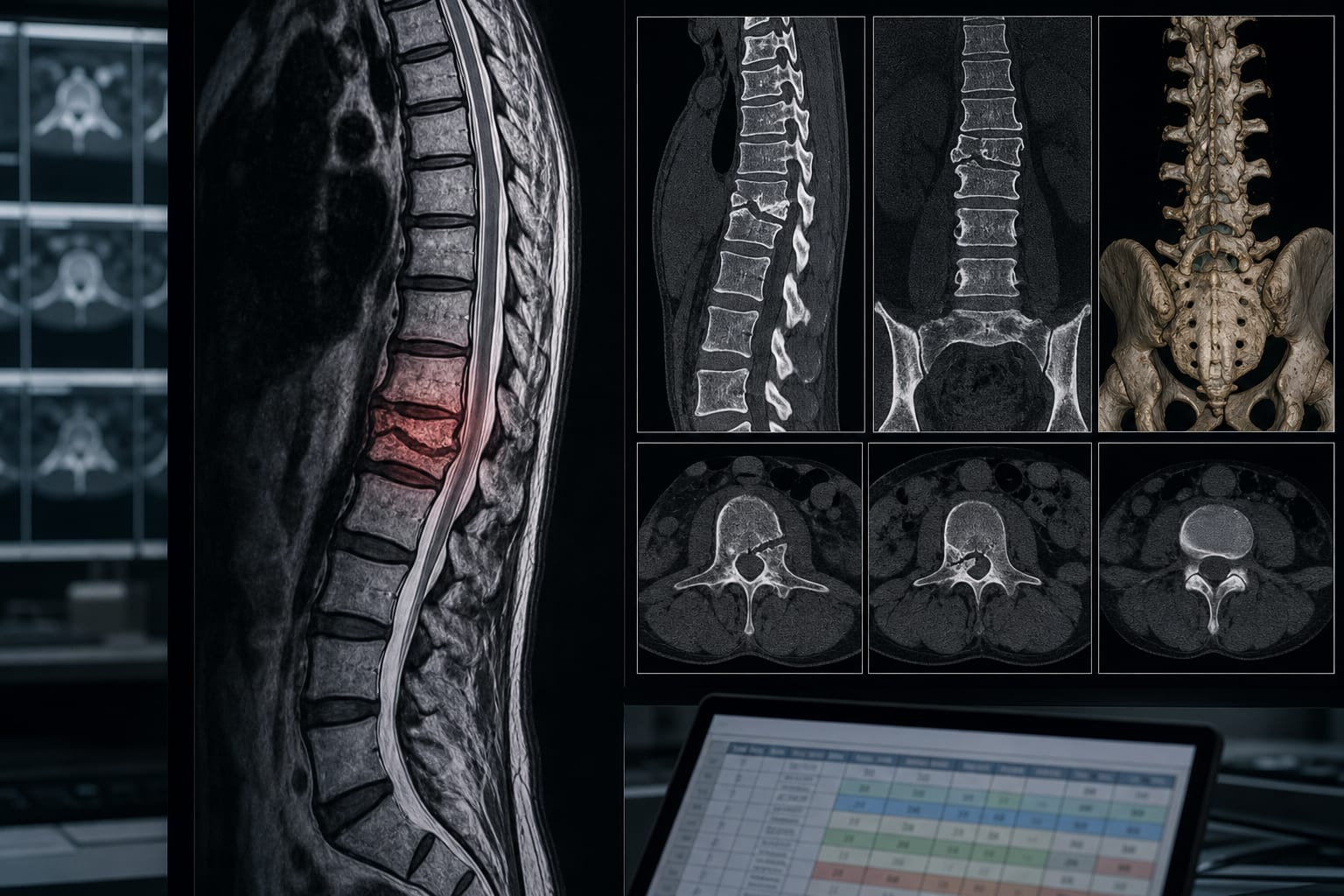
To evaluate the reliability and reproducibility of the modified Thoracolumbar Injury Classification and Severity Score (mTLICS) and the Thoracolumbar AO Spine Injury Score (TL AOSIS) in guiding surgical decision-making for thoracolumbar fractures.
Approach:
Study Design: A retrospective analysis of 100 thoracolumbar injury patients treated at the Second Affiliated Hospital of Zhejiang Chinese Medical University from January 2021 to December 2023.
Participants: Cohort included 64 males and 36 females, aged 25–55 years (mean 41.3 ± 6.9 years).
Assessment Method: Six evaluators independently assessed anonymized cases on two occasions separated by a 4-week interval using weighted Cohen's kappa coefficients.
Key Findings:
For TL AOSIS, interobserver/intraobserver kappa values were 0.706/0.687 for fracture morphology, 0.906/0.942 for neurological status, 0.869/0.879 for tension band injury, and 0.736/0.732 for surgical recommendation.
For mTLICS, interobserver/intraobserver kappa values were 0.773/0.763 for fracture morphology, 0.878/0.894 for neurological status, 0.716/0.721 for tension band injury, 0.837/0.845 for disc injury, and 0.702/0.685 for surgical recommendation.
Significant differences (P 0.05) were found in neurological status evaluations.
Interpretation:
Both TL AOSIS and mTLICS demonstrate good reliability and reproducibility in guiding surgical decision-making for thoracolumbar fractures.
Conclusion:
Both scoring systems provide reliable assessments for surgical decision-making in thoracolumbar fractures.
Teriparatide followed by zoledronic acid increased bone mineral density but did not reduce fracture risk compared with standard care in adults with osteogenesis imperfecta.