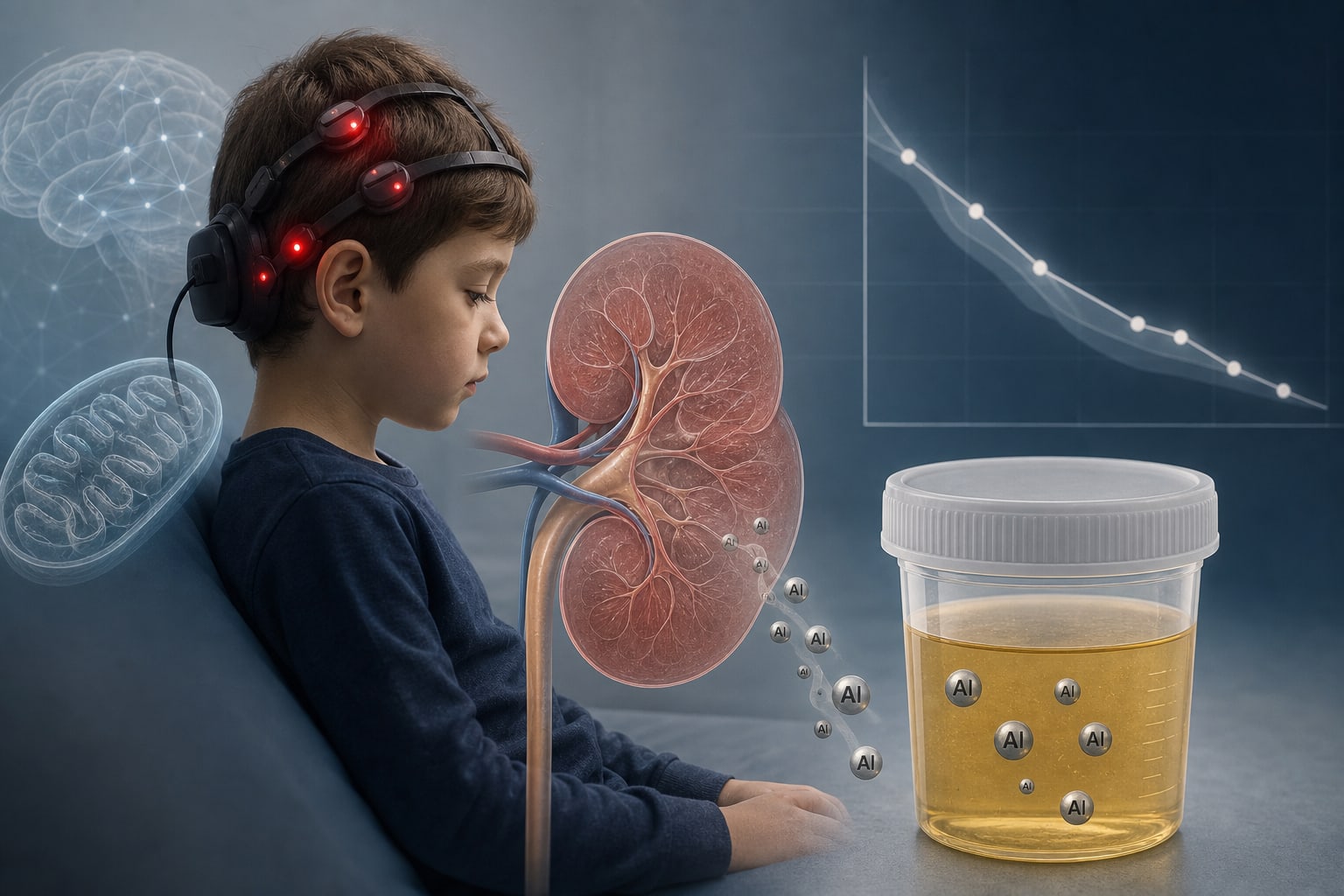
Alterations in urinary metals following pulsed 660 nm photobiomodulation in a pediatric patient with autism spectrum disorder: a case report - Summary - MDSpire
To document the laboratory kinetics of urinary aluminum levels following pulsed 660 nm photobiomodulation (PBM) in a child with autism spectrum disorder (ASD).
Approach:
Key Findings:
Baseline urinary aluminum levels were stable at 10.0 and 9.8 µg/g creatinine.
After PBM, urinary aluminum levels increased to 58 µg/g on Day 3 and peaked at 98 µg/g on Day 7.
At two-month follow-up, urinary aluminum remained elevated at 49 µg/g.
Mercury levels exceeded reference values in all specimens, with a follow-up level of 8.4 µg/g creatinine.
Interpretation:
The observed increase in urinary aluminum excretion following PBM does not provide sufficient evidence for systemic mobilization or clinical benefit.
Limitations:
The study is a single case report without controlled comparisons.
No mechanistic biomarkers were evaluated to support claims of enhanced metal clearance.
Conclusion:
The findings are hypothesis-generating and indicate the need for controlled studies with verified dosimetry and validated outcomes.
Survey results reveal the long-term socio-economic and psychological impacts of single ventricle congenital heart disease (SVHD) on families. See how cardiologists Deepti Bhat, MD, and Naim Duran, MD, contributors to this research, are using findings to transform Fontan Clinic care at Phoenix Children’s.