Mesenchymal R-spondin 3 promotes an immunogenic tumor microenvironment with adaptive immune resistance in human gastric adenocarcinoma - Summary - MDSpire
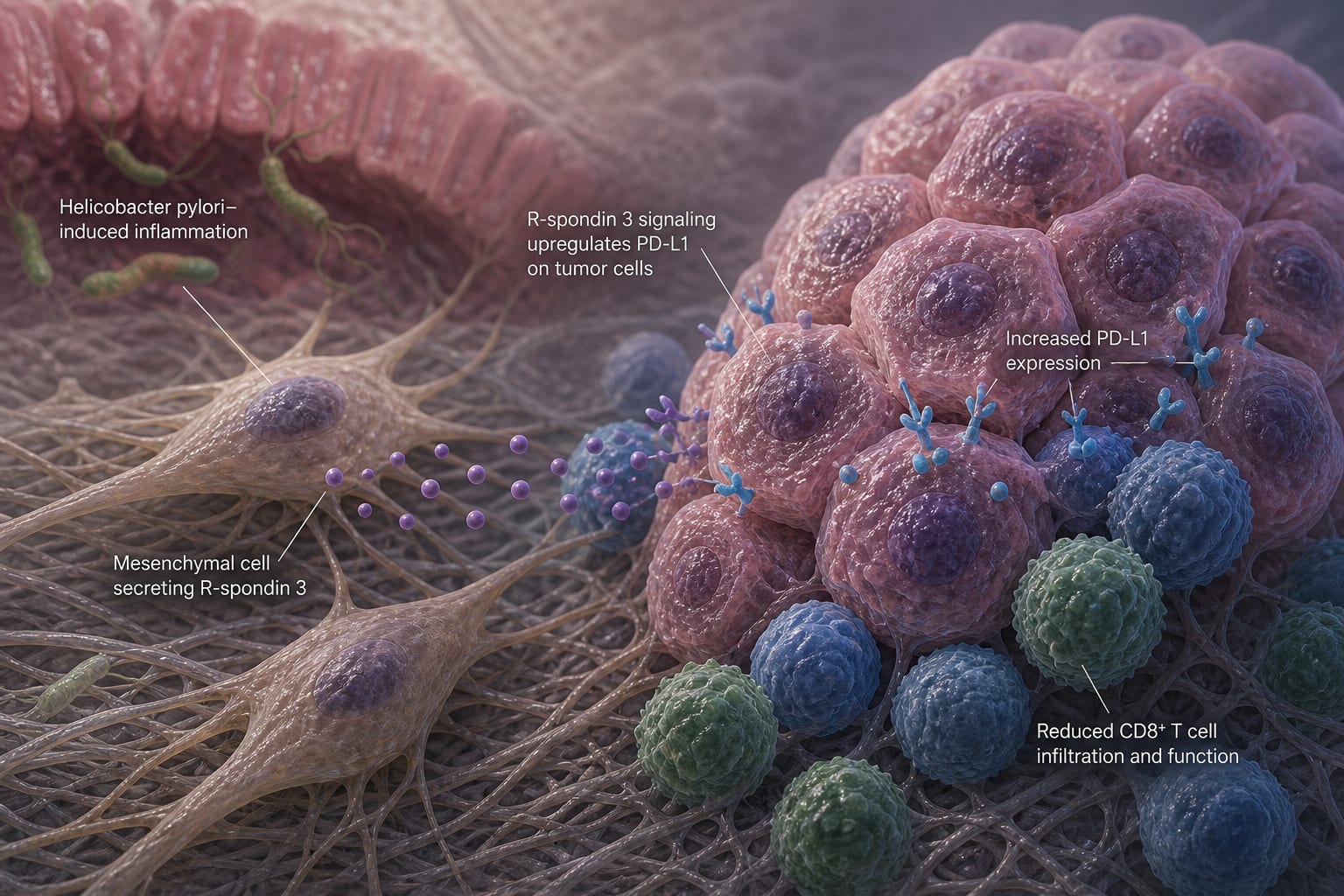
To assess the role of R-spondin 3 (RSPO3) in the immune landscape of gastric adenocarcinoma and its correlation with leukocyte infiltration and immune checkpoint signaling.
Approach:
Patient Cohort and Tissue Microarray Preparation: Archival tissue from 277 chemotherapy-naïve gastric cancer patients was collected for analysis, focusing on tumor stages and patient characteristics.
In Vivo Mouse Experiments: Conditional knockout and overexpression mouse models were utilized to study the effects of Rspo3 on gastric tissue in relation to H. pylori infection.
H. pylori Infection: Mice were infected with H. pylori to evaluate the impact of RSPO3 on gastric carcinogenesis and immune response.
Single-Molecule RNA In Situ Hybridization: RNA in situ hybridization was performed to detect RSPO3 expression in human and murine tissue samples.
Key Findings:
RSPO3 levels correlate with leukocyte infiltration in gastric adenocarcinoma.
RSPO3 enhances Wnt signaling, which may influence immune checkpoint pathways.
Dysregulated Wnt signaling is observed in approximately 50% of human gastric cancers.
Interpretation:
The study suggests that RSPO3 may play a significant role in modulating the immune landscape of gastric adenocarcinoma, potentially affecting treatment responses.
Limitations:
The study is retrospective and relies on archival tissue, which may limit the generalizability of findings.
Animal models may not fully replicate human gastric cancer biology.
Conclusion:
RSPO3 is implicated in enhancing immunogenicity and adaptive immune resistance in gastric adenocarcinoma, warranting further investigation into its role as a potential biomarker.
by Anne-Sophie Fischer, Alexander Arnold, Hilmar Berger, Stefanie Müllerke, Jonas Wizenty, Hans-Joachim Mollenkopf, David Horst, Frank Tacke, Christoph Treese, Michael Sigal