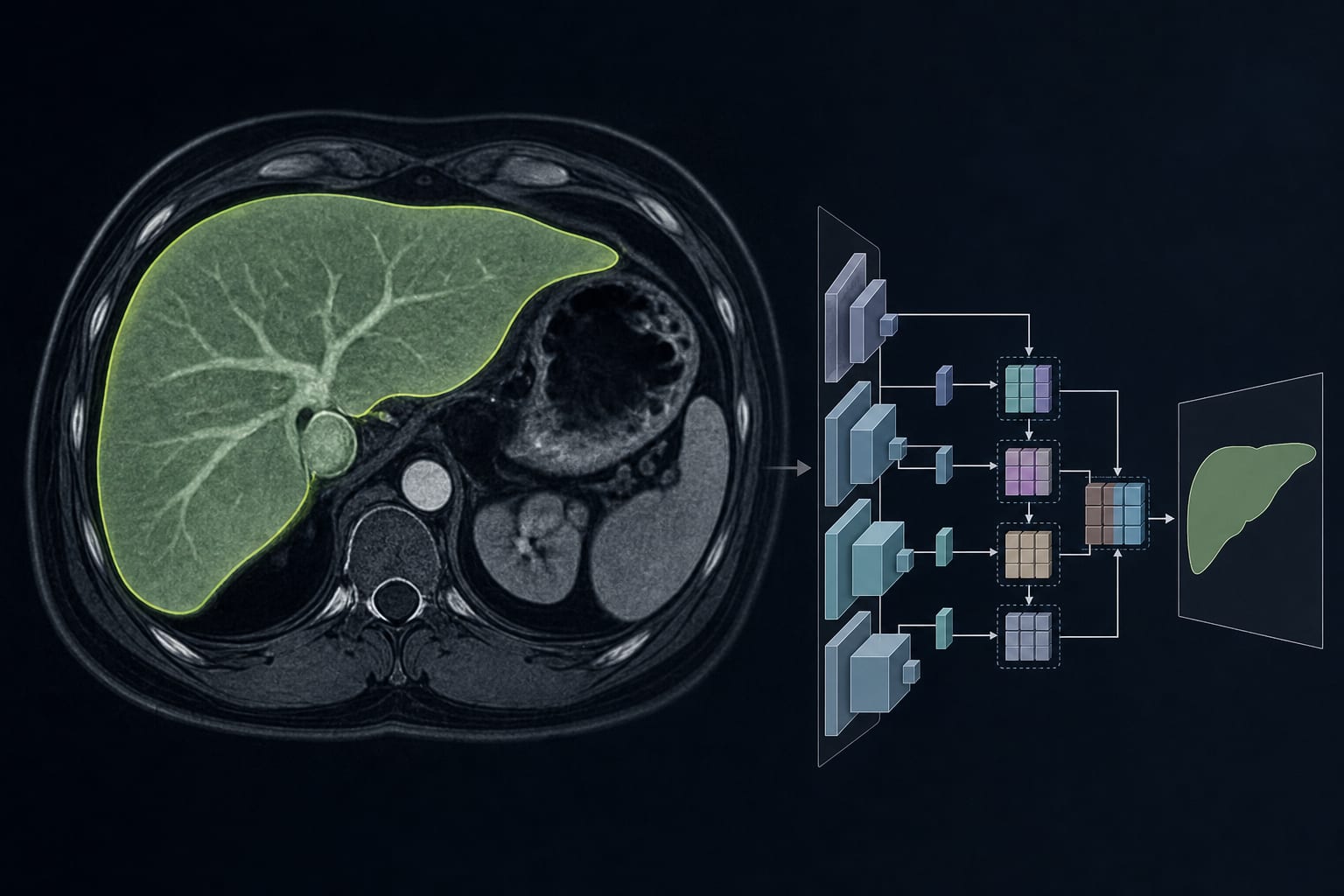
To develop an automated model for accurate liver segmentation in MRI scans, specifically addressing the time-consuming and operator-dependent nature of manual segmentation, which can vary significantly between experts.
Key Findings:
On the DLDS dataset, the model achieved an intersection over union of 0.905 and a Dice score of 0.913, with a Hausdorff distance of 7.31 and an average symmetric surface distance of 2.66.
On the CirrMRI600+ dataset, it achieved an intersection over union of 0.86 and a Dice score of 0.90, with a Hausdorff distance of 6.20 and an average symmetric surface distance of 9.80.
The model requires 14.91 GFLOPs for computation.
Interpretation:
The PSP-EffB0-MSFF model demonstrates reliable performance in liver segmentation across different MRI datasets, indicating its potential for clinical applications, such as improving diagnostic accuracy and treatment planning.
Limitations:
The model's performance may vary with different MRI protocols and patient populations, which could affect its generalizability.
Further validation on larger and more diverse datasets is needed to ensure robustness.
Conclusion:
The proposed model provides consistent and reliable liver segmentation results, which can aid in clinical decision-making and reduce the burden of manual segmentation.