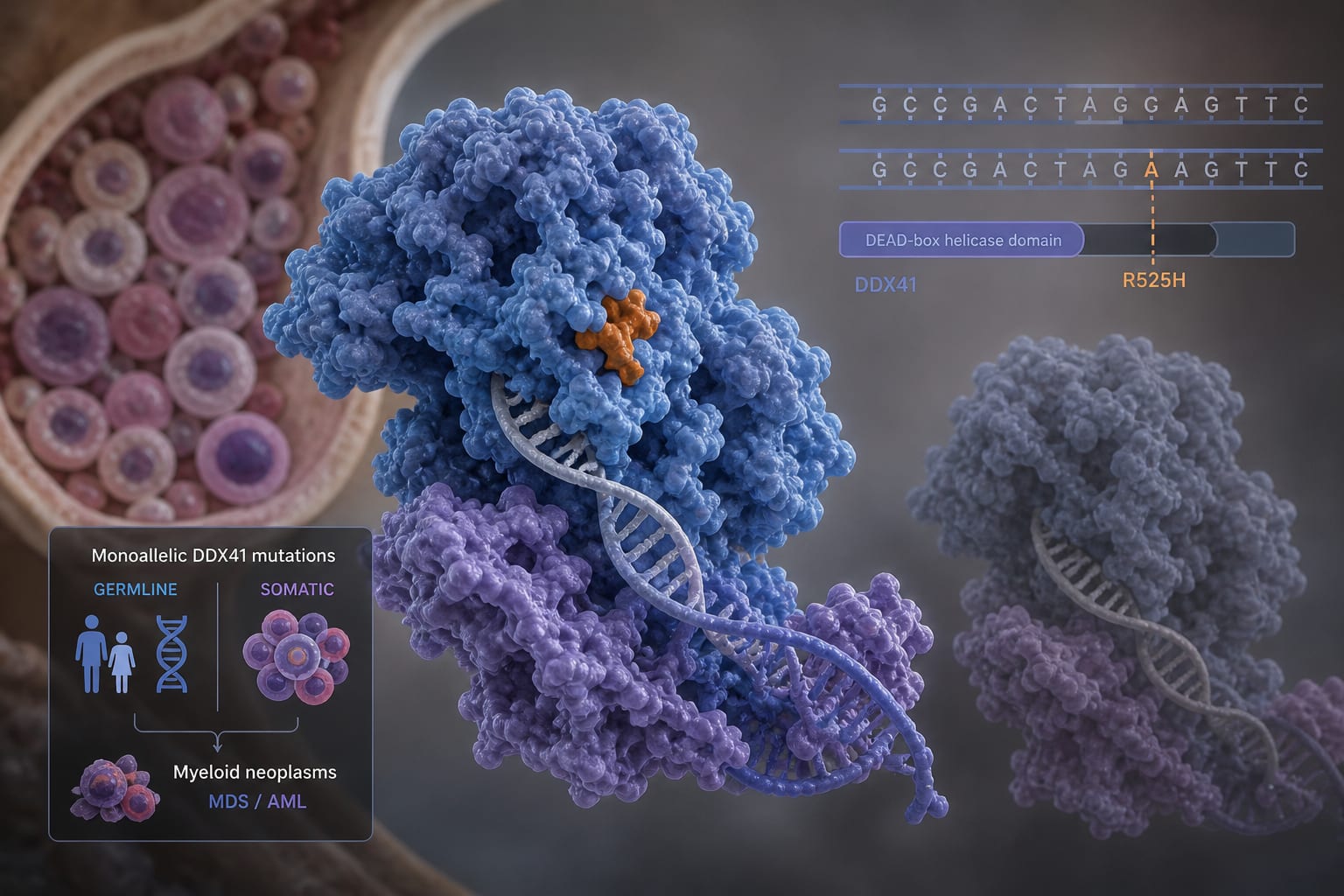
To characterize DDX41 mutation patterns and investigate additional genetic alterations in monoallelic DDX41 cases.
Approach:
Cohort analysis: Analyzed molecular data from 1,893 patients, including 1,331 Cleveland Clinic cases and 562 public-dataset cases.
Variant assessment: Examined germline and somatic DDX41 variants, variant allele fractions, and selected CD34+ cells using ultra-low-input sequencing.
Additional helicase genes: Used whole-exome sequencing and screened DDX/DHX genes for co-occurring alterations.
Key Findings:
DDX41 mutations were identified in 168 patients: 61% had germline variants alone, 25% had both germline and somatic hits, and 14% had a somatic hit alone.
D140 occurred in 19% of DDX41-mutant cases. R525H was a recurrent somatic variant and co-occurred with additional germline variants in some biallelic cases.
Somatic mutations in other RNA helicase genes occurred in 15% of monoallelic germline DDX41 cases; identifying these alterations reduced the unexplained case fraction from 61% to 53%.
MDS and AML occurred in 27% and 36% of cases, respectively, and were associated with normal karyotypes.
Interpretation:
The authors describe diverse DDX41 mutation configurations and additional alterations in other RNA helicase genes among some monoallelic cases. The findings do not resolve the mechanism underlying all monoallelic cases.
Limitations:
Low clonal fractions of somatic DDX41 variants may limit detection in blood or marrow sequencing.
Among four patients with acceptable low R525H read counts, two had findings that could not be distinguished from sequencing noise.
The supplied article context ends during the analysis of mutations that may substitute for somatic DDX41 hits; later results are unavailable.
Conclusion:
The study identified varied germline and somatic DDX41 mutation patterns and additional alterations in other RNA helicase genes in some monoallelic cases. These findings reduced, but did not eliminate, the unexplained monoallelic case fraction.
by Valeria Visconte, Carlos Bravo-Perez, Serhan Unlu, Arda Durmaz, Luca Guarnera, Ishani Nautiyal, Zachary Brady, Mark Orland, Atsushi Marumo, Aashray Mandala, Christopher Haddad, Matteo D’Addona, Yasuo Kubota, Eckhard Jankowsky, Chao-Yie Yang, Benjamin Kroger, Stephen S. Chung, David Bosler, Carmelo Gurnari, Jaroslaw P. Maciejewski
Final analysis of the pivotal KEYNOTE-564 trial in kidney cancer presented by Toni Choueiri, MD. After 7 years of follow-up, adjuvant pembrolizumab continued to extend disease-free survival and overall survival in high-risk clear-cell renal cell carcinoma.
Autolomous CEO Alexander Seyf says advanced therapy manufacturers need to digitize before they embrace AI – and that human expertise must remain in the loop