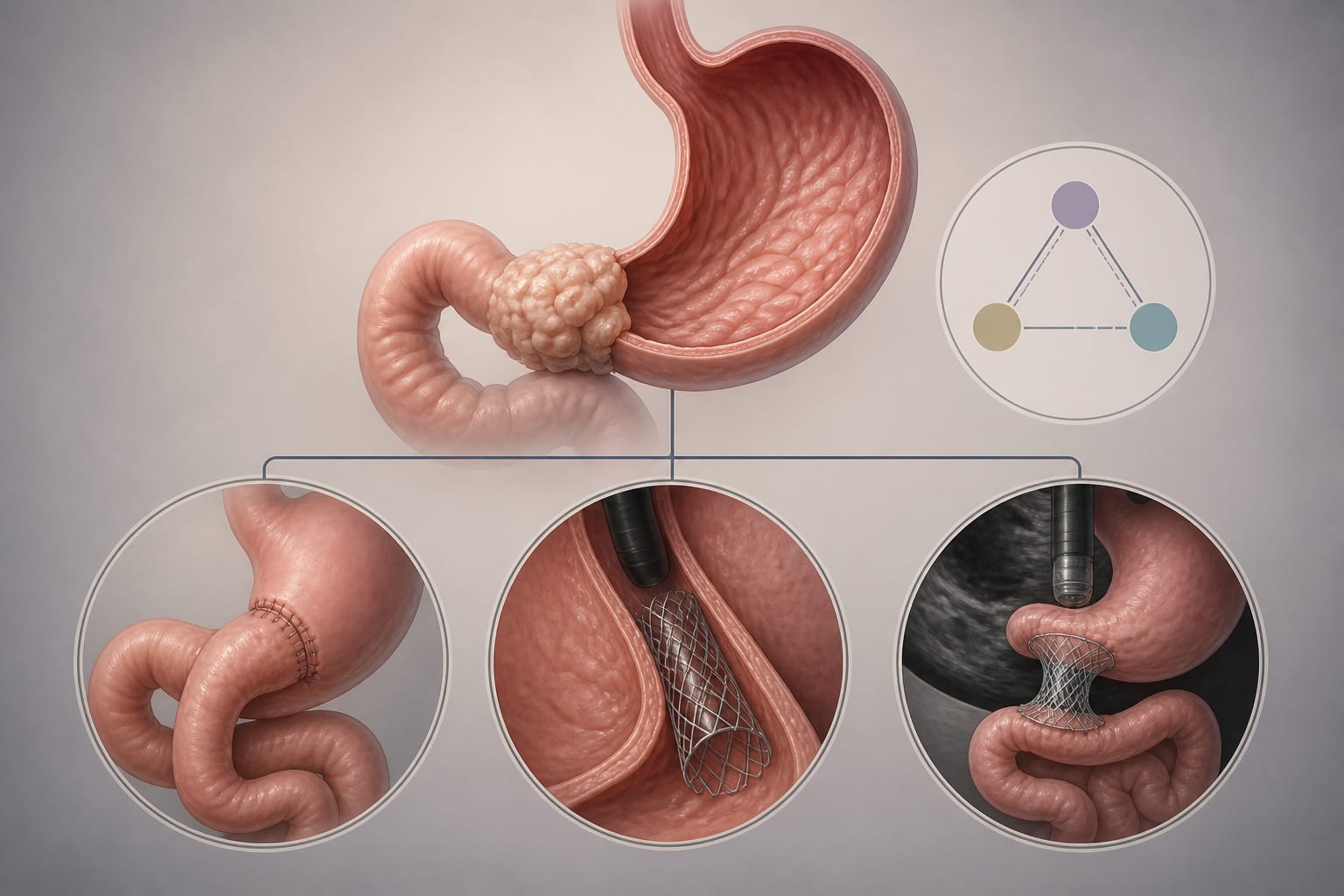
To compare the efficacy and safety of surgical gastrojejunostomy (S-GJ), endoscopic stenting (ES), and EUS-guided gastroenterostomy (EUS-GE) for palliation of malignant gastric outlet obstruction (GOO).
Approach:
Design: Systematic review and Bayesian network meta-analysis conducted according to PRISMA guidance; protocol registered in PROSPERO (CRD420261356335).
Search and eligibility: Five databases were searched from inception through April 13, 2026. Eligible studies compared at least two procedures in adults with malignant GOO and included randomized trials or comparative studies with prospective information for at least one treatment arm…
Outcomes and analysis: Primary outcomes were clinical success and reintervention. Secondary outcomes included adverse events, 30-day mortality, time to oral intake, hospital stay, and overall survival. The primary network included randomized and eligible cohort studies, with RCT-onl…
Key Findings:
Fifteen studies involving 827 patients were included: 7 randomized controlled trials and 8 cohort studies.
Ten studies compared ES with S-GJ, three compared EUS-GE with ES, and two compared EUS-GE with S-GJ; these comparisons formed a closed triangular network.
Interpretation:
The provided article context describes the review methods and included-study characteristics but does not report comparative outcome estimates or treatment rankings.
Limitations:
The supplied context ends before the outcome results, so comparative efficacy, safety, and ranking findings cannot be summarized.
The authors note that evidence from earlier reviews was largely retrospective and preceded several newer randomized trials.
Breast cancer screening has traditionally been organized around two principal variables: when mammography should begin and how frequently it should be performed.