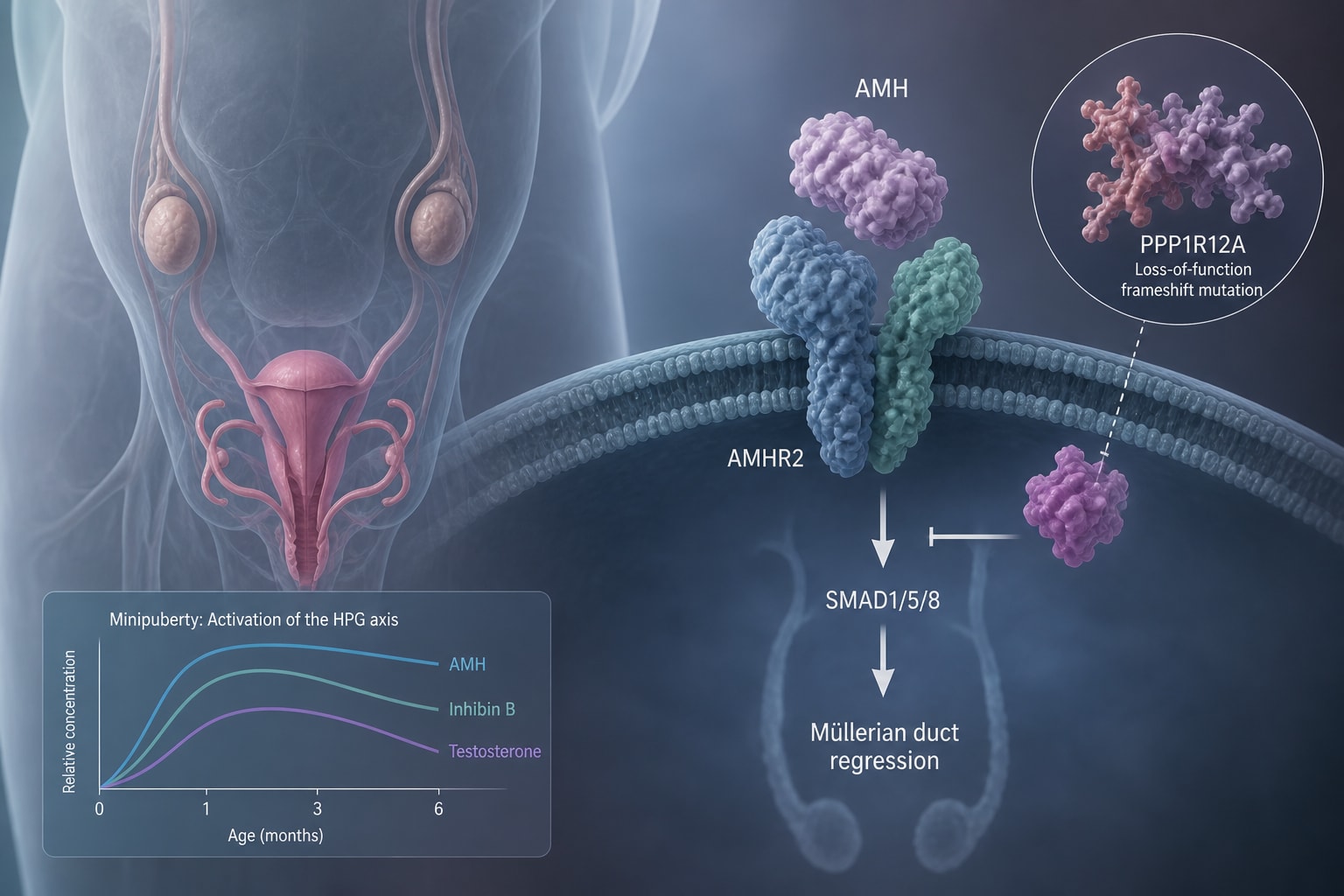
To characterize the neonatal and minipuberty hormonal profiles in a male neonate diagnosed with Persistent Müllerian Duct Syndrome (PMDS) carrying a likely pathogenic variant in the PPP1R12A gene.
Approach:
Genetic Analysis: A de novo heterozygous loss-of-function mutation in PPP1R12A was identified, which may contribute to the patient's condition.
Key Findings:
The patient exhibited a hormonal profile consistent with activation of the hypothalamic-pituitary-gonadal axis during minipuberty.
At birth, inhibin B was 108 pg/mL, AMH was 174.4 pmol/L, and testosterone was 1.4 nmol/L.
During minipuberty, inhibin B increased to 259 pg/mL, AMH to 342 pmol/L, testosterone to 9.2 nmol/L, LH to 19.1 IU/L, and FSH to 10.4 IU/L.
At 10 months, AMH and inhibin B levels decreased, suggesting potential Sertoli cell dysfunction.
Interpretation:
The findings support the hypothesis that the PPP1R12A variant may affect Müllerian duct development rather than causing primary gonadal failure.
Limitations:
The study is based on a single case, limiting generalizability.
Longitudinal follow-up is required to assess the long-term implications of the hormonal changes observed.
Conclusion:
['The study expands the understanding of the endocrine phenotype associated with PMDS.']