Association of intratumoral CD68+CD163+ M2-like macrophages with survival in metastatic colorectal cancer treated with chemotherapy plus bevacizumab - Summary - MDSpire
Advertisement
Association of intratumoral CD68+CD163+ M2-like macrophages with survival in metastatic colorectal cancer treated with chemotherapy plus bevacizumab
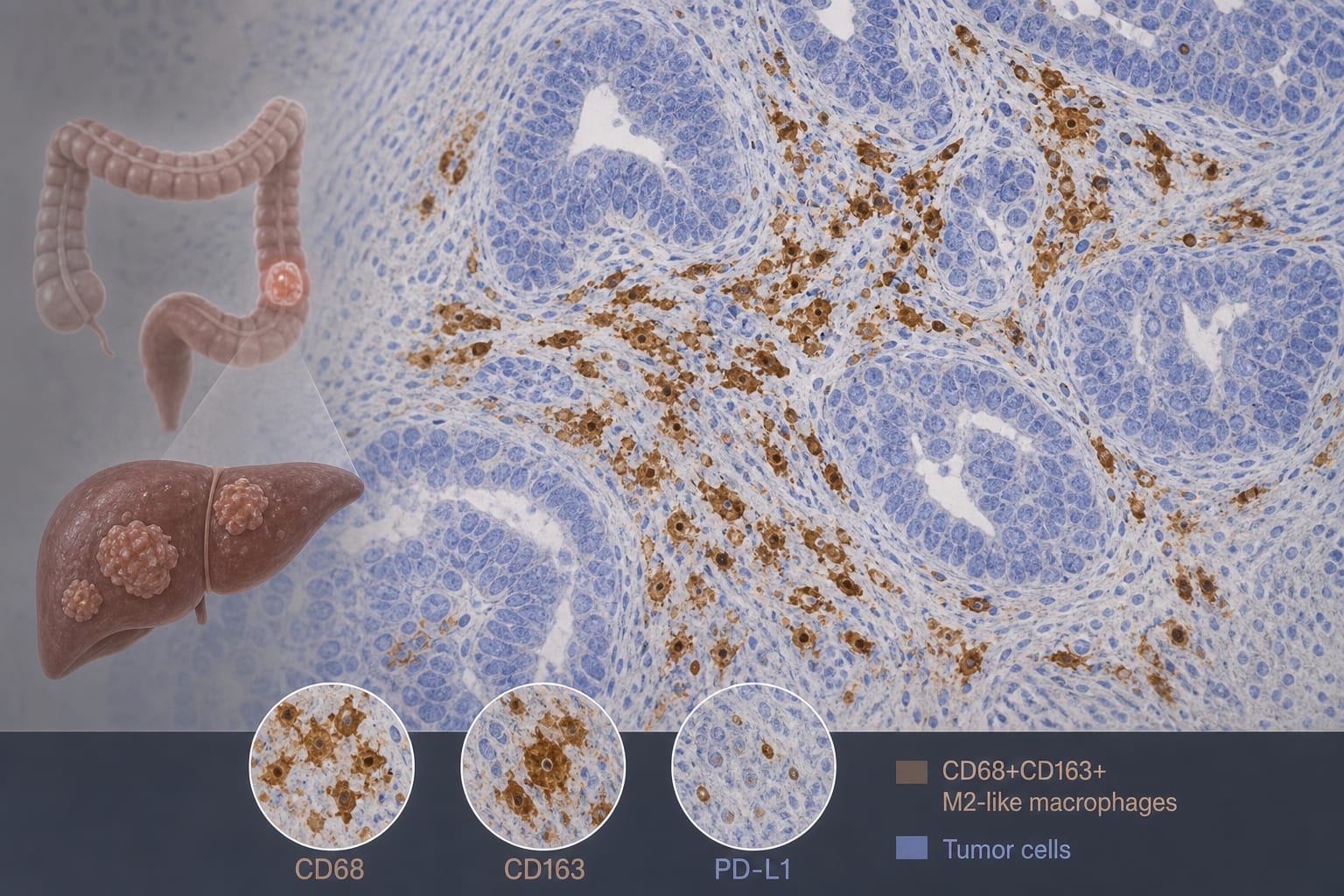
To investigate the association of CD68+CD163+ M2-like tumor-associated macrophages (TAMs) with post-treatment resistance and survival outcomes in metastatic colorectal cancer (mCRC) patients receiving chemotherapy and bevacizumab.
Approach:
Method: T
Method: h
Method: e
Method: s
Method: u
Method: d
Method: y
Method: i
Method: n
Method: v
Method: o
Method: l
Method: a
Method: r
Method: p
Method: c
Method: f
Method: m
Method: 4
Method: ,
Method: g
Method: z
Method: x
Method: b
Method: q
Method: w
Method: k
Method: 6
Method: 8
Method: 1
Method: 3
Key Findings:
Resistant patients had significantly higher proportions and densities of CD68+CD163+ M2-like TAMs and CD68+CD163+PD-L1+ M2-like TAMs compared to non-resistant patients (p < 0.05).
Infiltration levels of these macrophage subsets were significantly associated with post-treatment resistance (p < 0.05).
High density of intratumoral CD68+CD163+ M2-like TAMs was significantly associated with shorter overall survival (OS) (p < 0.05) and showed a trend toward shorter progression-free survival (PFS) (p = 0.06).
Multivariate Cox regression indicated that dense intratumoral infiltration of CD68+CD163+ M2-like TAMs was independently associated with unfavorable OS and PFS.
Interpretation:
Limitations:
The study is retrospective and involves a limited sample size of 44 patients.
Further validation in larger cohorts is necessary to confirm the findings.
Conclusion:
Increased infiltration of intratumoral CD68+CD163+ M2-like TAMs is associated with poor prognostic outcomes for both PFS and OS in mCRC patients undergoing chemotherapy and bevacizumab treatment.