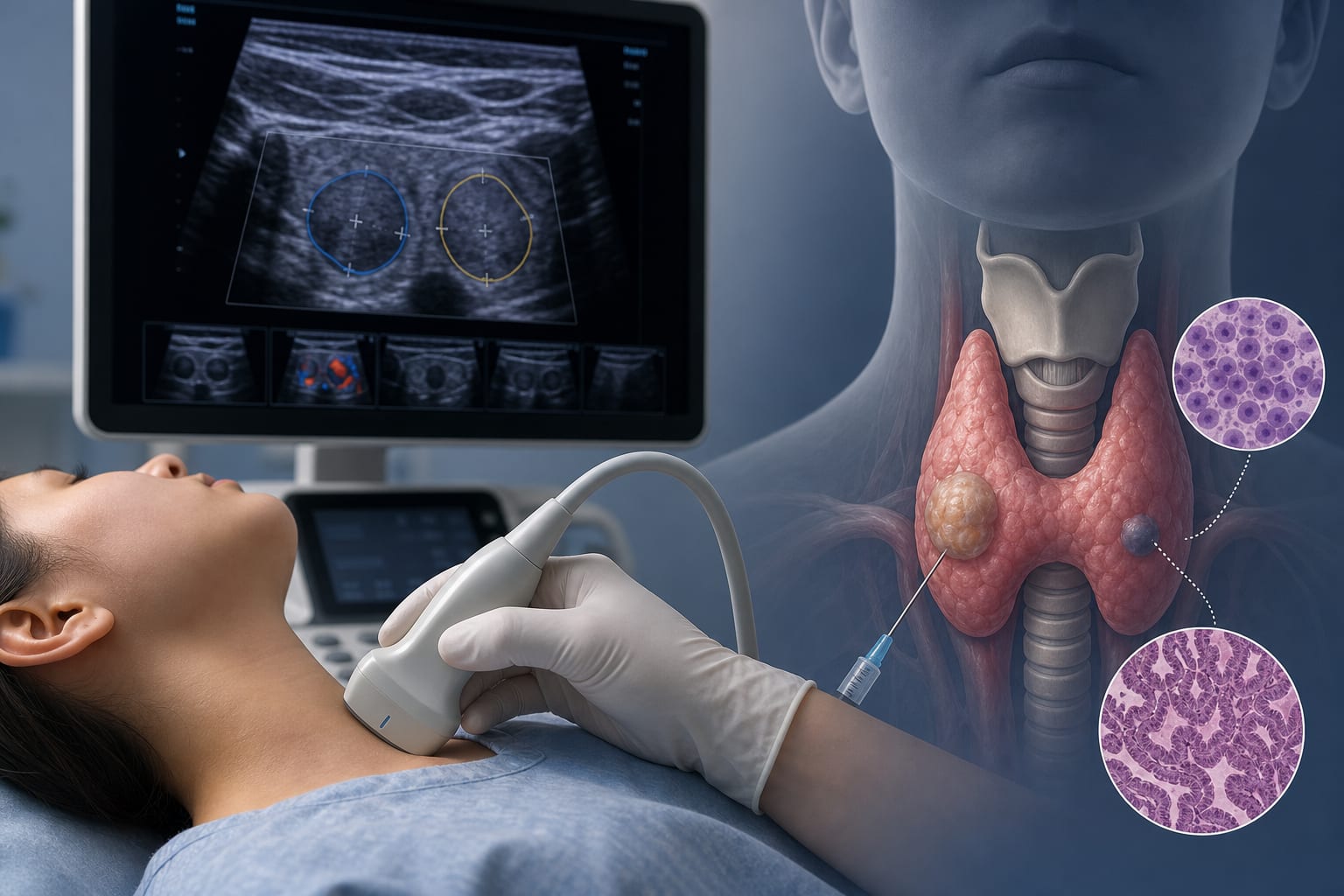
To evaluate the diagnostic performance of ACR-TIRADS and C-TIRADS in differentiating between malignant and benign thyroid nodules in the pediatric population.
Approach:
Study Design: Retrospective, single-center study analyzing 461 thyroid nodules from 393 pediatric patients.
Biopsy Scenarios: Scenario 1: Biopsy for ACR-TR3 nodules ≥35 mm and all ACR-TR5 nodules. Scenario 2: Biopsy for all C-TR4B, C-TR4C, and C-TR5 nodules, no biopsy for C-TR4A.
Key Findings:
The area under the receiver operating characteristic curve for Scenario 1 was 0.793 (95% CI: 0.753 -0.829) compared to 0.663 (95% CI: 0.618 -0.706) for ACR-TIRADS, and for Scenario 2 it was 0.825 (95% CI: 0.787 -0.858) compared to 0.689 (95% CI: 0.645 -0.731) for C-TIRADS.
Both scenarios demonstrated lower unnecessary biopsy rates: 47.5% for Scenario 1 versus 60.1% for ACR-TIRADS, and 30.6% for Scenario 2 versus 56.8% for C-TIRADS.
Biopsy triage failure rates were also lower: 5.4% for Scenario 1 compared to 13.6% for ACR-TIRADS, and 8.8% for Scenario 2 compared to 12.8% for C-TIRADS.
Interpretation:
The application of Scenario 1 and Scenario 2 can improve diagnostic performance and reduce unnecessary biopsy rates and biopsy triage failure rates in identifying malignant thyroid nodules in the pediatric population.
Limitations:
The study is retrospective and conducted at a single center.
The sample size may not fully represent the broader pediatric population.
Conclusion:
The proposed scenarios may enhance diagnostic efficacy for pediatric thyroid nodules.