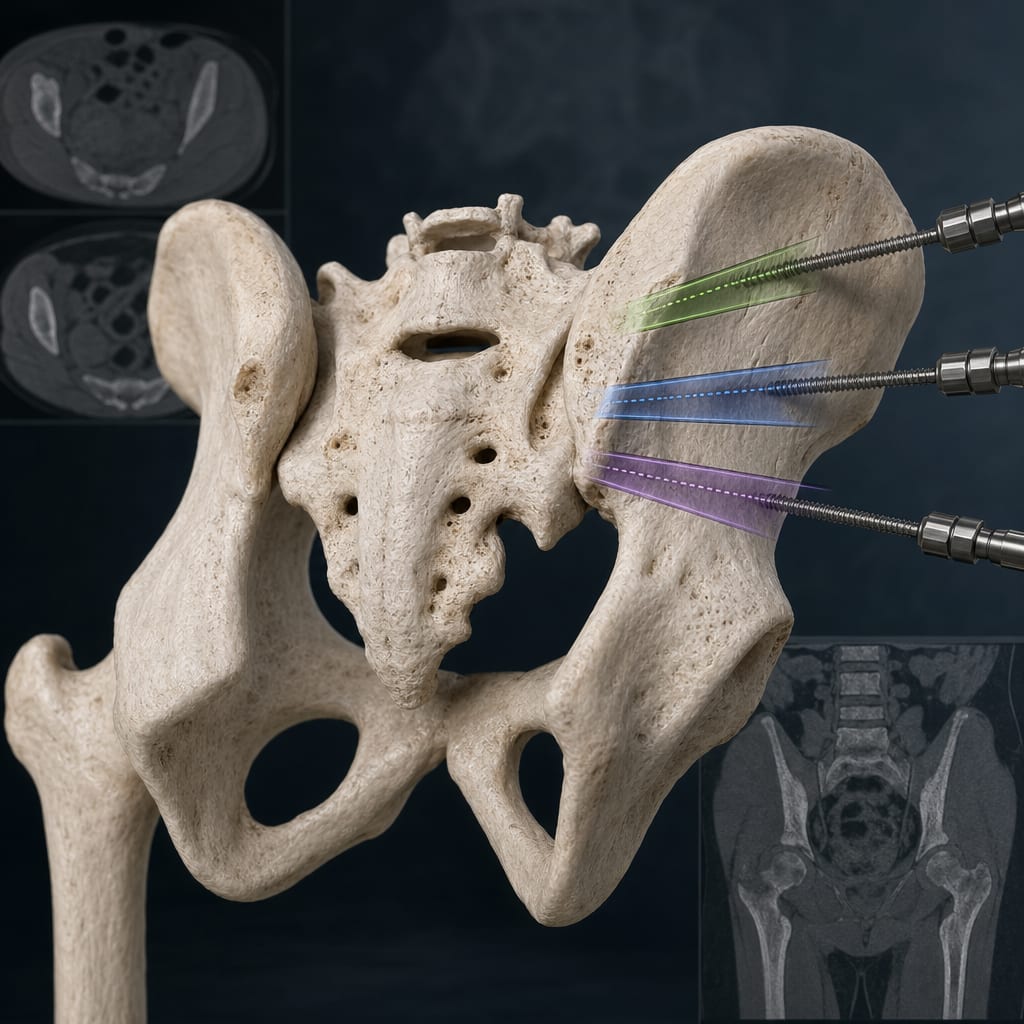
To delineate the anatomical limits of potential safe pathways for the insertion of Schanz screws during external fixation of unstable pelvic fractures in normally developed adolescents aged 11 - 14 years.
Key Findings:
Iliac Wing Corridor shape transitioned from proximal rectangular to distal funnel-like constriction.
Anterior/posterior corridor lengths ranged from 54.2–58.6 mm and 68.1–73.1 mm (95% CI).
Screw I1 entry required horizontal/sagittal angles of 22.5–25.8° and 53.7–61.2° (95% CI).
Screw I2 entry necessitated horizontal/sagittal angles of 21.5–25.1° and 61.3–66.1° (95% CI).
Supra-acetabular Corridor characterized by an S-shaped configuration with mid-corridor constriction.
Interpretation:
Both iliac wing and supra-acetabular corridors exhibited safe accommodation for 4-mm Schanz screws in adolescents, emphasizing the importance of adhering to established entry points and angles to minimize risks.
Limitations:
Study limited to a specific age group (11-14 years) and may not generalize to other populations.
Potential variability in anatomical structures not accounted for in the study.
Conclusion:
Compliance with established entry points and angles is essential to reduce perforation risks and enhance fixation stability. Patient-specific computer-aided preoperative surgical planning is particularly advantageous for adolescents in promoting surgical safety.