Activity-dependent adaptive deep brain stimulation improves gait in Parkinson’s disease - Summary - MDSpire

Activity-dependent adaptive deep brain stimulation improves gait in Parkinson’s disease

  • By

  • Stefano Scafa

  • Valeria de Seta

  • Ruijia Wang

  • Paula Sánchez López

  • Andrea Sánchez López

  • Camille Varescon

  • Icare Sakr

  • Nadia Bérard

  • Lea Bole-Feysot

  • Céline Deschenaux

  • Ian Enderli

  • Yohann Thenaisie

  • Morgane Burri

  • Frédéric Merlos

  • Vanessa Fleury

  • Benoit Wicki

  • Ettore Accolla

  • Andria Tziakouri

  • Cécile Hübsch

  • Mayte Castro Jiménez

  • Julien F. Bally

  • Alessandro Puiatti

  • Kyuhwa Lee

  • Henri Lorach

  • Antoine Collomb-Clerc

  • Jocelyne Bloch

  • Eduardo M. Moraud

  • June 15, 2026

  • 0 min

Share

Objective:

To develop adaptive deep brain stimulation (aDBS) therapies that dynamically adjust to individual locomotor deficits in patients with Parkinson's disease (PD), addressing the significant impact of these deficits on quality of life.

Key Findings:
  • Distinct muscle activation demands for daily mobility activities are encoded in STN dynamics, highlighting the need for personalized treatment.
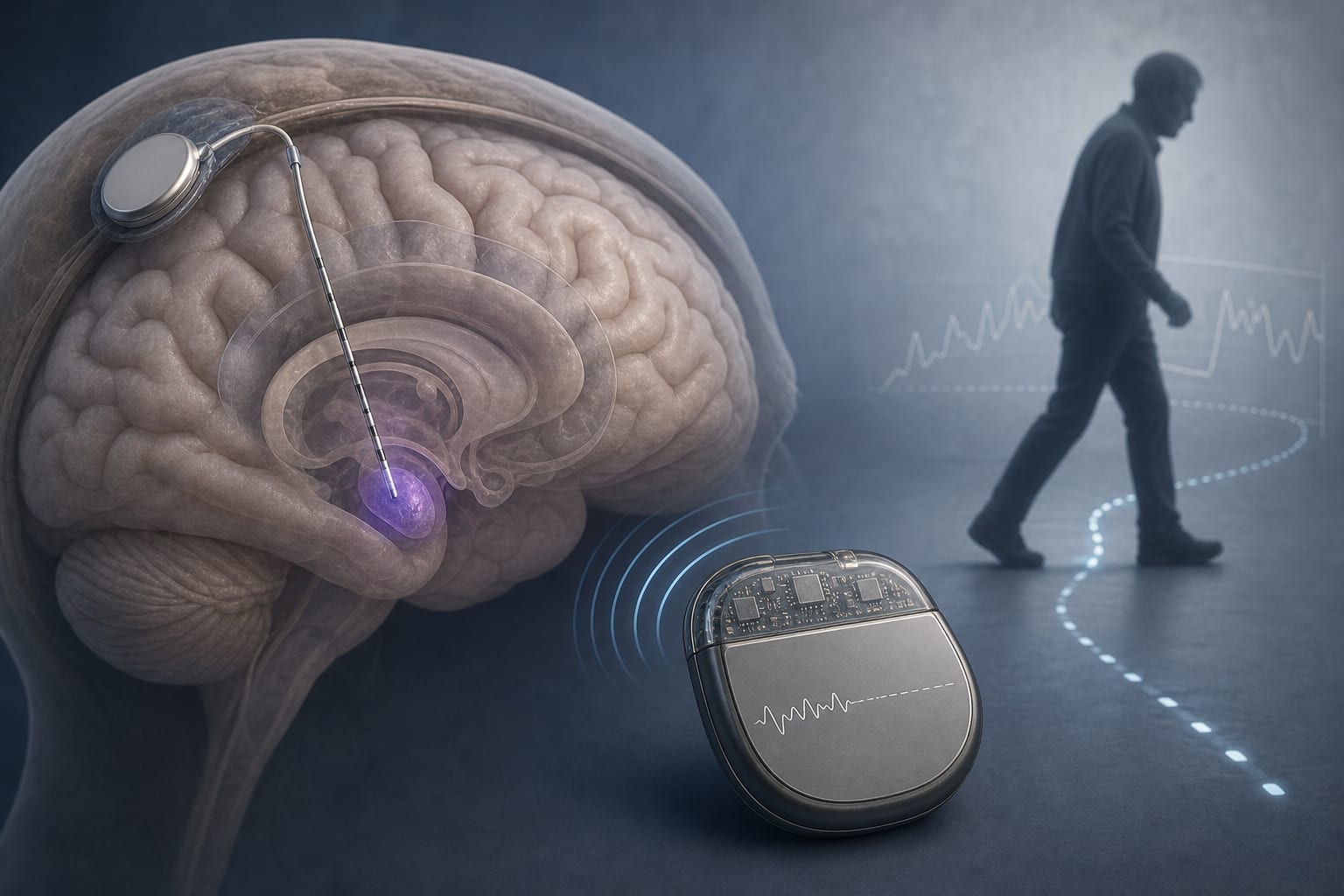
  • Activity-dependent DBS therapies personalized to individuals improved locomotor deficits and cardinal motor symptoms in real time, suggesting a shift in therapeutic strategies.
  • Standard-of-care L-DOPA and STN DBS led to significant improvements in gait quality, reinforcing the importance of these treatments.
Interpretation:

The study demonstrates that STN dynamics can be leveraged to create personalized, adaptive DBS therapies that enhance gait function in PD patients, potentially transforming treatment approaches.

Limitations:
  • The study involved a limited sample size of 35 participants, which may affect the generalizability of the findings. Further research is needed to validate the findings across larger and more diverse populations.
Conclusion:

Adaptive DBS therapies that respond to real-time physiological changes may provide a more effective treatment for locomotor deficits in Parkinson's disease, emphasizing the need for ongoing research in this area.

Original Source(s)

Related Content