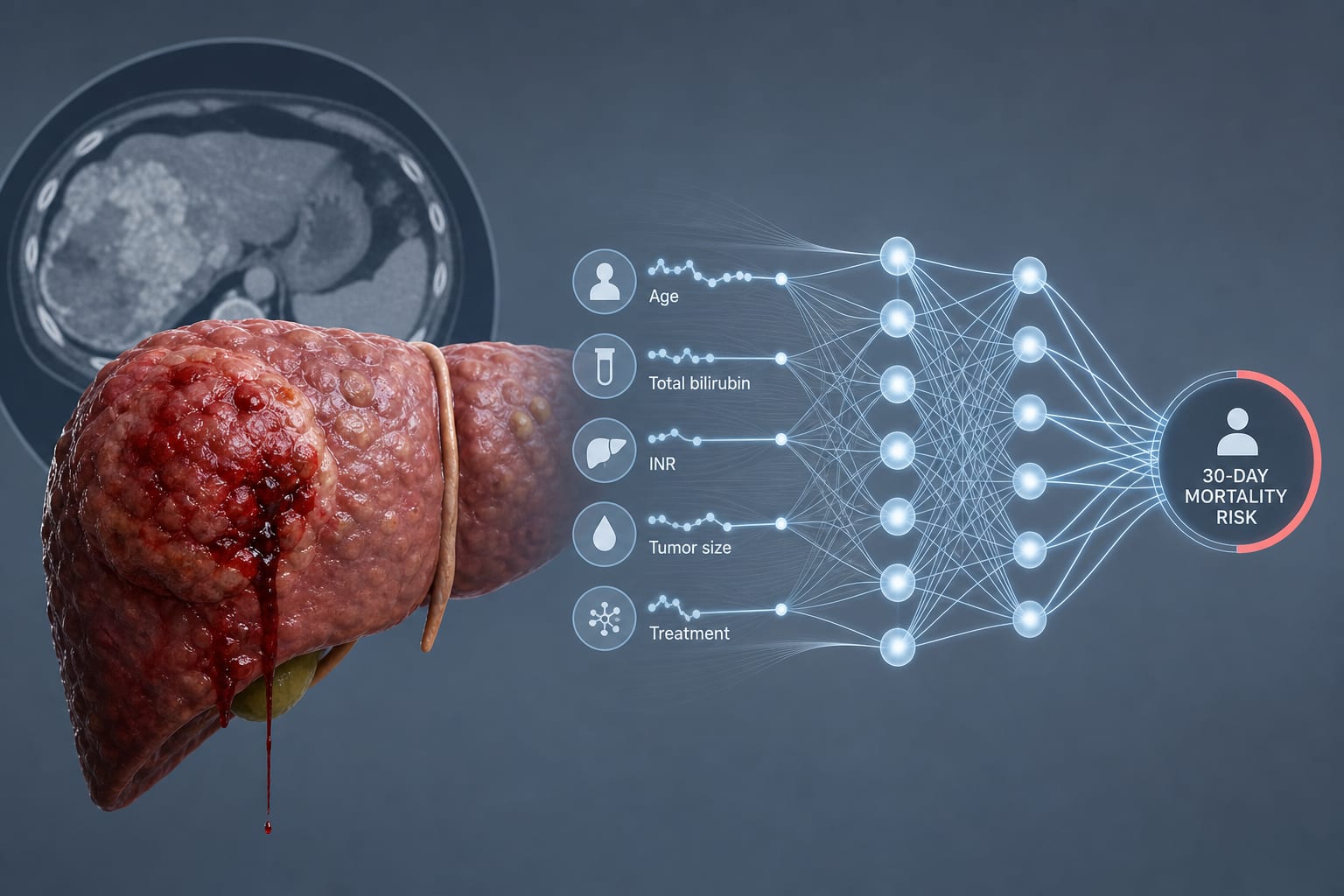
To create a machine learning model to forecast 30-day all-cause mortality in patients with ruptured hepatocellular carcinoma and to identify essential predictive elements.
Approach:
Key Findings:
The decision tree model showed sensitivity of 87.5% and AUC of 0.7901 for predicting 30-day mortality.
TBIL and INR were identified as primary predictors of mortality risk, with odds ratios of 1.45 (95% CI: 1.25–1.68) for TBIL (>40 μmol/L) and 4.95 (95% CI: 3.36–10.11) for INR (>2.5).
Nonlinear threshold effects were observed for TBIL (>40 μmol/L) and INR (>2.5), significantly increasing mortality risk.
Combining TBIL and INR improved predictive accuracy (AUC = 0.87).
Interpretation:
The decision tree model predicts 30-day mortality in patients with ruptured HCC, identifying TBIL and INR as significant predictors.
Limitations:
The study is limited to a single-center cohort, which may affect generalizability.
Retrospective design may introduce biases.
Conclusion:
The decision tree framework provides a method for assessing 30-day mortality risk in ruptured HCC patients.