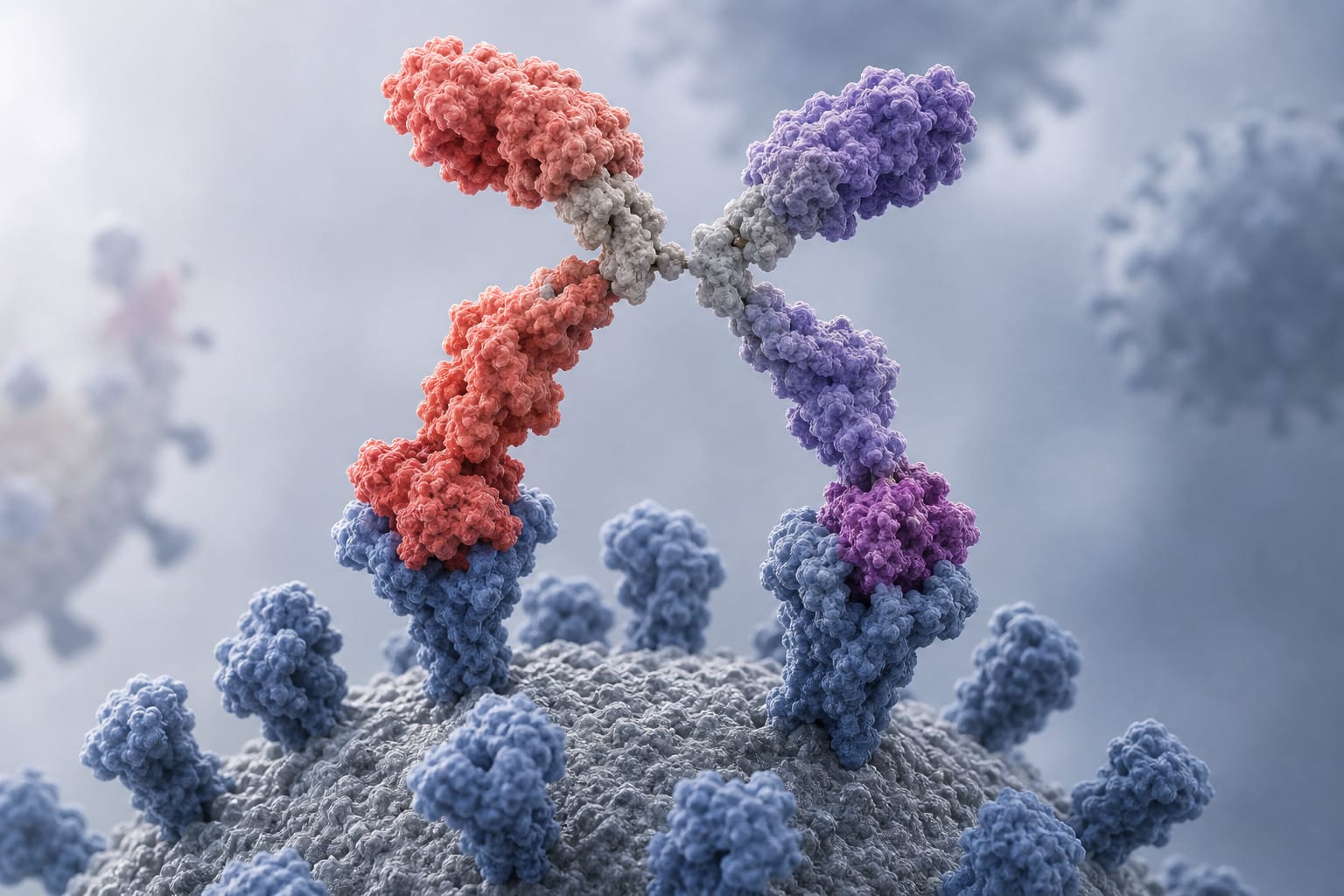
To explore the potential of bispecific antibodies (bsAbs) in neutralizing the Omicron variant of SARS-CoV-2 more effectively than traditional monoclonal antibodies (mAbs), particularly in terms of binding affinity and neutralization capacity.
Approach:
Key Findings:
Selected parental mAbs exhibited kinetic profiles ranging from 5.71 x 10⁻¹⁰ to 2.53 x 10⁻⁴ M across tested Omicron subvariants, indicating a range of binding strengths.
Lead bsAbs R3-1a-1/R4-1a-10 and R4-21/R4-1a-51 showed enhanced binding activity and lower IC50 values compared to controls and mAb cocktails, suggesting superior neutralization potential.
The bsAbs demonstrated strong binding and neutralizing activity across tested Omicron subvariants and retained activity against selected non-Omicron pseudovirus strains.
Interpretation:
The study highlights the implications of bispecific antibodies (bsAbs) in significantly improving neutralization efficacy against SARS-CoV-2 Omicron subvariants compared to traditional monoclonal antibodies (mAbs).
Limitations:
The study primarily focused on in vitro evaluations, which may not fully represent in vivo efficacy; further clinical studies are needed to assess the safety and effectiveness of the identified bsAbs in human populations.
Conclusion:
The research identified two promising bsAbs with strong neutralizing capabilities against various Omicron subvariants, suggesting a potential avenue for enhanced therapeutic strategies against SARS-CoV-2.