Smartphone-Based Proactive Self-Screening for Ocular Surface Malignancies: A Nonrandomized Clinical Trial - Summary - MDSpire

Mobile Device-Enabled Proactive Self-Assessment for Ocular Surface Cancers: A Nonrandomized Clinical Investigation

  • By

  • Ruixin Wang

  • Shaowei Bi

  • Duoru Lin

  • Mingyuan Li

  • Lanqin Zhao

  • Yukun Zhou

  • Ling Jin

  • Wenben Chen

  • Ruiyang Li

  • Yuanjun Shang

  • Huasheng Yang

  • Rongxin Chen

  • Wei Xiao

  • Siming Ai

  • Jianbing Li

  • Shiqi Ling

  • Xiaohang Wu

  • Zhixiong Li

  • Guiqin Liu

  • Yinyue Lu

  • Wen Lin

  • Huiying Rao

  • Xiangda Meng

  • Hua Yan

  • Cong Nie

  • Min Zhu

  • Huijing Ye

  • Haotian Lin

  • July 1, 2026

Share

Objective:

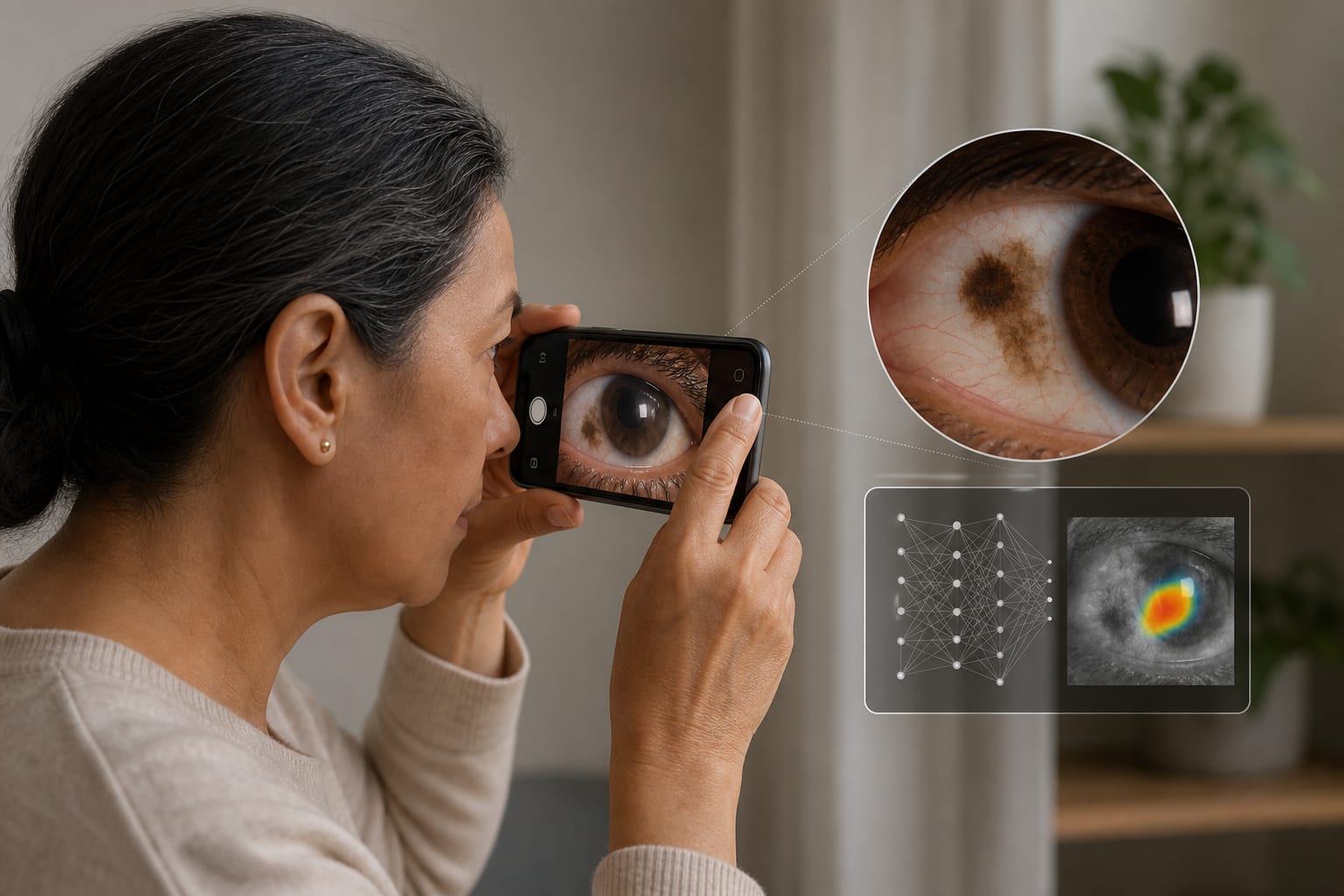
To develop and validate a smartphone-based screening system for ocular surface tumors in China.

Approach:
  • Study Design: A prospective, 3-stage study was conducted to create an AI-driven diagnostic system called CaptureTumor (CaT) for smartphone deployment.
  • Stages of Development: Stage 1 involved training the deep-learning model using clinical slitlamp images. Stage 2 adapted the model for smartphone photography. Stage 3 assessed the real-world implementation of the mobile application.
  • Diagnostic Taxonomy: A publicly oriented classification of pigmented ocular lesions was developed, including malignant and benign tumors.
Key Findings:
  • CaptureTumor (CaT) integrates public education, AI-facilitated self-screening, and structured referral pathways.
  • The study received ethical approval and was registered at ClinicalTrials.gov.
Interpretation:

The integrated framework of CaT aims to improve access to specialist care for rare ocular conditions through a closed-loop mobile health ecosystem.

Limitations:
  • The study is nonrandomized and may have biases inherent to observational studies.
  • The effectiveness of the mobile application in diverse populations and settings remains to be fully evaluated.
Conclusion:

The CaT system represents a strategy to enhance resource allocation and equity in managing rare ocular diseases.

Original Source(s)

Related Content