Exploring the predictive capacity of smartphone-based digital phenotyping to monitor pain and physical quality of life in advanced cancer patients, family caregivers, and dyads - Summary - MDSpire
Advertisement
Exploring the predictive capacity of smartphone-based digital phenotyping to monitor pain and physical quality of life in advanced cancer patients, family caregivers, and dyads
To explore the utility of digital phenotyping in assessing pain and physical quality of life in patients with advanced cancer and their caregivers.
Approach:
Participants: 14 patients with advanced cancer and 32 caregivers installed the Beiwe smartphone application for data collection.
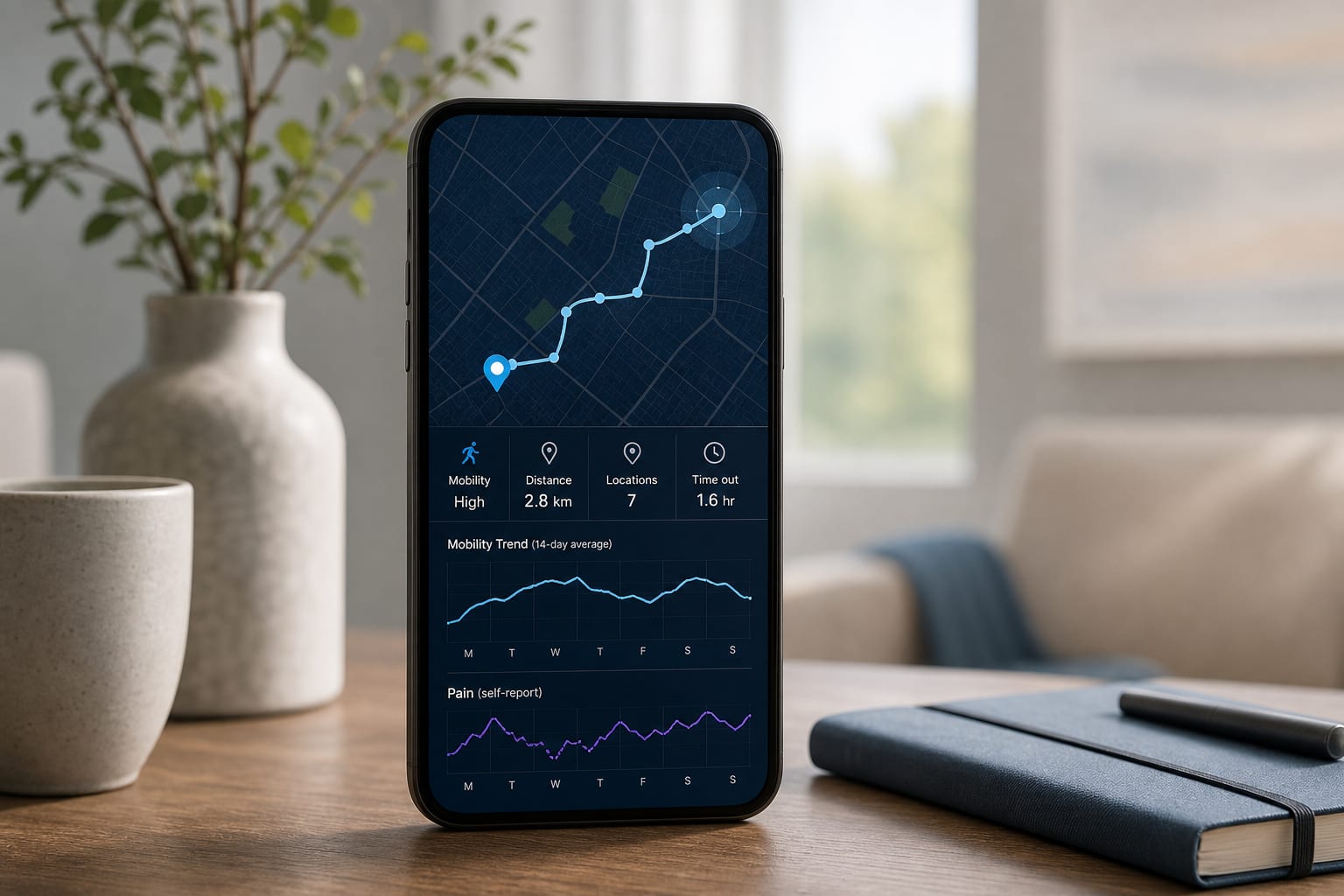
Data Collection: Passive GPS data were collected over 24 weeks, processed into daily mobility features, and combined with PROMIS measures of pain and physical QOL every 6 weeks.
Analysis: Within-person regression models were used to examine associations between mobility features and outcomes, with adjusted R² interpreted as effect size.
Key Findings:
Caregiver GPS-derived mobility features predicted a large proportion of variance in patient pain intensity (R² = 0.31) and pain interference (R² = 0.32).
Combined caregiver and patient mobility data predicted large variance in caregiver physical QOL (R² = 0.43) and medium-to-large variance in patient pain intensity (R² = 0.16) and pain interference (R² = 0.33).
Patient mobility features alone predicted small variance in caregiver physical QOL (R² = 0.02).
Mobility features were associated with small variance in patient physical QOL (R² = 0.03), pain intensity (R² = 0.05), and pain interference (R² = 0.08).
Interpretation:
Digital phenotyping may be a useful approach for predicting pain and physical QOL in advanced cancer, particularly when incorporating both patient and caregiver data.
Limitations:
Small sample size may limit generalizability.
Study duration may not capture long-term trends in pain and QOL.
Conclusion:
Further research is warranted to evaluate digital phenotyping as a novel method for monitoring symptoms and functional outcomes in advanced cancer care.
by Kristen Allen-Watts, Andres Azuero, Kyungmi Lee, Erin R. Harrell, Erin Currie, Avery C. Bechthold, Sally Engler, Kayleigh Curry, Frank Puga, Natashia Bibriescas, Arif H. Kamal, Christine S. Ritchie, George Demiris, Alexi A. Wright, Marie A. Bakitas, Burel R. Goodin, J. Nicholas Odom