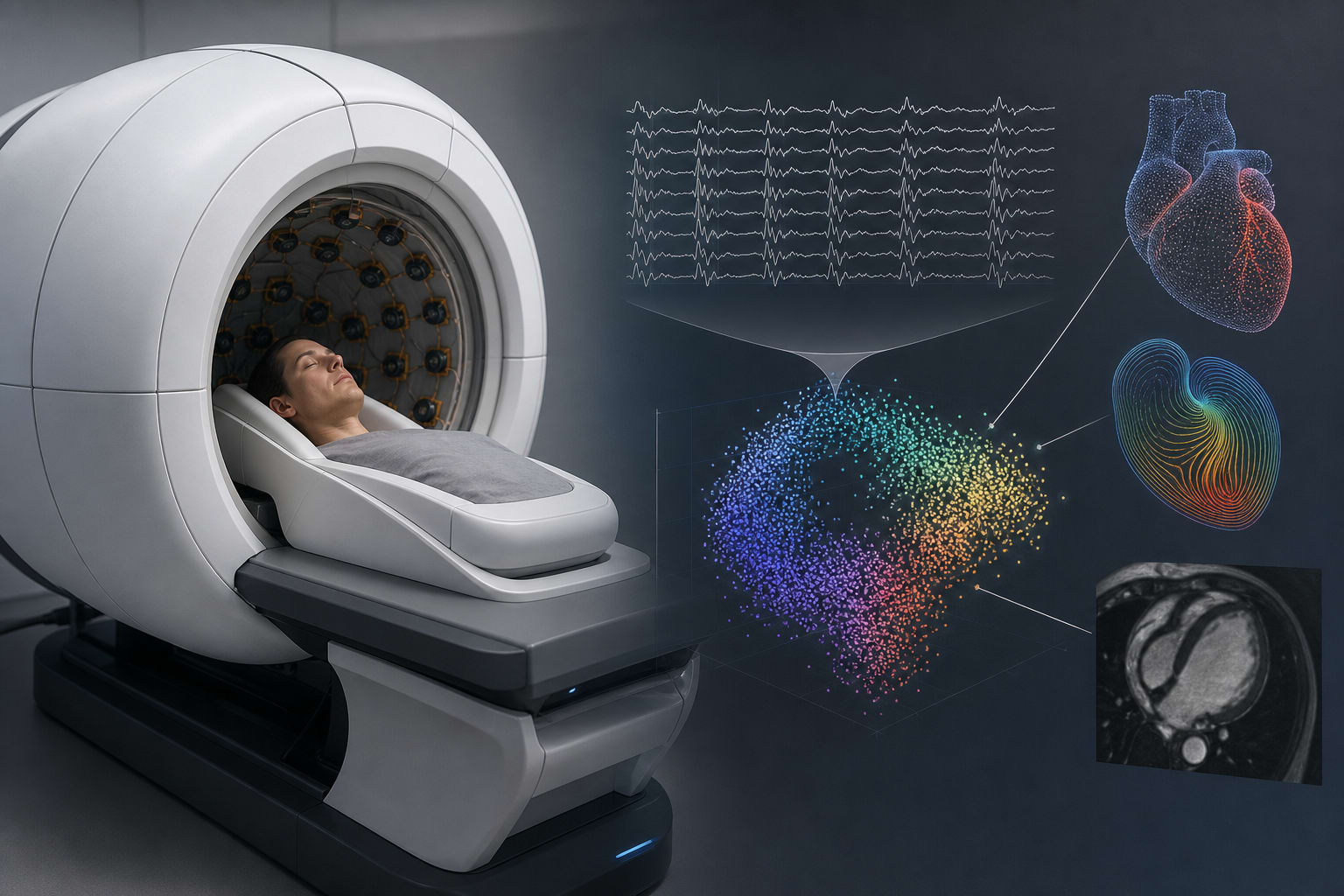
To investigate whether combining magnetocardiography (MCG) with self-supervised learning enables physiologically meaningful cardiac representations.
Key Findings:
Discrimination of multivessel coronary artery disease achieved an AUC of 0.89.
Reduced left ventricular ejection fraction was identified with an AUC of 0.81.
Atrial fibrillation risk was assessed with an AUC of 0.77.
Attribution analyses revealed probe-specific temporal and spatial patterns corresponding to cardiac events.
Interpretation:
Higher-fidelity sensing combined with self-supervised representation learning can yield structured and explainable embeddings from non-invasive cardiac magnetic field recordings.
Limitations:
Broader adoption of MCG is constrained by analytical challenges posed by high-dimensional recordings.
The study's findings are based on specific patient cohorts and may not generalize to all populations.
Conclusion:
The study highlights the importance of measurement physics in determining what medical AI systems can learn.
Investigators found that adding pregnancy-related and female-specific factors modestly improved postpartum cardiovascular risk prediction compared with traditional risk factors alone.