MERS-CoV in the Middle East and Africa: from surveillance gaps in humans and dromedary camels to One Health frameworks for spillover, prevention, research and response preparedness - Summary - MDSpire
Conexiant’s news site is now MDSpire News. Learn more
Advertisement
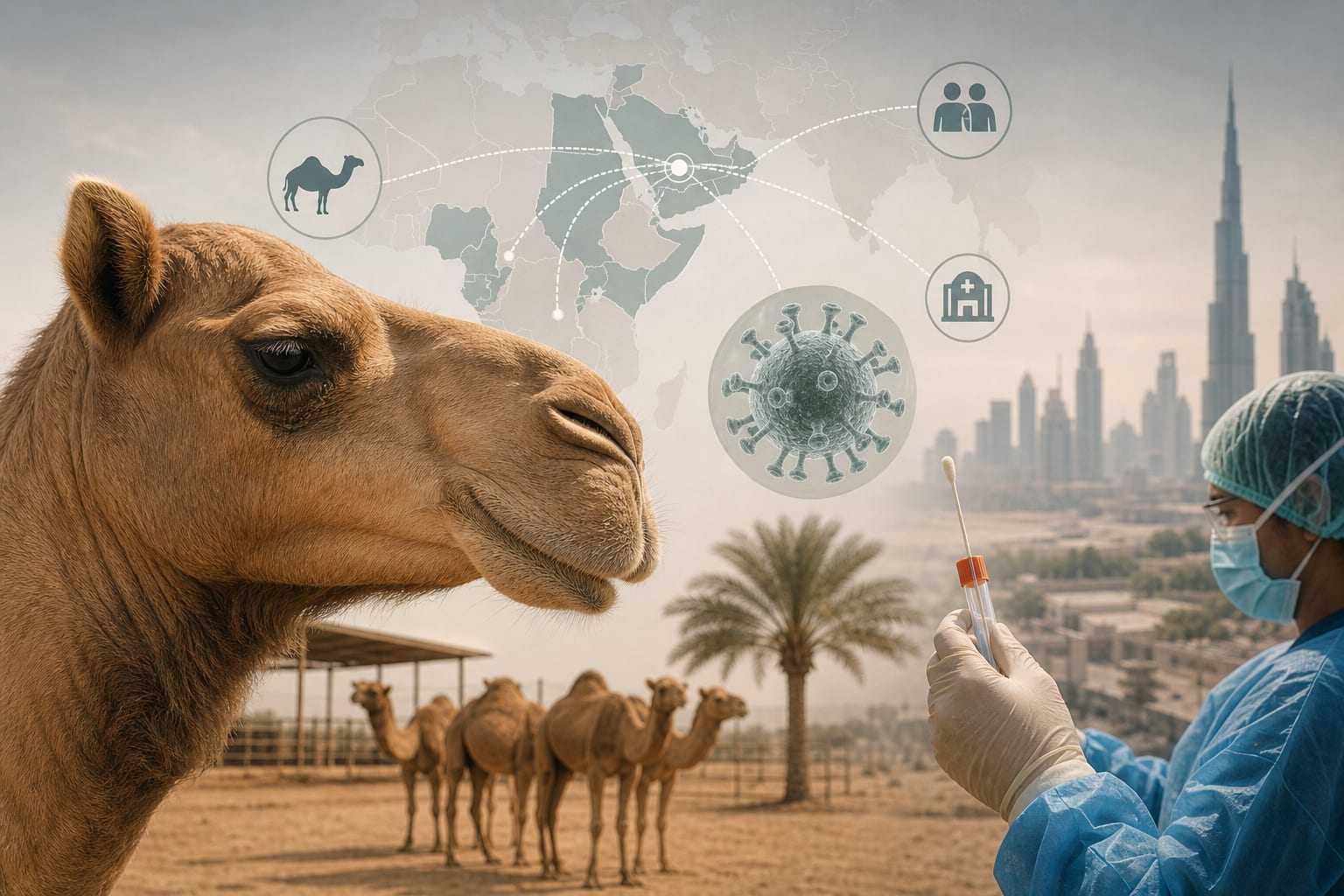
MERS-CoV in the Middle East and Africa: Addressing Surveillance Deficiencies in Humans and Dromedary Camels Through One Health Approaches for Spillover Prevention, Research, and Preparedness
To examine gaps in MERS-CoV surveillance across the Middle East–Africa dromedary camel belt and propose a One Health preparedness framework for earlier spillover detection, prevention, and response.
Approach:
Research Framework: The review expands the focus from recognized human MERS-CoV disease in the Arabian Peninsula to the wider Middle East–Africa dromedary camel belt, integrating human, animal, occupational, clinical, laboratory, genomic, environmental, and community systems.
Two-barrier Model: Proposes an upstream barrier to detect and reduce camel-to-human spillover and a downstream healthcare barrier to prevent amplification after human infection, supported by cross-cutting One Health surveillance, laboratory, genomic, governance, and research-readiness functions.
Literature Search: Conducted a narrative evidence synthesis using PubMed, MEDLINE, Scopus, Web of Science Core Collection, WHO, ECDC, CDC, ClinicalTrials.gov, and reference lists for evidence published from January 1, 2012, through July 29, 2026.
Key Findings:
As of July 5, 2026, 2,637 laboratory-confirmed human MERS-CoV cases had been reported to WHO from 27 countries, with 965 deaths (36.6%). The authors note that this reported case-fatality proportion likely overestimates infection fatality because mild and asymptomatic infections are underdetected.
Extensive MERS-CoV infection or exposure has been documented in dromedary camels across North Africa, East Africa, the Horn of Africa, the Sahel, and the Arabian Peninsula, while PCR-confirmed human disease has rarely been reported from Africa. The authors identify under-detection as the most plausible explanation for this “Africa paradox,” while also considering clinical misclassification, viral lineage differences, and exposure or host factors.
Dromedary camels are described as the principal reservoir for repeated zoonotic transmission to humans, with high levels of exposure in adult camels and active infection documented by viral RNA detection and genomic studies.
Interpretation:
The absence of reported human MERS-CoV cases in many African settings should not be interpreted as absence of human infection. Surveillance should follow the ecology of MERS-CoV across the connected dromedary camel belt and link camel, human, occupational, clinical, environmental, and genomic data.
Limitations:
The article is a narrative evidence synthesis and conceptual framework rather than a systematic review, and no review protocol was prospectively registered.
The analysis relies predominantly on published evidence and may underrepresent locally held, unpublished surveillance data from African settings.
The proposed ranking of explanations for the Africa paradox is provisional and may change as more geographically representative human, camel, genomic, serological, and surveillance data become available.
Conclusion:
MERS-CoV preparedness should be organized around linked camel and human surveillance, early PCR testing of atypical pneumonia and camel-exposed severe acute respiratory infection, healthcare infection prevention and control, genomic surveillance, and research-ready platforms. A Middle East–Africa preparedness compact could convert fragmented surveillance into a standing transregional system for earlier detection, prevention, and equitable response.
by Esam I. Azhar, Manaf Alqahtani, Abdullah M. Assiri, Seif S. Al-Abri, Tieble Traore, Francine Ntoumi, Moses Bockarie, Eskild Petersen, Giuseppe Ippolito, David S. Hui, Brian McCloskey, Stanley Perlman, Alimuddin Zumla