Genome-wide association study identifies and validates genetic variation in the RIG-I/MAVS signaling pathway associated with HIV-related Kaposi sarcoma in children and adults - Summary - MDSpire
Advertisement
Genome-wide association study identifies and validates genetic variation in the RIG-I/MAVS signaling pathway associated with HIV-related Kaposi sarcoma in children and adults
To identify genetic risk factors associated with HIV-related Kaposi sarcoma (KS) in children and adults, particularly focusing on the RIG-I/MAVS signaling pathway.
Approach:
Study Design: Conducted a two-phase genome-wide association study (GWAS) involving a discovery phase with perinatally HIV-infected children and a validation phase with adults living with HIV.
Sample Population: Discovery phase included 45 KS cases and 91 controls among children; validation phase included 215 KS cases and 262 controls among adults.
Genotyping: Performed genotyping using Illumina kits enriched for African populations, followed by quality control procedures.
Key Findings:
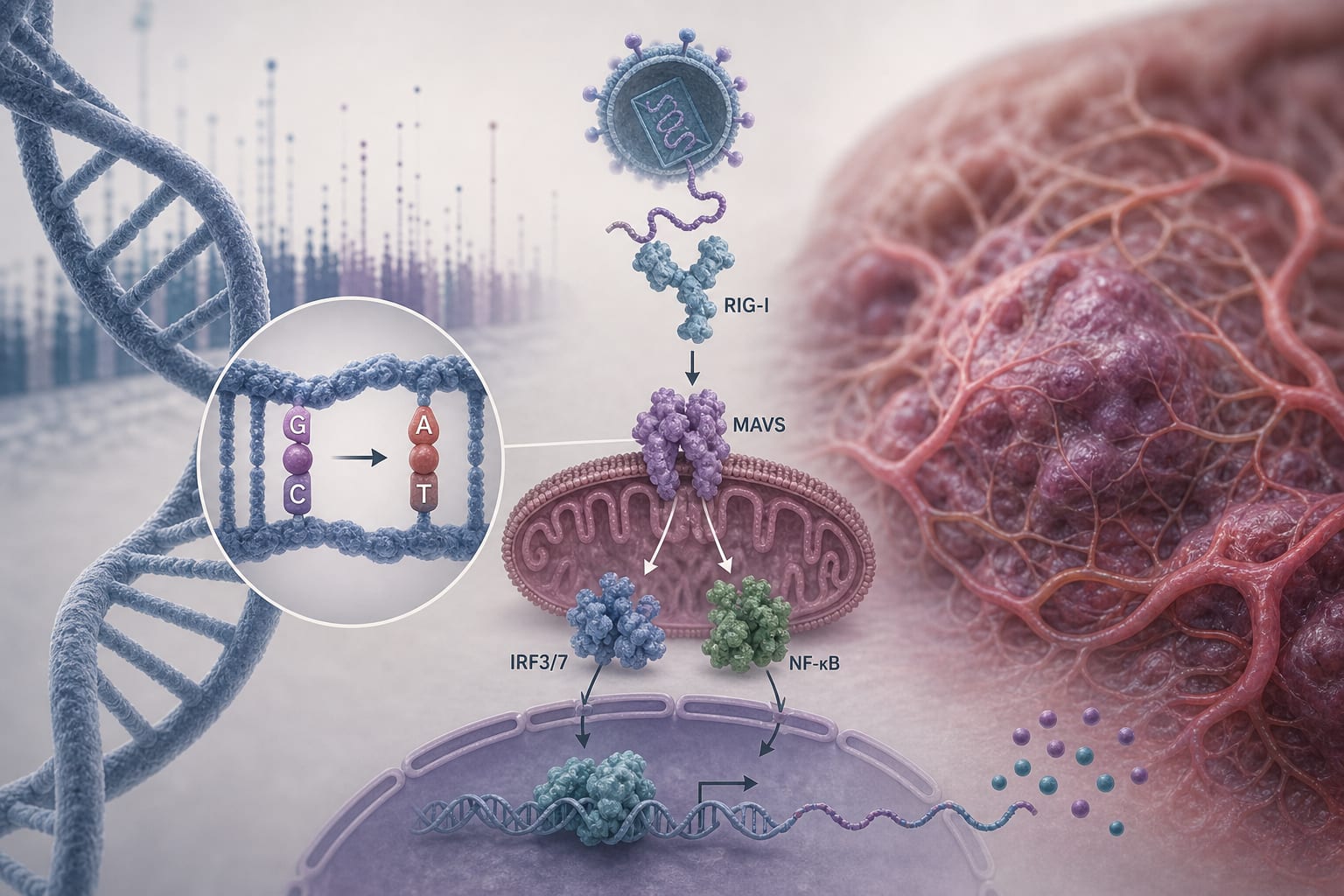
In children, a missense variant in the MAVS gene (rs7269320) showed a suggestive association with KS (OR 3.8, 95% CI 2.2 - 6.7, p=9.7×10⁻⁷).
The same MAVS variant was associated with KS in adults, indicating a recessive inheritance pattern (OR 2.2, 95% CI 1.2 - 3.9, p=0.006).
MAVS is implicated in the RIG-I/MAVS signaling pathway, affecting the antiviral response to HHV-8.
Interpretation:
Limitations:
The study was limited to specific populations in Uganda, which may affect generalizability.
HHV-8 serostatus was unavailable for pediatric control samples.
Conclusion:
The study provides the first pediatric evidence of genetic susceptibility to KS and identifies the RIG-I/MAVS pathway as a potential target for further research.
by Casey L. McAtee, Erin Peckham-Gregory, Pagna Sok, Melissa Richard, Luis Olivares, Deborah Marquez-Do, Grace Kisitu, Jeffrey Martin, Nader Kim El-Mallawany, Carl E. Allen, Joseph Lubega, Michael E. Scheurer