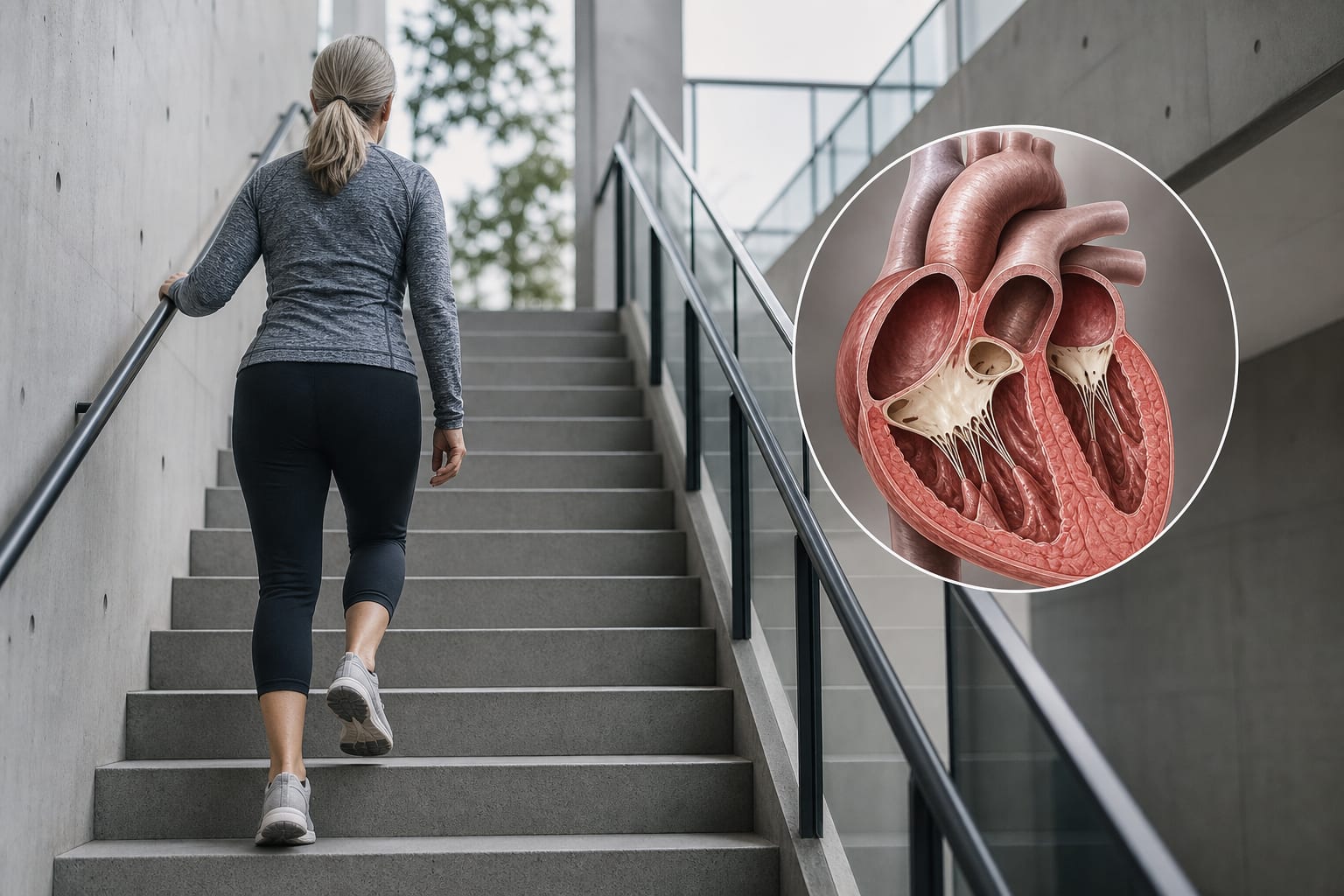
To investigate the association between stair climbing and the risk of incident valvular heart disease (VHD) and its subtypes.
Approach:
Study Population: Included 488,964 participants from the UK Biobank with stair climbing data collected via touchscreen questionnaire from 2006 to 2010.
Data Collection: Stair climbing was self-reported, and VHD was assessed using ICD-10 codes linked to hospital admission and death registry data.
Statistical Analysis: Cox models were used to assess the association between stair climbing and VHD, with a median follow-up of 13.0 years.
Key Findings:
17,494 participants (3.6%) experienced new-onset VHD during follow-up.
Climbing 10–50, 60–100, 110–150, and ≥160 steps per day was associated with reduced VHD risks of 12% (HR: 0.88, 95% CI: 0.82–0.94), 15% (HR: 0.85, 95% CI: 0.79–0.91), 22% (HR: 0.78, 95% CI: 0.73–0.84), and 20% (HR: 0.80, 95% CI: 0.74–0.86), respectively.
Higher stair climbing was linked to lower risks of rheumatic valve disease (HR: 0.79, 95% CI: 0.66–0.95), non-rheumatic valve disease (HR: 0.78, 95% CI: 0.72–0.83), multiple valve disease (HR: 0.82, 95% CI: 0.74–0.90), and endocarditis (HR: 0.63, 95% CI: 0.48–0.83).
Interpretation:
Limitations:
The study is observational, which limits causal inferences.
Self-reported stair climbing may be subject to recall bias.