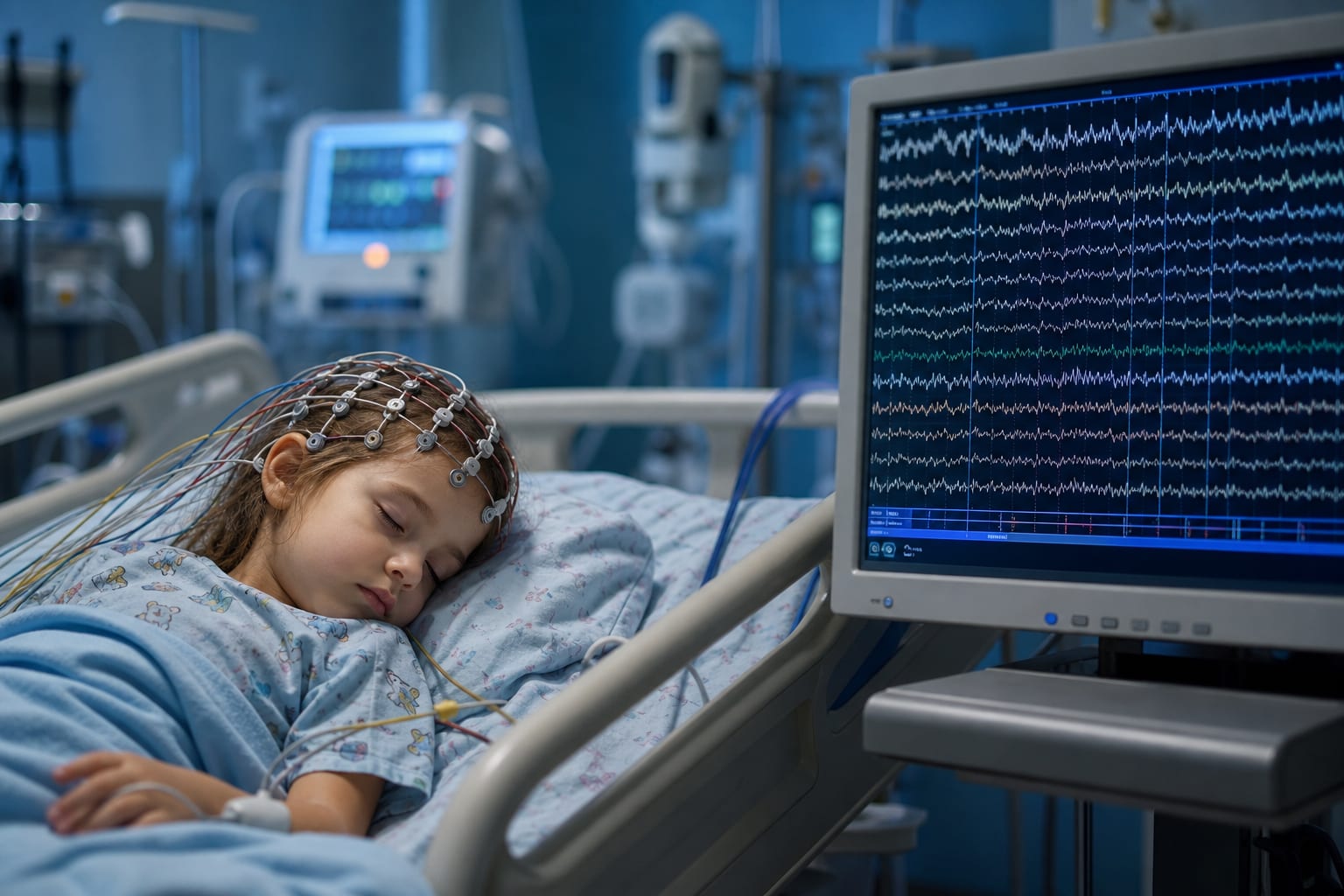
To describe sleep disruptions in critically ill children, including young infants and patients with CNS injury, and compare polysomnography-derived sleep parameters with healthy reference ranges.
Approach:
Study Design: An observational study conducted at Erasmus MC Sophia Children's Hospital, involving two cohorts: critically ill children in the PICU and non-critically ill children with suspected sleep disordered breathing.
Study Population: Participants included critically ill children aged term to 18 years admitted to the PICU and non-critically ill children undergoing polysomnography for suspected SDB.
Sleep Measurements: Polysomnography was used to measure sleep, with a full montage EEG performed when feasible. Sleep scoring was conducted by certified professionals.
Key Findings:
Sleep in critically ill children is often fragmented and reduced, with disruptions exacerbated by environmental and pharmacological factors.
Previous studies on sleep in PICU settings have largely excluded young infants and children with CNS injuries.
Only five studies have utilized polysomnography to assess sleep in PICU, reporting significant sleep fragmentation and reduced REM sleep.
Interpretation:
Limitations:
Exclusion of certain patient populations may limit the generalizability of findings.
Challenges in sleep scoring due to immature or atypical EEG patterns in young infants and children with CNS injuries.
by Eris van Twist, Arnout B. G. Cramer, Sascha C. A. T. Verbruggen, Maartje Louter, Karlien Veldscholte, Koen F. M. Joosten, Matthijs de Hoog, Karla Biesheuvel, Dirk C. G. Straver, Rogier C. J. de Jonge