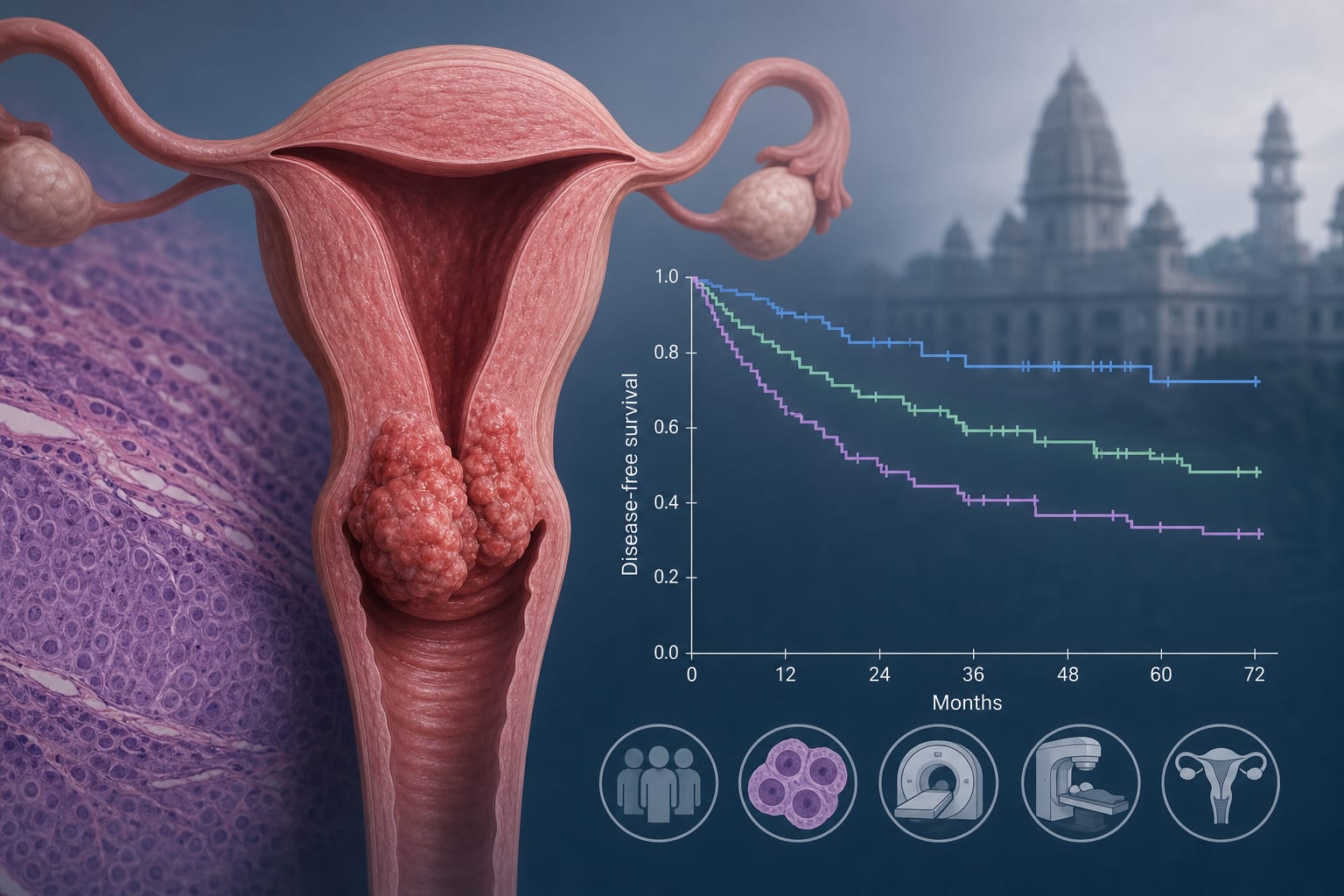
Survival beyond treatment: patterns and determinants of disease-free survival in cervical cancer at a tertiary care center in India - Summary - MDSpire
To assess disease-free survival (DFS) patterns and identify prognostic factors among cervical cancer patients treated at a tertiary care center in India.
Approach:
Study Design: A retrospective–prospective cohort study was conducted at Sir Sunderlal Hospital, Banaras Hindu University, Varanasi, including 587 cervical cancer patients diagnosed between 2011 and 2021.
Data Collection: Data were obtained from medical records, with follow-up until February 2025. Patients with incomplete records or other cancers were excluded.
Statistical Analysis: Kaplan–Meier methods, log-rank tests, and Cox proportional hazards models were used to estimate survival and identify predictors.
Key Findings:
The median follow-up duration was 23.4 months (IQR: 10.2–52.6).
Most patients were aged ≤50 years (51.8%), from rural areas (68.5%), and presented with advanced disease (FIGO stage II: 36.3%; stage III: 45.8%).
Significant differences in DFS were observed by age (p=0.002), tumor size (p=0.005), vaginal involvement (p=0.011), lymph node involvement (p=0.012), and addiction status (p=0.023).
In multivariable analysis, age ≤50 years (AHR = 1.64; 95% CI: 1.16–2.34), tumor size ≥4 cm (AHR = 2.98; 95% CI: 1.44–6.15), and vaginal involvement (AHR = 1.56; 95% CI: 1.06–2.29) were independently associated with poorer DFS.
Interpretation:
DFS in cervical cancer is influenced by tumor burden and locoregional spread, with a notable early decline in survival.
Limitations:
The study is limited to a single tertiary care center, which may affect generalizability.
Data on some socio-behavioral factors may be incomplete.
Conclusion:
Intensive follow-up during the first two years post-treatment is essential.
A first-in-human study reduces stem-cell collection and manufacturing times, Bristol Myers ends its Breyanzi agreement with Cellares, and two approaches strengthen CAR T-cell activity against solid tumors