Chronic pain as a state-constrained brain network disorder: a dynamical systems model integrating physiological regulation and self-organisation - Summary - MDSpire
To propose a state-constrained triple-network model of self-organisation in the context of chronic pain, incorporating physiological regulation to enhance understanding of the disorder.
Approach:
Key Findings:
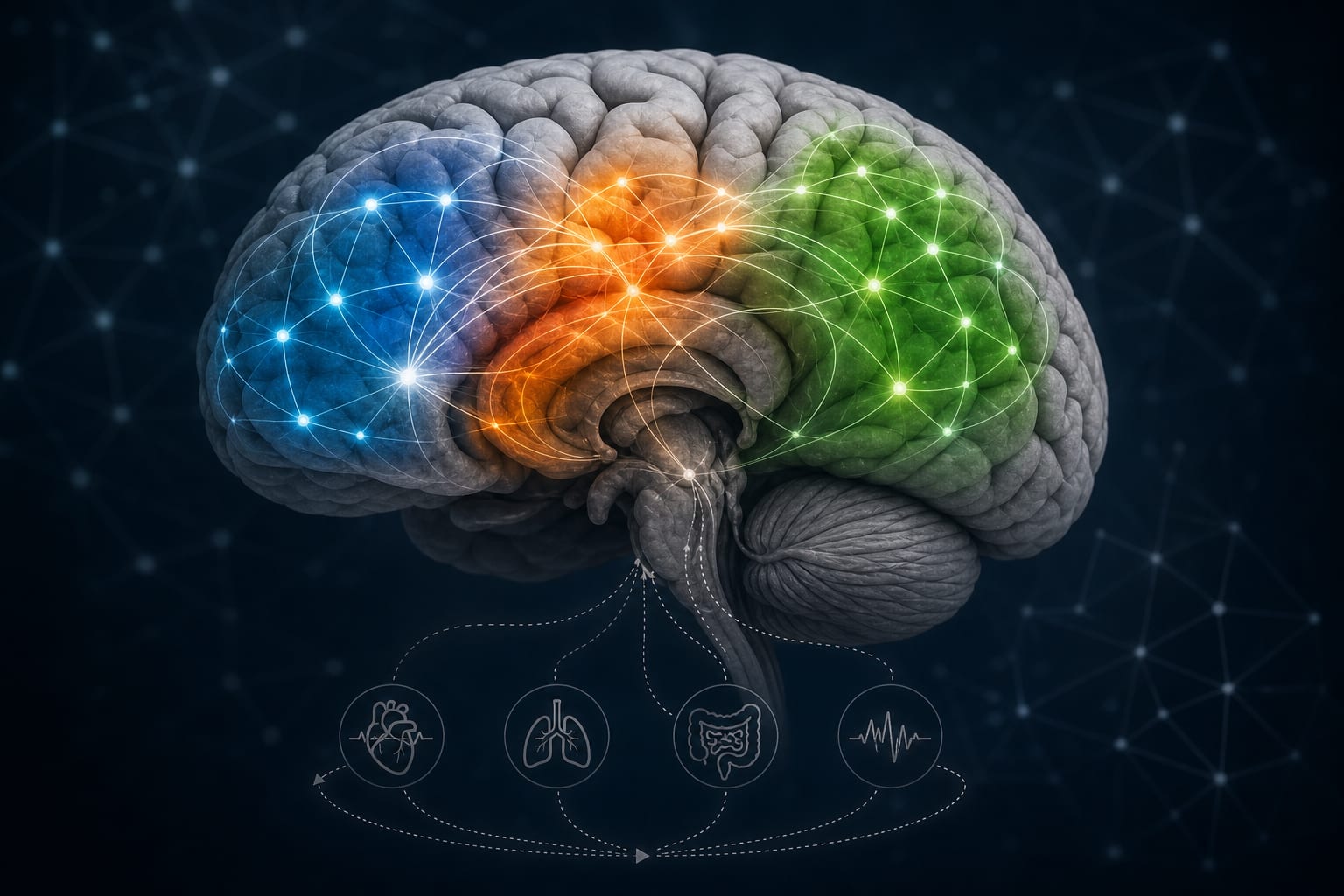
Chronic pain is linked to disturbances in large-scale brain networks, particularly the SN, DMN, and CEN, with physiological regulation playing a crucial role in these dynamics.
Physiological regulation influences the dynamics of these brain networks, contributing to the persistence and variability of pain states.
Self-organisation of brain networks is proposed as a mechanism through which chronic pain emerges and stabilizes, influenced by physiological factors.
Interpretation:
Chronic pain may reflect a theoretical stable attractor configuration of brain network interactions maintained by physiological regulatory constraints.
Limitations:
The model does not propose physiological dysregulation as the sole cause of chronic pain but acknowledges its role within a broader context.
Current models may not fully account for the complexity of interactions among physiological, neural, and experiential factors as they relate to the proposed model.
Conclusion:
The proposed framework links network neuroscience with physiological regulation and self-experience, offering a multilevel understanding of chronic pain.
Patients with preoperative vitamin D deficiency had higher postoperative pain scores and opioid use after mastectomy, including more than triple the odds of moderate to severe pain within 24 hours of surgery.