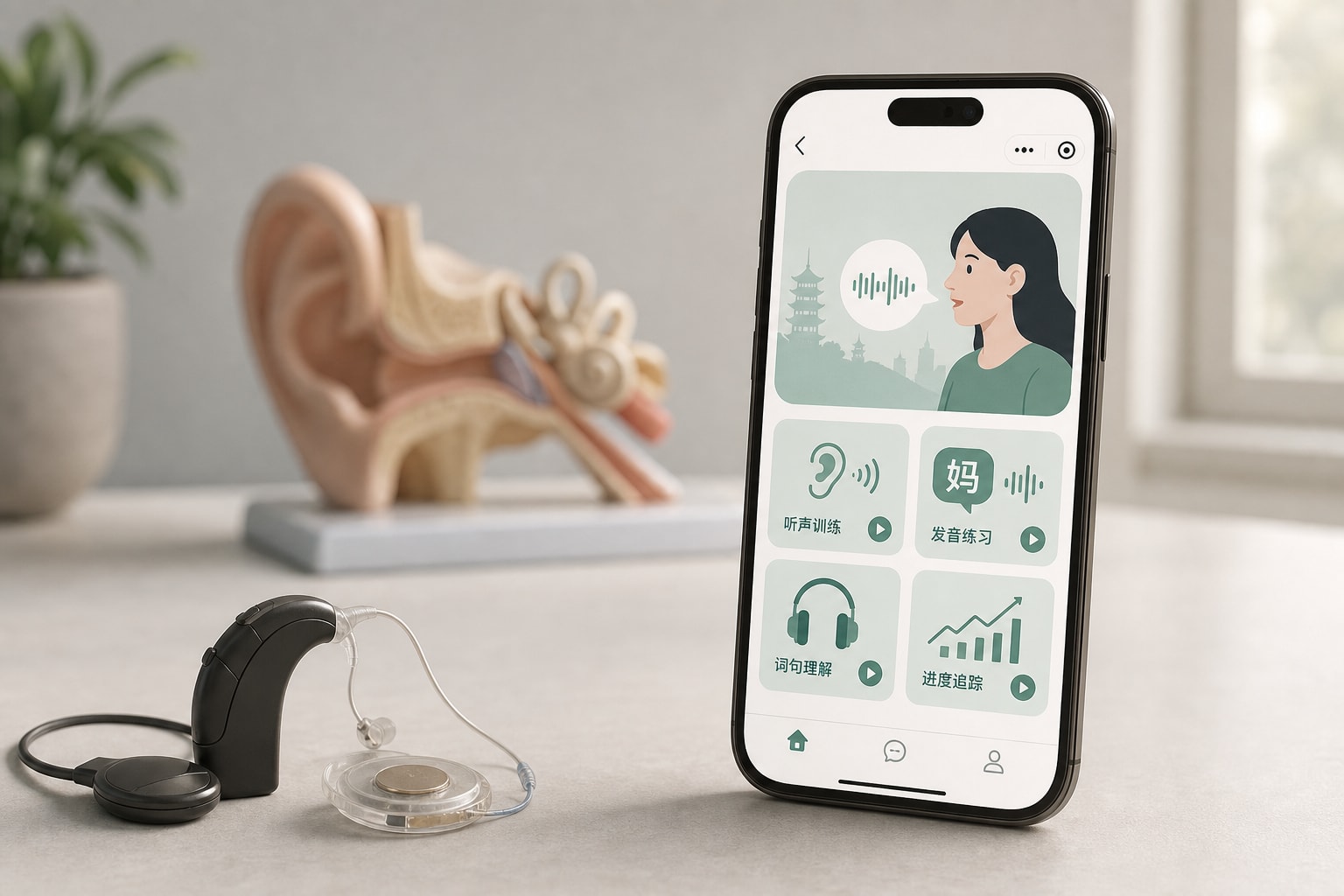
Development and preliminary validation of a WeChat-based auditory-speech rehabilitation system for Mandarin-speaking cochlear implant users - Summary - MDSpire
To develop and preliminarily validate the 'Miao Yan Hui' Mini Program as an integrated auditory-speech rehabilitation and assessment system for adult Mandarin-speaking cochlear implant users.
Approach:
Study Design: Preliminary validation study conducted at Shanghai Sixth People’s Hospital with 20 Mandarin-speaking cochlear implant users.
System Design: An interdisciplinary team developed the Mini Program using an iterative process, focusing on individualized rehabilitation and assessment.
Rehabilitation Workflow: Participants completed a baseline assessment, received individualized training plans, and underwent re-evaluation to adapt training levels.
Assessment Module: Established a multidimensional auditory and speech assessment framework covering six domains: auditory function, respiratory function, vocal function, resonance function, articulation function, and language function.
Key Findings:
The Mini Program provides a structured approach to auditory-speech rehabilitation tailored for Mandarin-speaking users.
Participants engaged in a closed-loop process of assessment, training, and re-evaluation.
The assessment framework covers multiple domains of auditory and speech functions.
Interpretation:
Limitations:
The sample size was small and based on feasibility rather than a formal calculation.
Variations in device type and recording conditions may affect assessment accuracy.
Conclusion:
The 'Miao Yan Hui' Mini Program warrants further clinical studies.