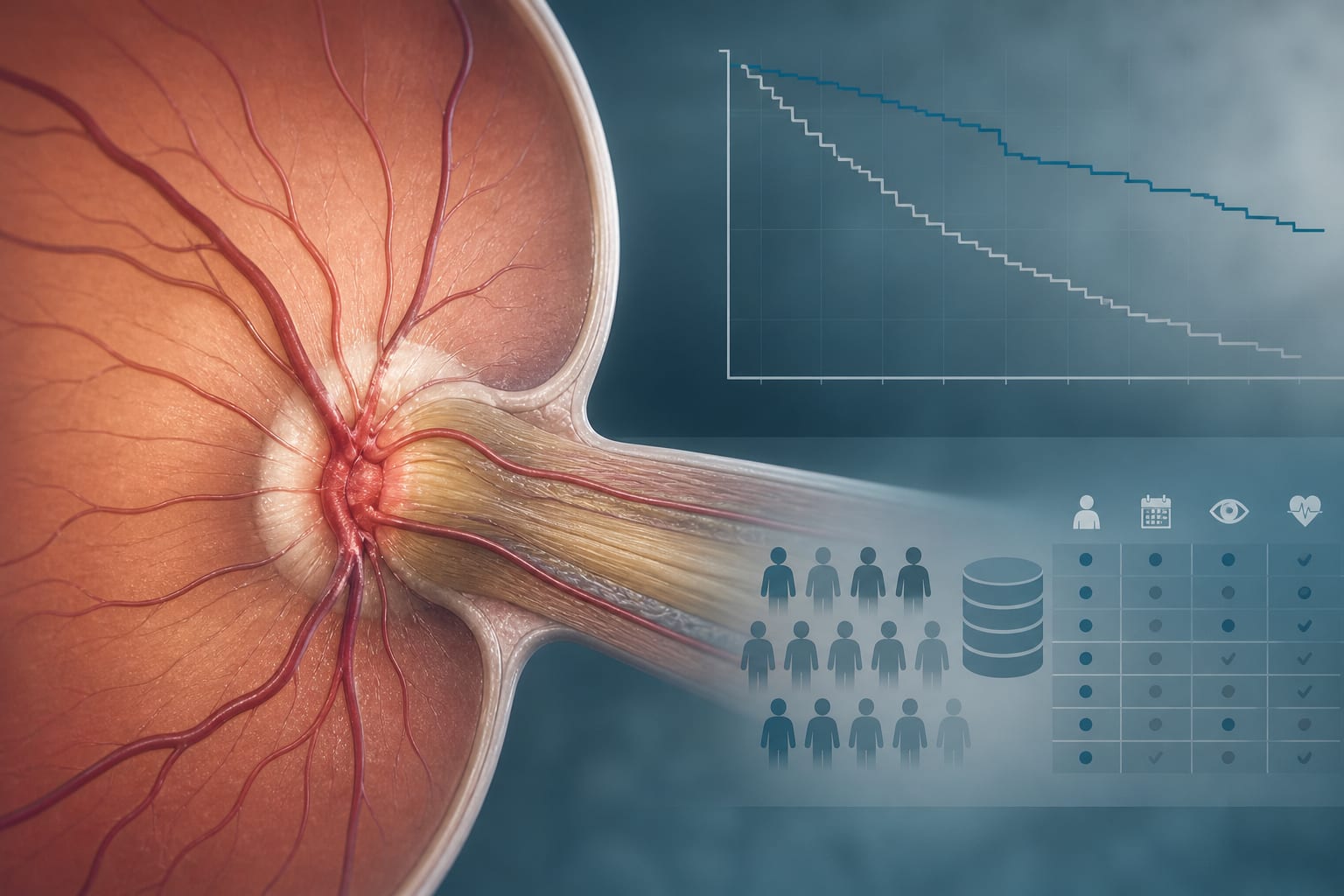
The article examines the objective, findings, and clinical context described in Reply: Data Interpretation and Temporal Risk of Semaglutide-Associated NAION.
Approach:
Risk-table accounting: Clarified that at-risk counts refer to immediately before each time point, while cumulative events and censoring include occurrences through that time point. At day 182.5, the SGLT2i group totals reconcile to the full day-0 cohort of 90,883.
Proportional hazards: Estimated cause-specific treatment hazard ratios (HRs) for year 1 and later follow-up in the overlap-weighted cohort, and assessed scaled Schoenfeld residuals in the unweighted cohort.
Outcome classification: Discussed the positive predictive value of the ICD-10 algorithm used to identify NAION and whether misclassification differed by treatment group.
Key Findings:
The risk-table figures reconcile exactly; the authors report no patients missing from the accounting.
The HRs were 1.78 (95% CI, 0.90–3.51) in year 1 and 2.93 (95% CI, 1.75–4.91) thereafter; the between-period contrast was not statistically significant (HR difference, 1.15; P = .25).
Scaled Schoenfeld residuals showed no detected temporal trend (χ²₁ = 0.084; P = .77).
The ICD-10 algorithm’s reported positive predictive value for NAION is approximately 74.5%. The authors found no evidence that misclassification varied by treatment group.
Interpretation:
The authors state that their analyses do not indicate an appreciable violation of proportional hazards and support interpreting the reported HR as an effect summary averaged over follow-up. They note that nondifferential outcome misclassification would, if anything, bias the HR toward the null.
Limitations:
The NAION coding algorithm has an approximately 74.5% positive predictive value, indicating potential outcome misclassification.
The authors state that they have no indication censoring was informative regarding treatment; the reply does not provide a direct test of that assumption.
Conclusion:
The authors reiterate that absolute risk was low and state that consideration should be given to counseling patients about the rare but evident risk of NAION following semaglutide initiation.