Attenuation value of non-contrast computed tomography for spontaneous intracerebral hemorrhage: an important marker for the rapid identification of hematoma expansion - Summary - MDSpire
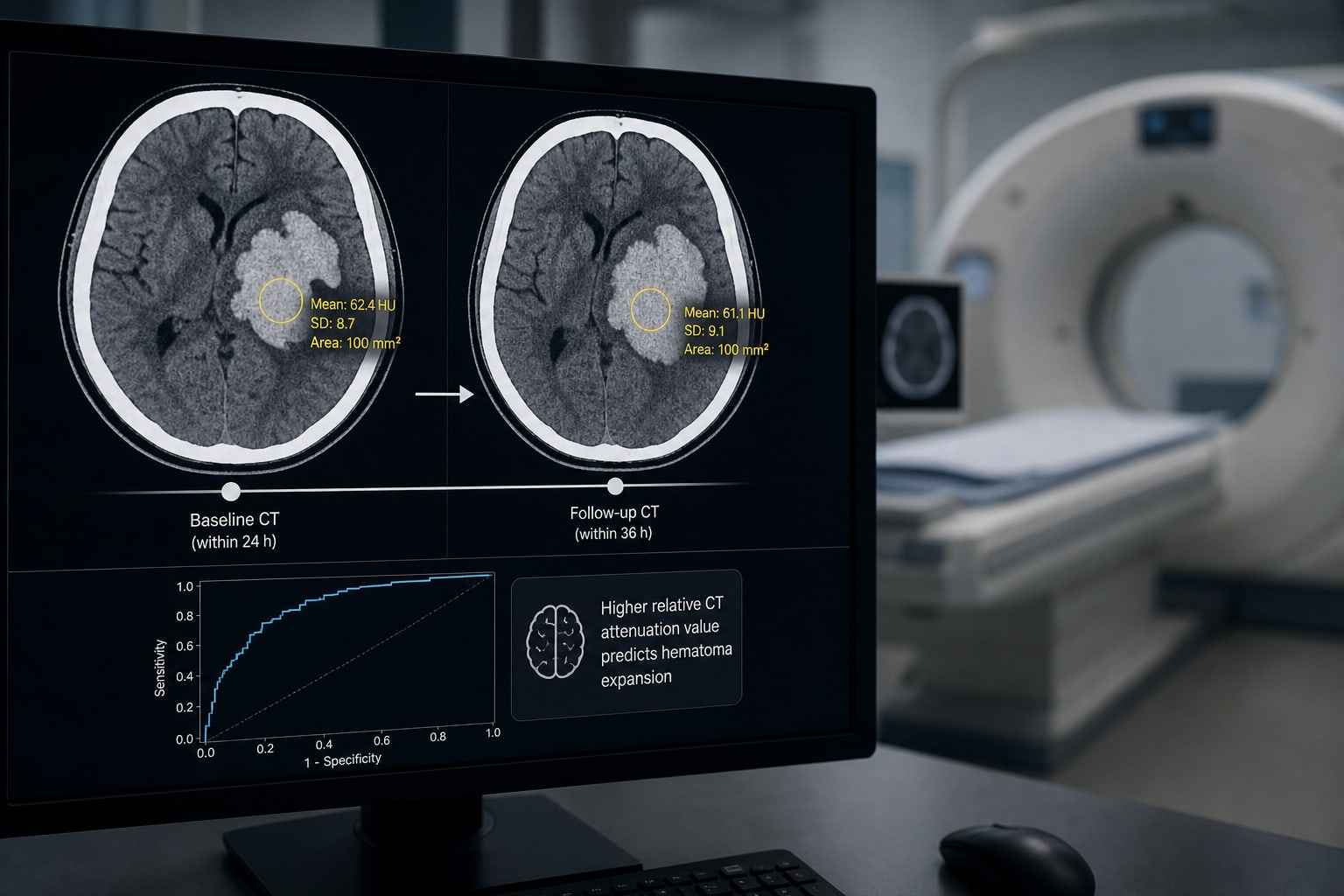
This study aims to evaluate the efficacy of relative CT attenuation values in predicting hematoma expansion (HE) in patients diagnosed with spontaneous intracerebral hemorrhage (sICH).
Approach:
Study Design: A retrospective cohort study was conducted involving patients with sICH who received treatment between January 1, 2020, and December 31, 2023. All participants underwent both baseline and follow-up non-contrast CT scans to assess hematoma characteristics.
Data Analysis: Receiver operating characteristic (ROC) curves were generated to identify the optimal threshold for predicting HE based on relative CT attenuation values measured in Hounsfield Units (HU).
Key Findings:
The analysis revealed that the sensitivity and specificity for predicting HE at a relative CT attenuation threshold of ≤33.35 HU were 40.9% and 83.1%, respectively. This indicates that while the threshold has a high specificity, its sensitivity is relatively low, suggesting that not all cases of HE may be detected using this criterion.
Interpretation:
The study concludes that the relative CT attenuation value of the hematoma can serve as an independent predictor of hematoma expansion in patients with sICH, providing valuable information for clinical decision-making.
Limitations:
The retrospective nature of the study may introduce biases and limit the generalizability of the findings.
Conducting the study at a single center may restrict the diversity of the patient population.
Variability in CT scanner models and differences in acquisition protocols could potentially influence the measured attenuation values, impacting the reliability of the results.
Conclusion:
The relative CT attenuation value has the potential to be utilized as a predictive marker for hematoma expansion in patients with sICH, aiding clinicians in assessing the risk of deterioration and guiding treatment strategies.