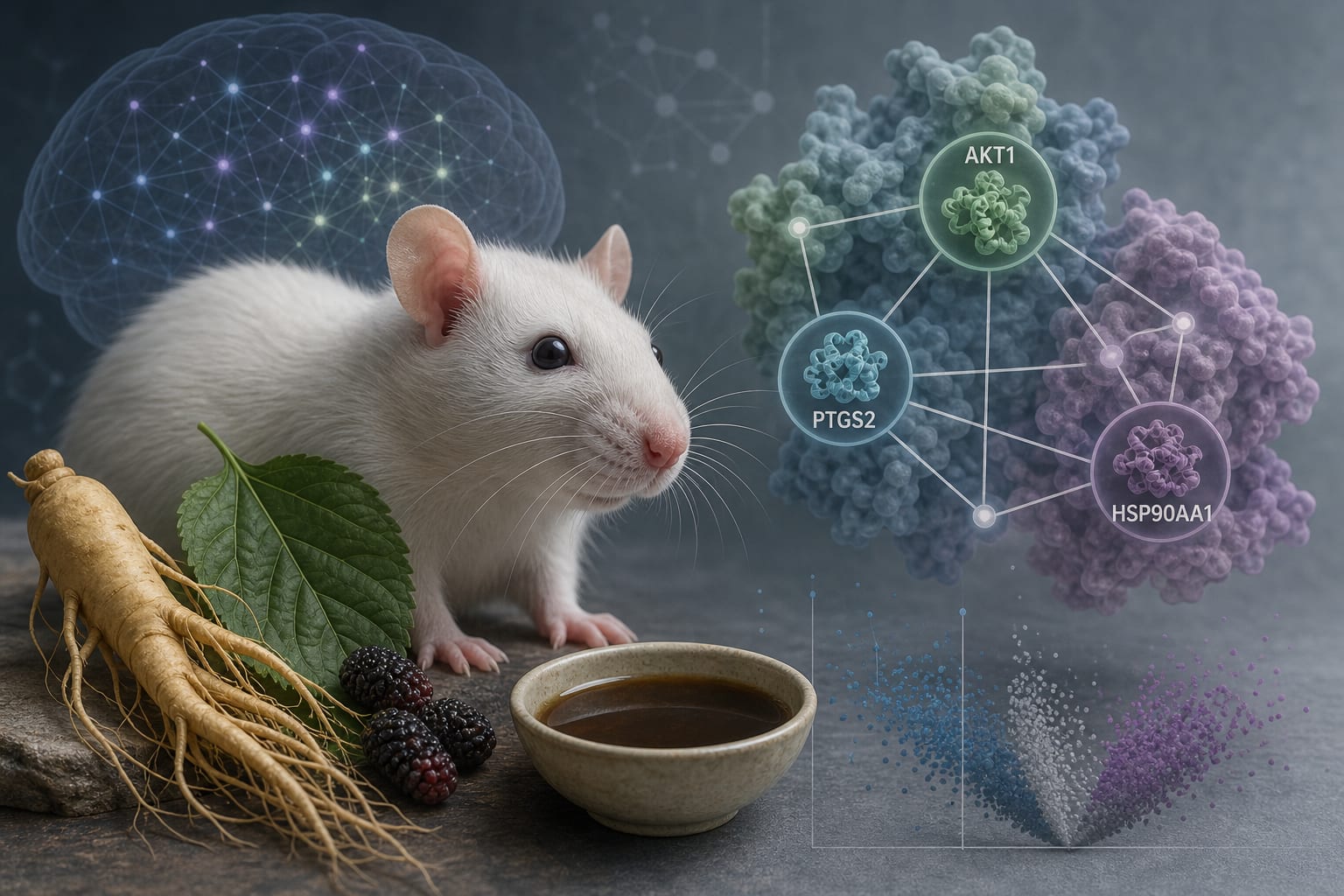
Ginseng-mulberry (medicine-food homologous) pair mitigates cadmium-induced anxiety: a clinical proteomics-guided network pharmacology with rat validation - Summary - MDSpire
Advertisement
Ginseng-mulberry (medicine-food homologous) pair mitigates cadmium-induced anxiety: a clinical proteomics-guided network pharmacology with rat validation
To identify multi-target interventions for cadmium-induced anxiety using clinical proteomics and network pharmacology, focusing on their mechanisms.
Key Findings:
Identified 120 differentially expressed proteins associated with anxiety in cadmium-exposed individuals, highlighting potential biomarkers.
Ginseng and mulberry leaf were prioritized as effective interventions through network pharmacology, indicating their therapeutic potential.
The decoction improved anxiety-like behavior and prefrontal neurovascular/glial pathology in rats, suggesting a beneficial effect on neurotoxicity.
Interpretation:
The study suggests a poly-pharmacological approach to counteract cadmium-induced neurotoxicity through the ginseng-mulberry leaf combination, which may inform future treatment strategies.
Limitations:
Potential errors in interaction predictions due to the complexity of network construction and analysis, which may affect the reliability of the findings.
Findings are based on a specific cohort and may not generalize to broader populations, necessitating caution in interpretation.
Conclusion:
The ginseng-mulberry leaf pair shows promise in addressing cadmium-associated neurobehavioral changes, warranting further studies to explore dosage and mechanisms.
Swedish study finds two-way associations between premenstrual disorders and psychiatric conditions, with strongest links involving depression, anxiety, attention-deficit/hyperactivity disorder, bipolar disorder, and personality disorders.