Anxiety, depression and health-related quality of life in patients with thoracic aortic disease: a longitudinal study in a cardiothoracic outpatient clinic - Summary - MDSpire
Advertisement
Anxiety, depression and health-related quality of life in patients with thoracic aortic disease: a longitudinal study in a cardiothoracic outpatient clinic
To describe longitudinal trajectories of HRQoL and psychological distress in patients with TAD and to examine associations with key demographic and clinical variables.
Approach:
Study Design: Retrospective analysis of 111 patients with 256 visits from 2023 to 2025, using linear mixed-effects models and logistic regression.
Key Findings:
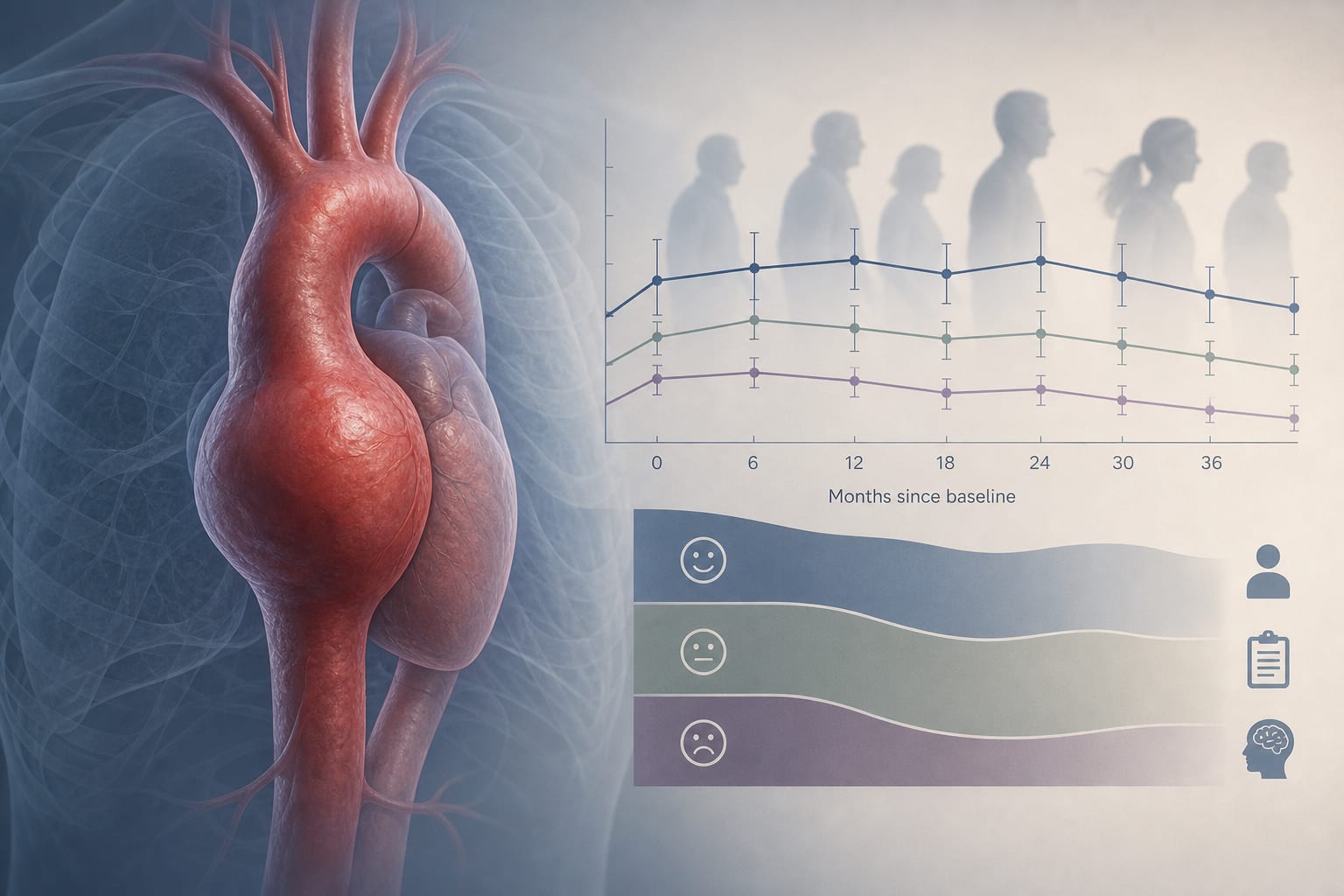
Median EQ-5D-5L was 0.71 (IQR 0.55–0.88), EQ-VAS 70 (IQR 60–80), and PHQ-4 3 (IQR 1–5).
Time since surgery predicted HRQoL improvement (p < 0.001).
Preoperative patients had lower HRQoL and twice the odds of clinically relevant distress (OR 2.0, 95% CI 1.2–3.3).
Female sex showed nonsignificant trends toward lower HRQoL and higher distress.
Interpretation:
Preoperative TAD patients reported lower HRQoL and higher distress, while postoperative recovery was associated with gradual improvement.
Limitations:
The study reflects a real-world outpatient cohort with heterogeneous pre- and postoperative trajectories.
Pre- and postoperative classifications are based on clinical status at presentation rather than strict longitudinal follow-up.
Conclusion:
Findings reflect real-world patterns in a mixed pre-/postoperative outpatient cohort.
by Ismail Dalyanoglu, Anna Maria Markser, Johannes Nienhaus, Esma Yilmaz, Mohammed Morjan, Amin Thwairan, Ulrike Dinger, Artur Lichtenberg, Hannan Dalyanoglu
As ASE convenes its 37th Scientific Sessions near Denver, the meeting will spotlight echocardiographic AI and big data, contrast-enhanced ultrasound, evolving guidelines, the Feigenbaum Lecture, and the future of the sonographer workforce.