The association of remnant cholesterol inflammatory index with the risk of major adverse cardiovascular events in patients with angina undergoing percutaneous coronary intervention: a retrospective study - Summary - MDSpire
Conexiant’s news site is now MDSpire News. Learn more
Advertisement
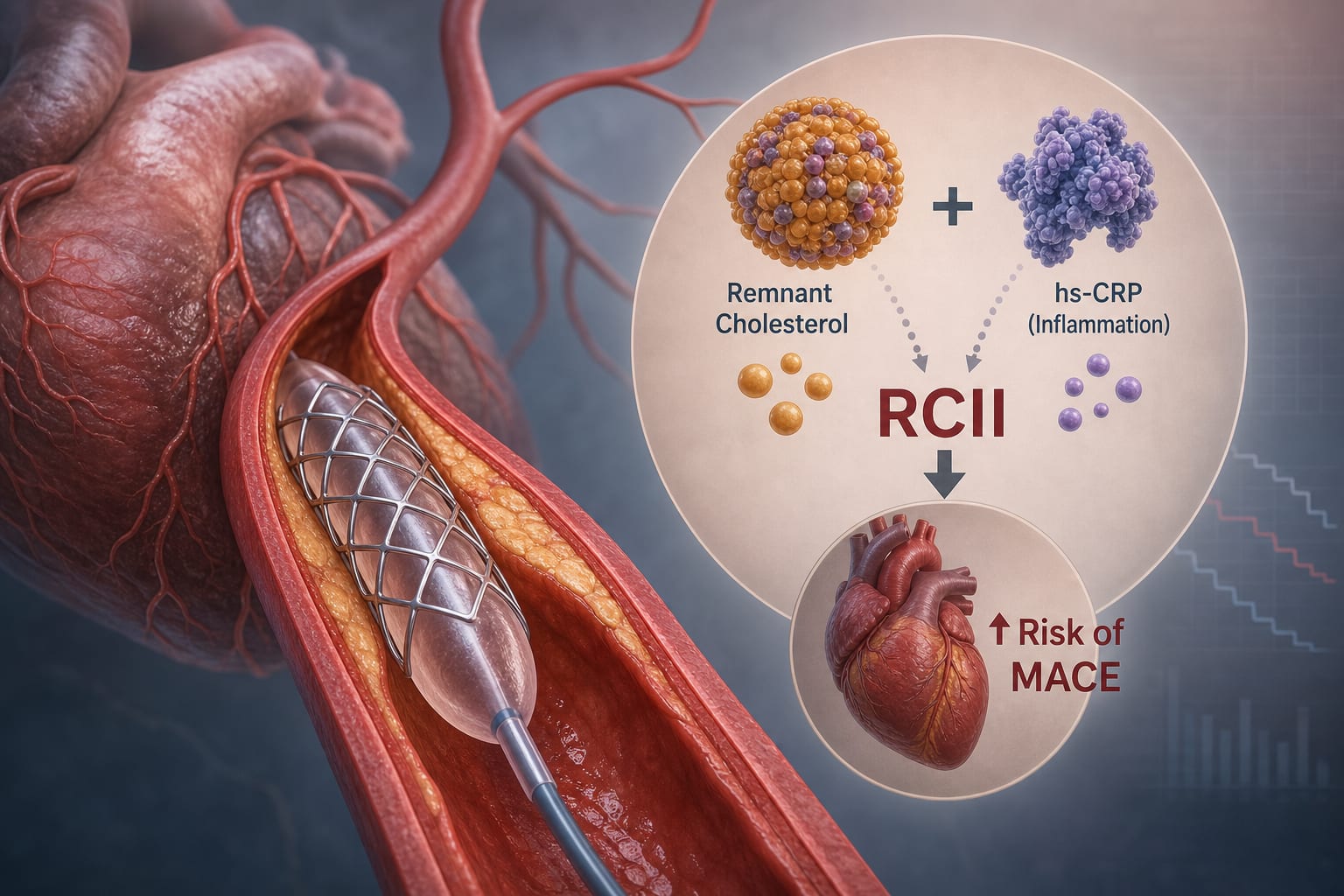
Linking the Remnant Cholesterol-Inflammation Index to Major Adverse Cardiovascular Event Risk in Angina Patients Undergoing Percutaneous Coronary Intervention: A Retrospective Analysis
To evaluate the association between the remnant cholesterol-inflammation index (RCII) and the risk of major adverse cardiovascular events (MACE) in patients with angina undergoing percutaneous coronary intervention (PCI).
Approach:
Key Findings:
Each standard deviation increase in RCII was associated with a 5% higher MACE risk (HR = 1.05, 95%CI: 1.04–1.07).
Hazard ratios for MACE risk in the second and third tertiles of RCII were 2.87 (95%CI: 2.03–4.04) and 4.42 (95%CI: 3.09–6.32), respectively.
RCII was significantly associated with MACE risk across various subgroups without significant interactions.
RCS analysis indicated a non-linear positive association (P for non-linearity < 0.001).
Time-dependent ROC analysis showed moderate discriminatory ability with AUCs ranging from 0.739 to 0.786 over 30 months.
Interpretation:
Baseline RCII may serve as a potential clinical biomarker for assessing the risk of new-onset MACE in patients with angina undergoing PCI.
Conclusion:
The study suggests that RCII could be a useful indicator for MACE risk in this patient population.