Rethinking white matter–tumor interaction: a tractography based analysis of associations between fractional anisotropy and morphometry in the IFOF and arcuate fasciculus - Summary - MDSpire

Rethinking white matter–tumor interaction: a tractography based analysis of associations between fractional anisotropy and morphometry in the IFOF and arcuate fasciculus

  • By

  • Roberto Altieri

  • Lorenzo Ugga

  • Andrea Bianconi

  • Stefano Caneva

  • Ferdinando Caranci

  • Giovanni Cirillo

  • Fabio Cofano

  • Sergio Corvino

  • Oreste de Divitiis

  • Giuseppe Maria Della Pepa

  • Donatella Franco

  • Ciro De Luca

  • Pietro Fiaschi

  • Gianluca Galieri

  • Diego Garbossa

  • Giuseppe La Rocca

  • Salvatore Marino

  • Edoardo Mazzucchi

  • Grazia Menna

  • Antonio Mezzogiorno

  • Alberto Morello

  • Alessandro Olivi

  • Michele Papa

  • Daniela Pacella

  • Rosellina Russo

  • Giovanni Sabatino

  • Giovanna Sepe

  • Assunta Virtuoso

  • Giovanni Vitale

  • Giuseppe Vitale

  • Gianluigi Zona

  • Manlio Barbarisi

  • July 7, 2026

  • 0 min

Share

Objective:

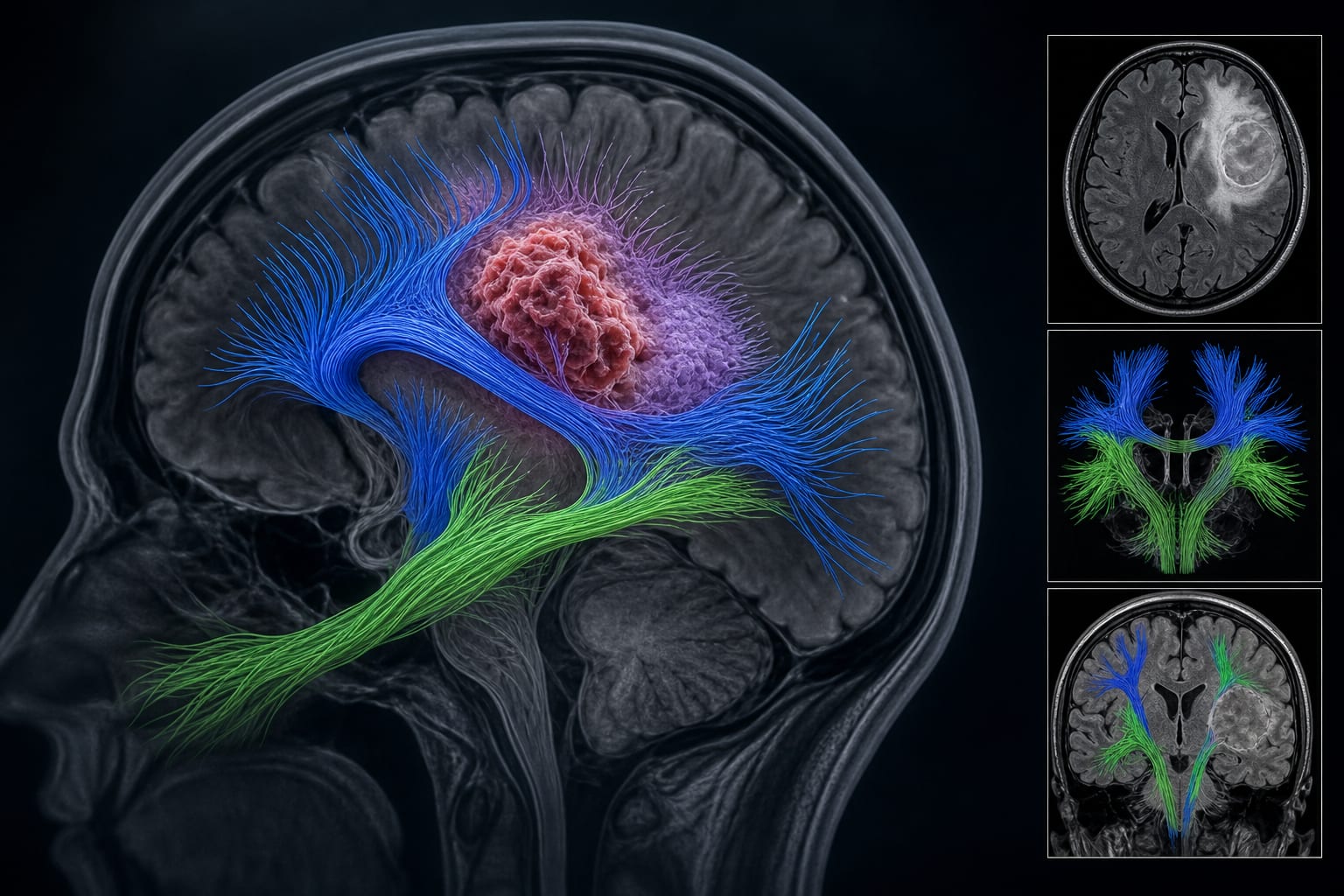
To investigate whether fractional anisotropy (FA) directly influences morphometric and neuroimaging characteristics of the inferior fronto-occipital fasciculus (IFOF) and arcuate fasciculus (AF) in relation to different tumor histotypes.

Approach:
  • Study Design: A retrospective multicenter study was conducted across six Italian Neurosurgical Units, reviewing medical records of 1,294 patients who underwent surgery for various intracranial tumors.
  • Inclusion Criteria: Patients aged ≥ 18 years with histological/molecular diagnosis of glioblastoma, low-grade glioma, brain metastasis, or meningioma, and complete preoperative neuroimaging were included.
  • MRI and DTI Analysis: MRI scans were performed using 1.5 and 3 Tesla systems, with DTI data acquired using varying diffusion directions across institutions. Tractography analyses were standardized and assessed by a multidisciplinary team.
  • Statistical Analysis: Data were analyzed using linear mixed-effects regression models to assess the association between AF/IFOF FA and their length or volume.
Key Findings:
  • FA is a recognized index of white matter integrity.
  • Morphometric alterations of the IFOF and AF were previously described in relation to different tumor histotypes.
  • Reduced FA may influence tract reconstruction and morphometric measures.
Interpretation:

The relationship between FA and tract morphometric measures reflects both biological changes in white matter integrity and methodological characteristics of diffusion tractography.

Limitations:
  • Retrospective design limits causative conclusions.
  • Inconsistent acquisition parameters across centers may affect data reliability.
Conclusion:

The study aims to clarify the interaction between white matter integrity and tumor characteristics.

Original Source(s)

Related Content