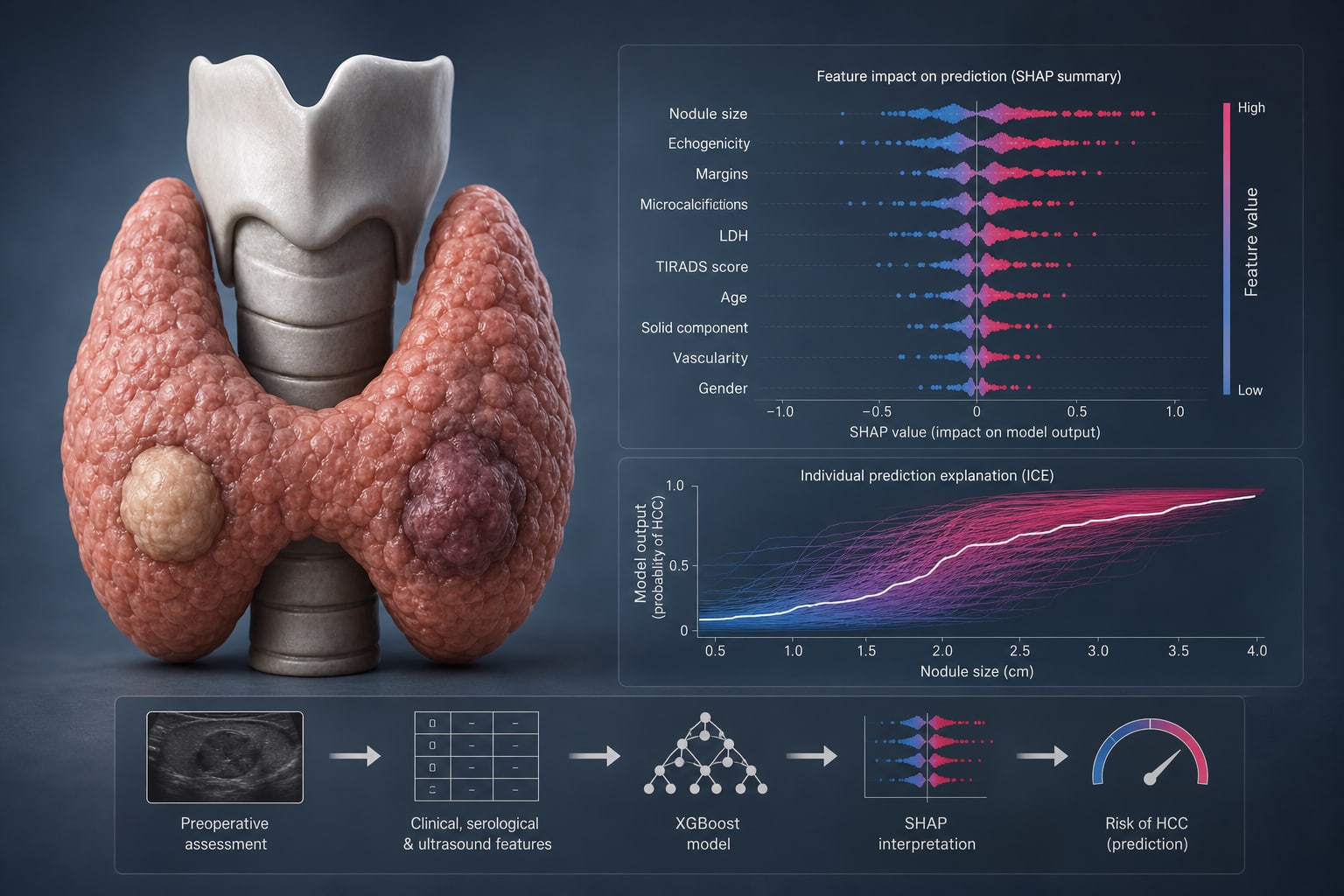
To develop an interpretable machine learning framework to improve diagnostic accuracy for distinguishing between benign Hürthle cell adenoma (HCA) and malignant Hürthle cell carcinoma (HCC).
Approach:
Patient Enrollment: Retrospective enrollment of 554 patients (280 HCA, 274 HCC) from a single center.
Feature Selection: Incorporation of 15 clinical, serological, and ultrasonographic variables with feature selection via LASSO and Random Forest algorithms.
Model Training: Training and evaluation of four advanced machine learning models and logistic regression (LR) using 10-fold cross-validation.
Interpretation Techniques: Utilization of SHAP and ICE trajectories for global and local interpretation of the optimal model.
Key Findings:
The XGBoost model achieved an AUC of 0.911, significantly outperforming logistic regression (AUC = 0.746).
Decision curve analysis indicated a higher clinical net benefit for the XGBoost model.
SHAP analysis identified vascularity grade, absent halo sign, and elevated serum thyroglobulin as top predictors of malignancy.
The SHAP-augmented XGBoost framework provides accurate, interpretable, and personalized presurgical risk stratification for Hürthle cell neoplasms.
Limitations:
The study is retrospective and conducted at a single center, which may limit generalizability.
The reliance on historical data may introduce biases inherent to retrospective studies.
Conclusion:
The developed machine learning framework has the potential to provide transparent and personalized risk stratification, potentially reducing unnecessary diagnostic thyroidectomies.