Accelerometer-Based Activity Sensing by an Insertable Cardiac Monitor In Ambulatory Patients: A Subanalysis of LUX-Dx TRENDS (LUX-Dx Heart Failure Sensors in an Insertable Cardiac Monitor System Clinical Study) - Summary - MDSpire
Conexiant’s news site is now MDSpire News. Learn more
Advertisement
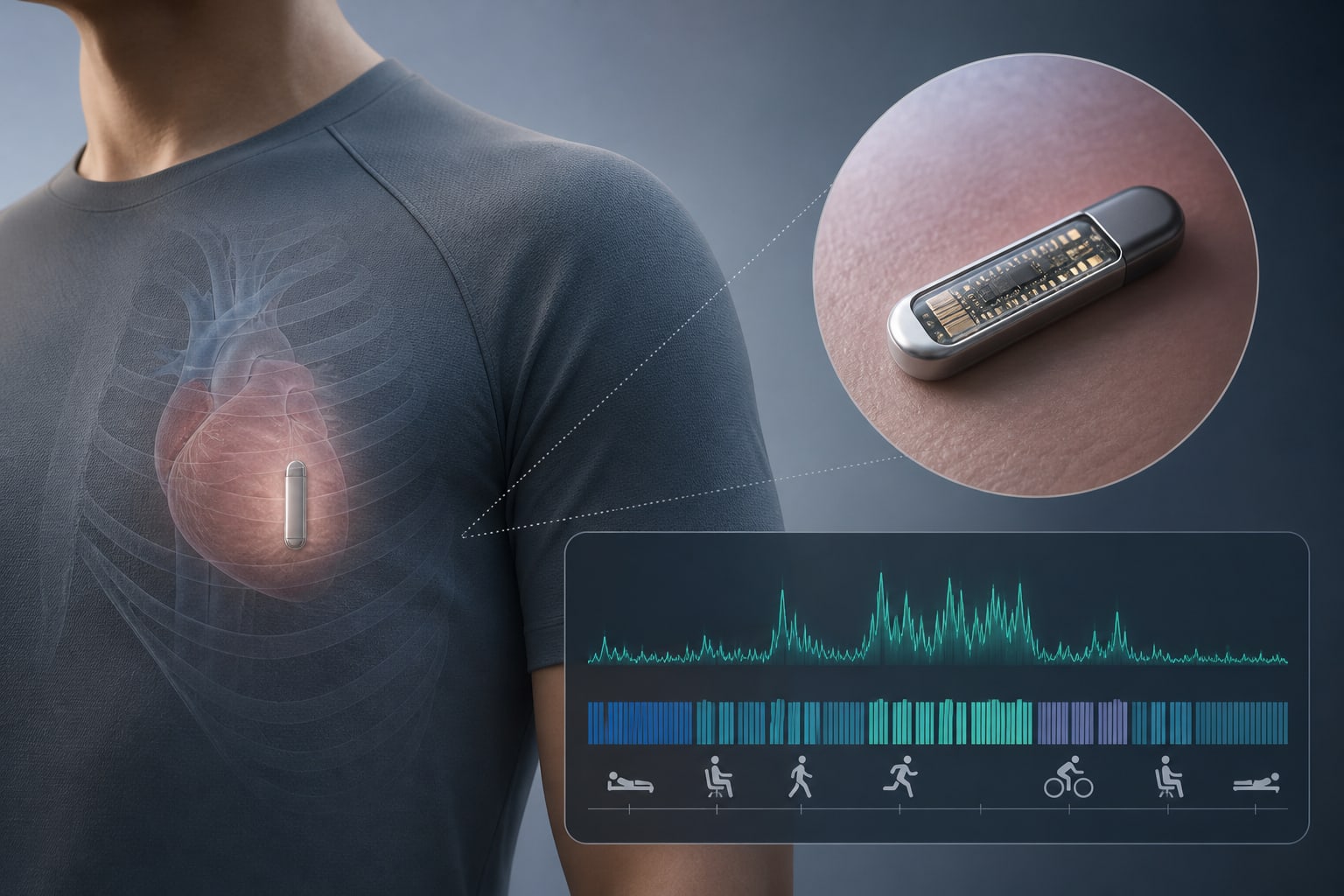
Activity Monitoring With an Insertable Cardiac Monitor in Ambulatory Patients: Subanalysis of the LUX-Dx TRENDS Clinical Study of Heart Failure Sensors
To assess the relationship between subcutaneous accelerometer signals and treadmill walking speed and evaluate an insertable cardiac monitor (ICM) algorithm for classifying activity.
Approach:
Study population: Exercise-substudy participants are adults with New York Heart Association class II or III heart failure enrolled in the multicenter LUX-Dx TRENDS study who are considered suitable for exercise testing.
Assessments: Participants maintain stationary postures and complete progressively faster treadmill stages. Investigators analyze accelerometer signals and compare algorithm classifications with a prespecified reference standard.
Analysis: The primary classification analysis defines walking speeds ≥1.2 mph as active and stationary postures as inactive, excluding the 0.7-mph treadmill stage. Agreement is assessed in dataset 2 using Cohen’s kappa.
Key Findings:
The exercise substudy includes 104 participants at 26 US sites; device data are analyzed for 56 participants in dataset 1 and 45 in dataset 2. Device data are unavailable for 3 participants.
Activity signals increase by an estimated 33.7 mG per 1-mph increase in walking speed in dataset 1 and 32.3 mG in dataset 2; both associations have P < .0001.
In dataset 2, agreement between algorithm classifications and the reference standard is κ = 0.971 (95% CI, 0.947–0.985), exceeding the prespecified goal of κ > 0.8.
Sensitivity is 0.974, specificity is 0.994, positive predictive value is 0.991, and negative predictive value is 0.982.
The kappa performance goal remains met in sensitivity analyses classifying the 0.7-mph treadmill stage as either active or inactive.
Interpretation:
In this ambulatory heart failure population, subcutaneous accelerometer signals show a strong positive association with treadmill walking speed, and the device algorithm shows high agreement with the prespecified activity reference standard under controlled conditions.
Limitations:
Testing is limited to controlled treadmill exercise and stationary postures; other activities, including biking and swimming, are not studied.
Gait differences, treadmill calibration, operator compliance, reference-label inaccuracies, and external vibration may affect results. Several potential influences, including electromagnetic interference, temperature variation, and respiratory rate changes, are not assessed.
Stationary measurements may not reflect prolonged rest during sleep. Selection may exclude frailer or gait-limited patients, and substantial attrition occurs at higher speeds. Algorithm performance is not evaluated within patient subgroups.
Conclusion:
The findings demonstrate the feasibility of accelerometer-based activity assessment using a miniaturized subcutaneous ICM. Further research should evaluate the algorithm’s real-world utility for detection, risk stratification, and patient management.
by ANDREW J. SAUER, E. MATTHEW QUIN, KARAN BHALLA, SASHI ADIGOPULA, BIN MI, EMILY THOMPSON, DEEPA MAHAJAN, MING DUANMU, CRAIG M. STOLEN, MOLLY E. KUPFER, ALYSIA ROSNER, SELÇUK ADABAG, SCOTT D. SOLOMON, ELAINE Y. WAN