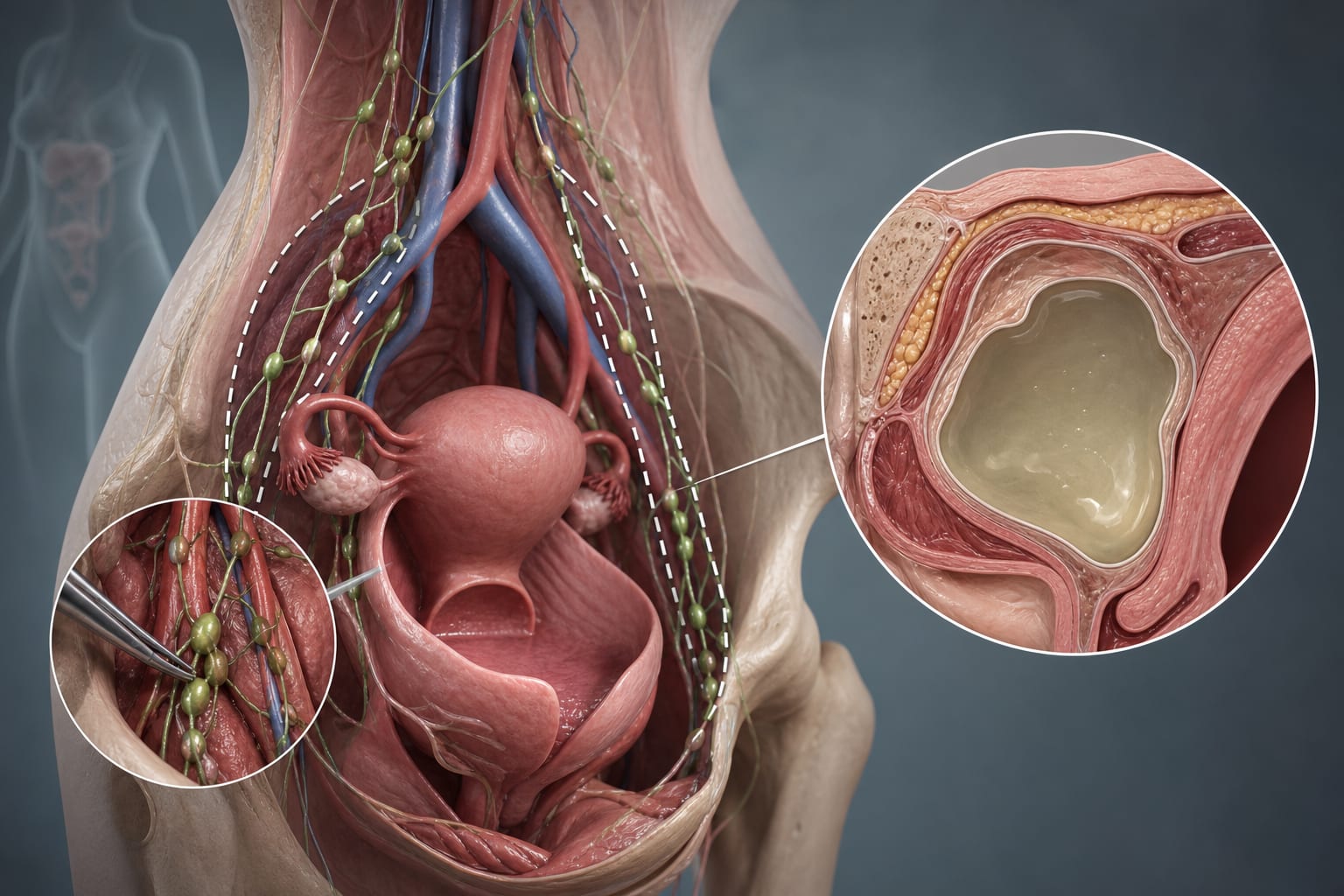
Identifying Risk Factors for Postoperative Lymphocele in Patients with Gynecological Malignancies: A Systematic Review and Meta-Analysis
By
Ting-yu Zhao
Wen Jiang
Jia-min Liu
Zhi-yi Liu
Ping Xie
June 10, 2026
Objective: To identify risk factors for postoperative lymphoceles following lymph node dissection for gynecological malignancies.
Approach: Key Findings: Pooled incidence of postoperative lymphocele was 30.18%. Significant risk factors included age >50 years (OR = 1.21, 95%CI: 1.02–1.42), BMI ≥24 kg/m² (OR = 1.45, 95%CI: 1.10–1.93), diabetes mellitus (OR = 1.30, 95%CI: 1.11–1.52), laparotomy (OR = 2.76, 95%CI: 2.12–3.58), resection of >20 lymph nodes (OR = 2.75, 95%CI: 2.16–3.51), pelvic and para-aortic lymphadenectomy (OR = 1.86, 95%CI: 1.42–2.43), omentectomy (OR = 1.56, 95%CI: 1.18-2.07), retroperitoneal closure (OR = 2.44, 95%CI: 1.67–3.57), monopolar electrosurgery (OR = 2.48, 95%CI: 1.75–3.51), prolonged operation time (>3h) (OR = 1.56, 95%CI: 1.10-2.21), 24h drainage >100 ml (OR = 1.61, 95%CI: 1.10-2.36), prolonged drainage (>3d) (OR = 1.60, 95%CI: 1.03-2.46), transvaginal drainage (OR = 2.90, 95%CI: 1.92–4.40), ovarian cancer (OR = 1.69, 95%CI: 1.21–2.36), lymphovascular invasion (OR = 1.25, 95%CI: 1.03–1.52), deep myometrial invasion (OR = 1.89, 95%CI: 1.25–2.87), lymph node positivity (OR = 1.59, 95%CI: 1.26–2.00), anemia (OR = 1.20, 95%CI: 1.02–1.40), hypoalbuminemia (OR = 1.58, 95%CI: 1.07–2.34), postoperative chemotherapy (OR = 1.85, 95%CI: 1.29–2.65), and concurrent chemoradiotherapy (OR = 2.49, 95%CI: 1.68–3.69). Interpretation: Clinicians can stratify lymphocele risk by integrating preoperative features, surgical procedures, tumor pathology, nutritional status, and adjuvant therapy.
Limitations: Moderate to high heterogeneity detected for most outcomes. Predominance of single-center retrospective studies. Conclusion: Well-designed prospective studies with unified criteria are needed to validate and refine prevention strategies.
Sources: