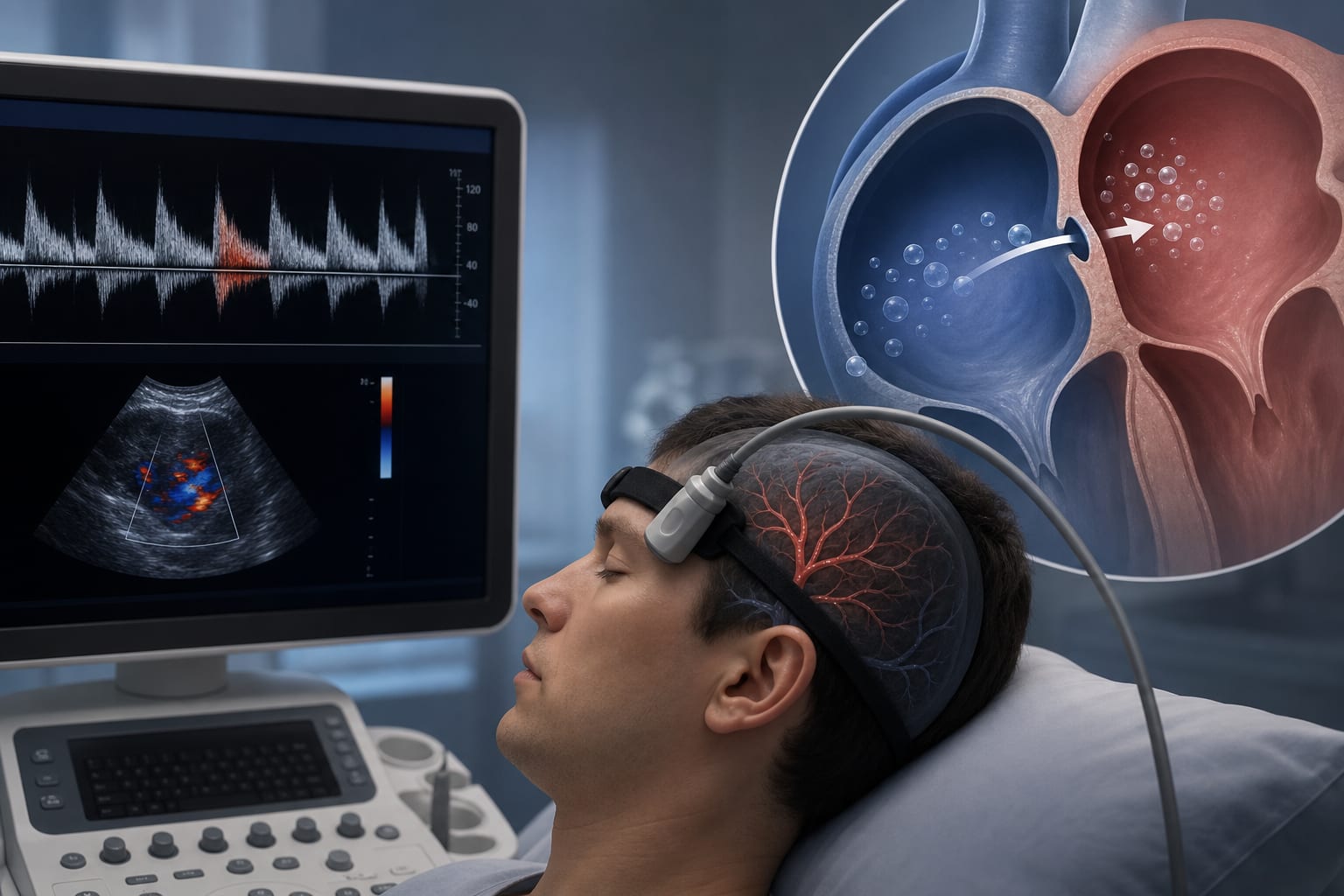
To assess the diagnostic precision of the transcranial Doppler bubble test (TCD-bubble) for identifying patent foramen ovale (PFO) in younger adults with acute ischemic stroke (AIS).
Key Findings:
31% of 383 individuals participated in TCD-bubble evaluation, with 120 individuals evaluated.
Sensitivity of TCD-bubble for detecting PFO was 97.1% and specificity was 71.2%.
Positive predictive value (PPV) for RLS-positive instances was 69.4%, and negative predictive value (NPV) was 97.4%.
A threshold of ≥3 bubbles during TCD-bubble testing yielded a sensitivity of 91.4% and specificity of 88.5%.
Interpretation:
The TCD-bubble test is a reliable, non-invasive screening method for PFO in younger AIS patients, with high sensitivity and NPV, suggesting it could significantly reduce the need for invasive assessments.
Limitations:
Retrospective design may introduce selection bias, potentially affecting the results.
Limited generalizability due to the specific patient population and setting.
Conclusion:
The TCD-bubble assay is a promising first-line screening tool for PFO in younger AIS patients, warranting confirmatory TEE for positive results to ensure accurate diagnosis.
by Anna Bogdanova, Lena Mers, Alexander Sekita, Laura Besendorf, Ludwig Singer, Tobias Engelhorn, Caroline Merkel, Kosmas Macha, Arnd Doerfler, Stefan Schwab, Stefan T. Gerner