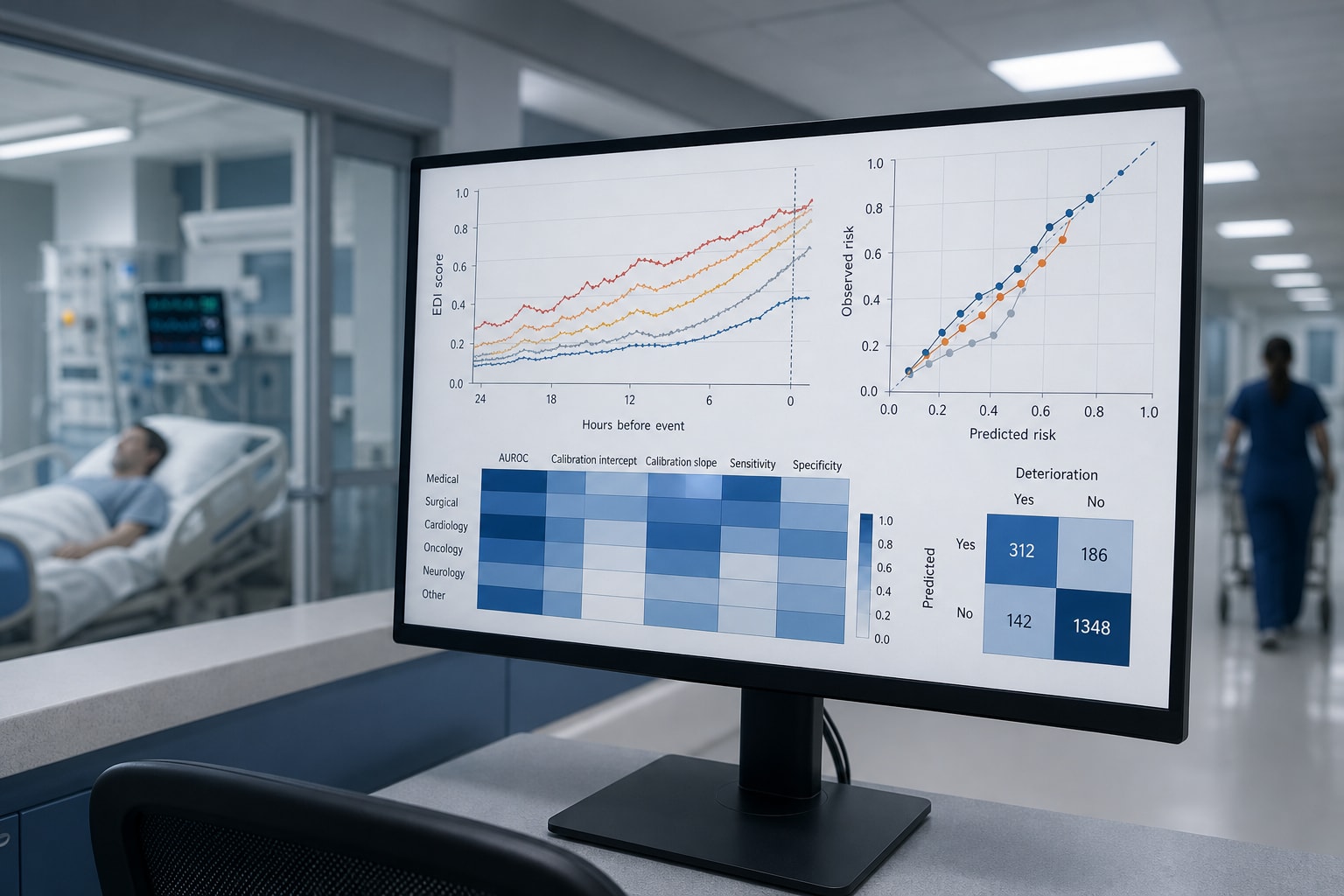
Assess whether Epic Deterioration Index (EDI) predictive performance varies across clinical service lines and hospital locations.
Approach:
Design and population: Retrospective cross-sectional study of adult inpatients at a Northern California academic hospital from 2021 to 2024.
Outcome and evaluation: Deterioration was defined as ICU transfer, rapid response team activation, comfort-care initiation, or death. EDI scores generated every 15 minutes were evaluated using discrimination, calibration, and classification measures, primarily for a 12-hour predictio…
Key Findings:
The analysis included 77,478 encounters and 10,579 deterioration events; overall AUROC was 0.763 (95% CI 0.759–0.768).
AUROC varied by service line, from 0.815 in haematology/oncology/BMT to 0.670 in cardiology and 0.677 in neurosciences.
Performance also varied across hospital locations.
Interpretation:
The authors report substantial variation in EDI performance across clinical subpopulations and state that understanding this variation is important for safe, effective, and precise inpatient deployment.
Limitations:
The study was conducted at a single academic medical centre.
The supplied context does not provide detailed results for calibration, classification, or the sensitivity analyses.