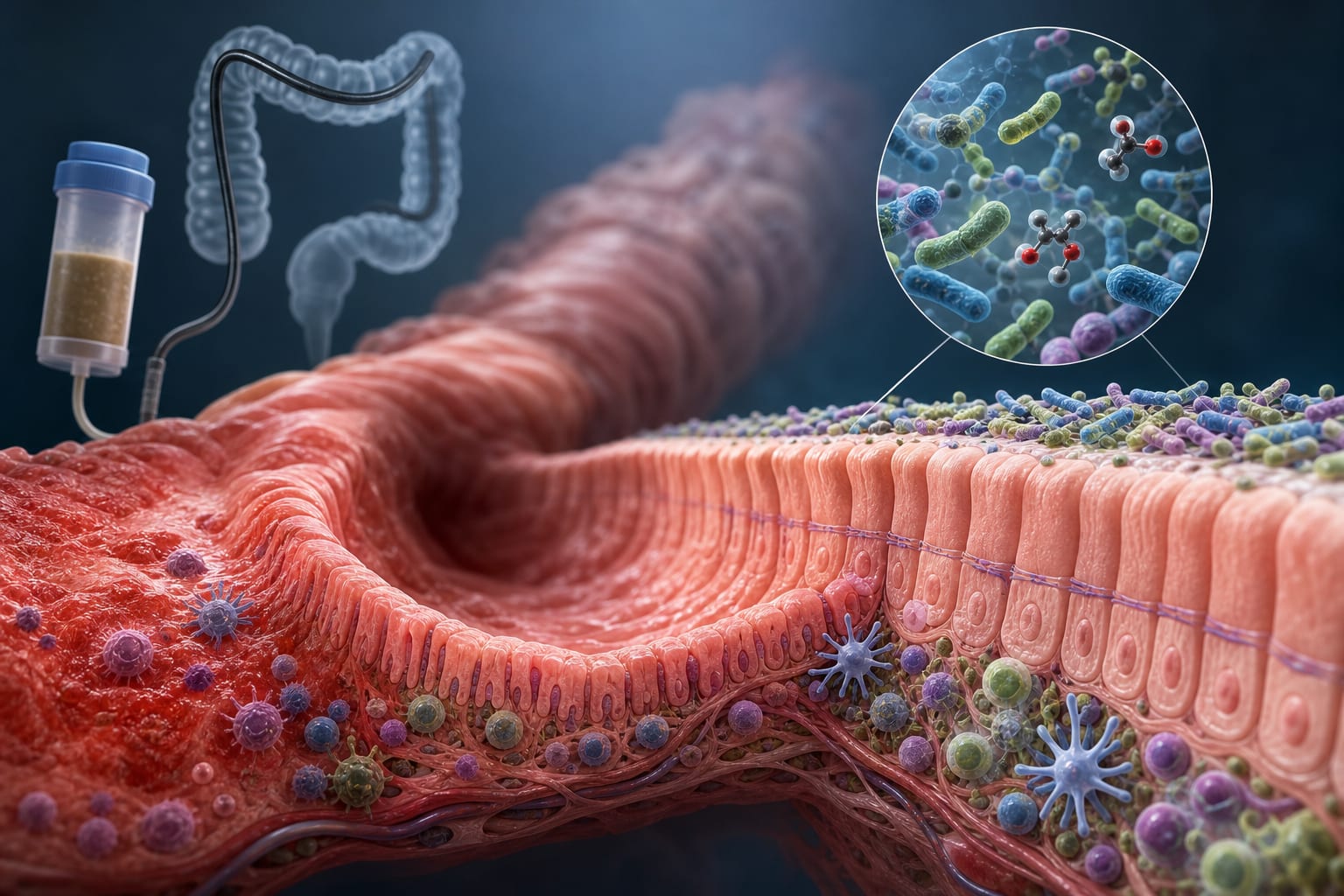
To distinguish shared IBD genetic liability from exploratory subtype-weighted spatial patterns and assess IBD-associated genetic signals in adult Crohn's disease (CD) and ulcerative colitis (UC) lesion contexts.
Approach:
Experimental Validation: Conducted targeted RT-qPCR in NCM460 epithelial cells and THP-1-derived macrophage-like cells to validate findings.
Key Findings:
Strong positive genetic correlations among overall IBD, CD, and UC.
MAGMA and PoPS prioritized immune-inflammatory candidates such as IL23R, JAK2, and STAT3.
Significant enrichment of overall IBD signals in adult immune regions and various tissue contexts.
RT-qPCR showed JAK2 knockdown reduced cytokine-induced CCL2 and CXCL8.
Interpretation:
Shared IBD genetic liability is linked to an adult immune–epithelial inflammatory lesion program involving various tissue contexts.
Limitations:
Developmental and subtype-weighted spatial signals are exploratory and should not be viewed as definitive mechanisms.
Conclusion:
The study provides a framework for linking IBD susceptibility to specific adult intestinal lesion environments, emphasizing the exploratory nature of the findings.