Hemorrhage-coagulation immune phenotype is associated with CD163/HO-1-enriched heme-processing macrophage remodeling and predicts recurrence in colorectal cancer: a real-world retrospective cohort study - Summary - MDSpire
Advertisement
Hemorrhage-coagulation immune phenotype is associated with CD163/HO-1-enriched heme-processing macrophage remodeling and predicts recurrence in colorectal cancer: a real-world retrospective cohort study
To evaluate the association of a prespecified hemorrhage-coagulation immune phenotype (HCIP) with recurrence-free survival (RFS) and CD163/HO-1-enriched immune remodeling in colorectal cancer.
Approach:
HCIP Definition: Defined from local hemorrhagic pathology assessed via H&E staining and systemic coagulation activation based on preoperative blood tests including fibrinogen, D-dimer, and platelet count.
Key Findings:
752 patients included in the final analytic cohort.
HCIP-poor tumors associated with advanced AJCC stage, larger tumor size, ulceration, and necrosis.
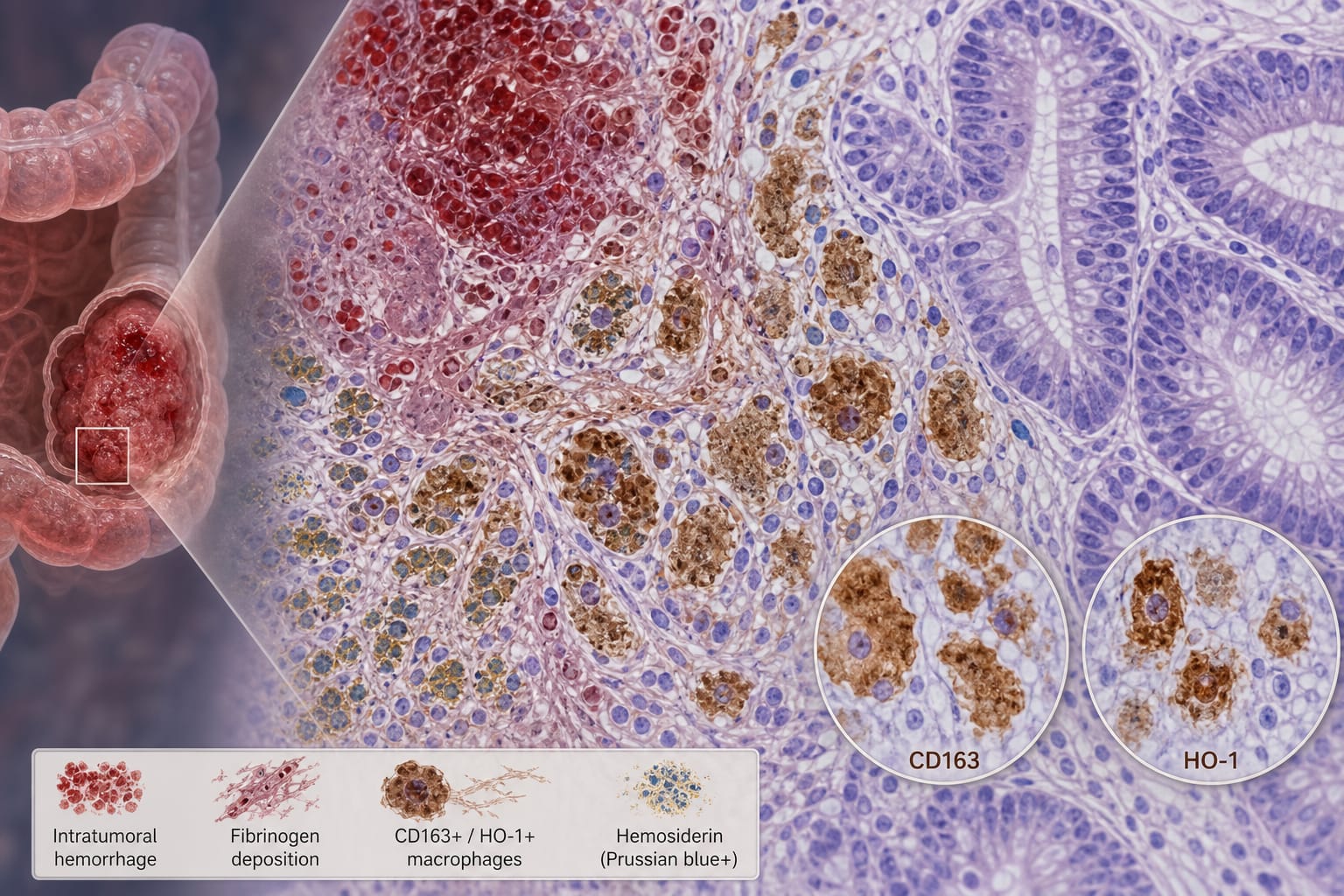
HCIP-poor tumors exhibited lower CD8+ T-cell density and higher CD163+ macrophage density.
HCIP-poor status linked to worse RFS (adjusted HR 1.91, 95% CI 1.33-2.73).
Fibrinogen was the most stable marker associated with RFS.
Interpretation:
HCIP identifies a hemorrhage-coagulation state linked to macrophage remodeling and recurrence risk in colorectal cancer.
Limitations:
Retrospective design may introduce bias.
Single-center study limits generalizability.
Conclusion:
HCIP links local hemorrhagic pathology and systemic coagulation activation to recurrence risk.