Development and validation of a multimodal predictive model based on clinical, biochemical, and quantitative dual-energy CT parameters: for predicting the benignity and malignancy of thyroid nodules - Summary - MDSpire
Advertisement
Development and validation of a multimodal predictive model based on clinical, biochemical, and quantitative dual-energy CT parameters: for predicting the benignity and malignancy of thyroid nodules
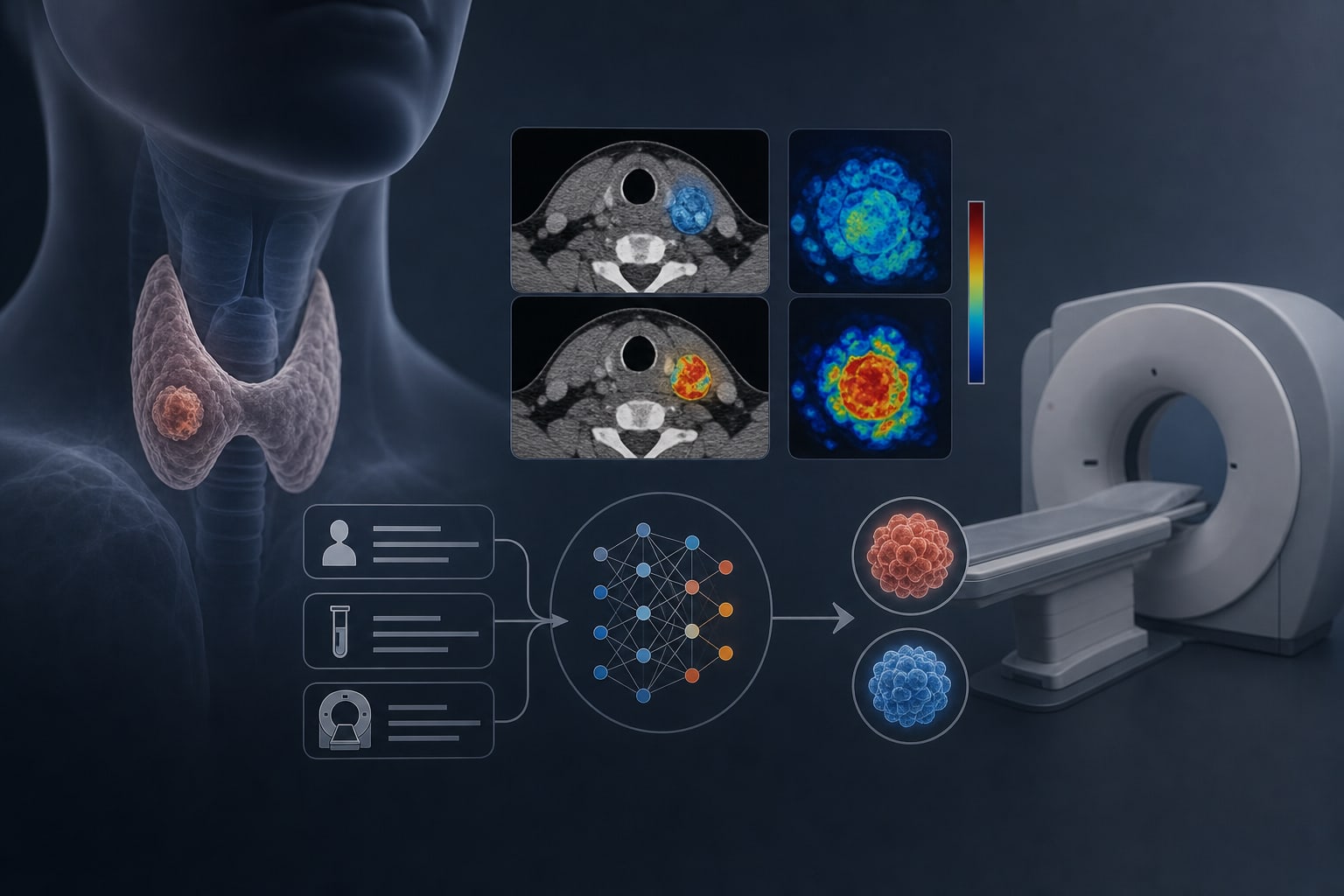
To develop and validate a clinical prediction model integrating clinical characteristics, biochemical markers, and quantitative dual-energy CT (DECT) parameters to differentiate malignant from benign thyroid nodules.
Approach:
Study Design: Retrospective study including 172 patients with thyroid nodules (87 malignant and 85 benign) who underwent DECT.
Data Collection: Clinical variables, biochemical markers, and spectral CT-derived quantitative parameters were collected for model development.
Model Development: Feature selection was performed using LASSO and Boruta algorithms, followed by multivariable logistic regression analysis.
Model Evaluation: Model performance was assessed using AUC, calibration curves, and decision curve analysis (DCA).
Key Findings:
Age, TSH, and thyroid nodule volume were identified as independent predictors of malignancy.
The final model achieved an AUC of 0.866 in the training cohort and 0.852 in the validation cohort.
Goodness-of-fit tests and calibration curves indicated good agreement between predicted and observed outcomes.
Interpretation:
The multimodal predictive model demonstrated excellent diagnostic accuracy for thyroid nodules.
Limitations:
The study was retrospective and conducted at a single institution.
No formal a priori sample size calculation was performed.
Conclusion:
The study successfully developed a predictive model integrating various features for accurate differentiation of thyroid nodules.