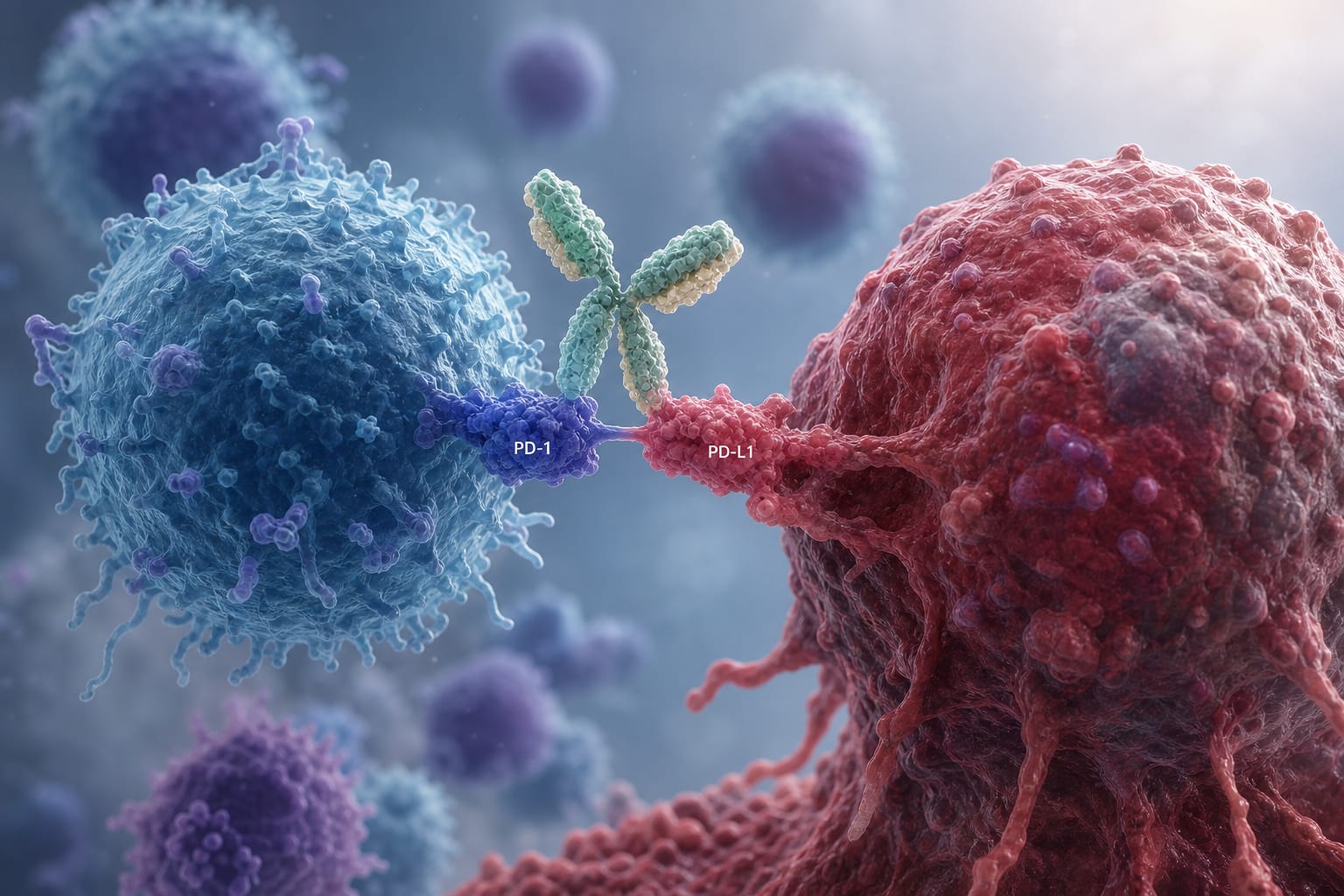
To assess the real-world efficacy and safety of PD-1 inhibitors in people living with HIV (PWH) presenting with concurrent malignancies, particularly those with low CD4+ T-cell counts or detectable HIV RNA.
Approach:
Study Design: A retrospective cohort analysis of patients diagnosed with cancer and treated with PD-1 inhibitors from January 2022 to December 2024.
Patient Enrollment: Patients were divided into HIV-positive and HIV-negative groups, with demographic and clinical data collected.
Data Analysis: Propensity score matching was used to compare progression-free survival (PFS), objective response rate (ORR), disease control rate (DCR), and treatment-related adverse events (TRAEs) between groups.
Key Findings:
The ORR and DCR were comparable between HIV-positive (16.2% and 51.4%) and HIV-negative (15.8% and 47.4%) groups, based on a matched cohort of 56 patients.
Median PFS was 11.5 months for HIV-positive patients and 16.9 months for HIV-negative patients.
In the lung cancer subgroup, ORR and DCR were 23.5% and 70.6% for HIV-positive patients, compared to 30.0% and 50.0% for HIV-negative patients.
Among patients with low CD4+ T-cell counts, the DCR was 25.0% based on four patients.
TRAEs were predominantly grades 1–2, with severe toxicities occurring in 5.4% of patients, all within the HIV-positive group.
Interpretation:
HIV status was not an independent prognostic factor for treatment outcomes, and robust immune restoration was achievable in patients with advanced immunosuppression.
Limitations:
The study is retrospective and may have inherent biases.
The sample size was relatively small, particularly for subgroups.
Conclusion:
PD-1 inhibitors are effective and generally well tolerated in PWH with concurrent malignancies, with low overall toxicity rates.