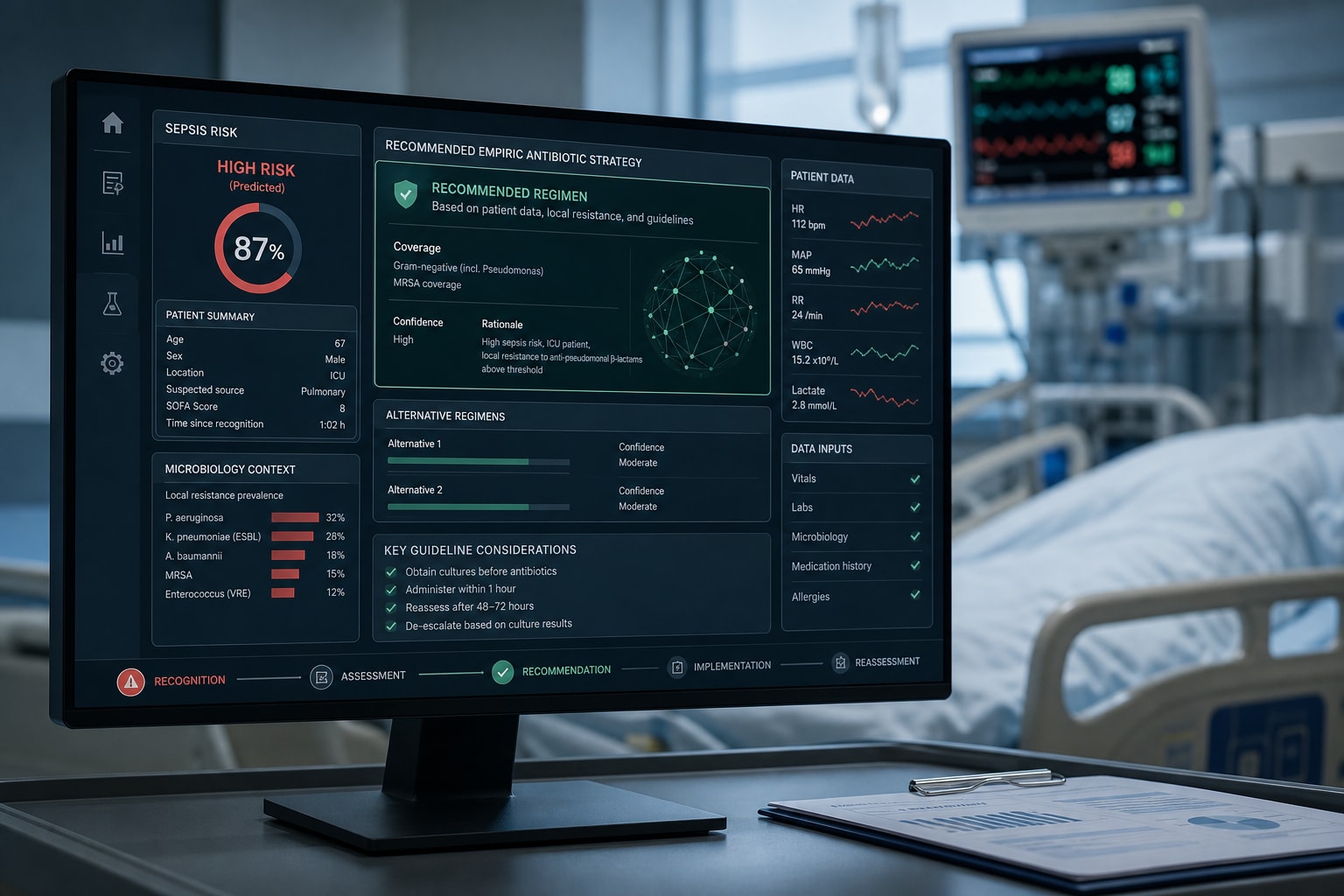
To develop an AI-based clinical decision support system (CDSS) specifically for individualized prediction of effective empirical antibiotic therapies in sepsis patients.
Key Findings:
Sepsis is a leading cause of global morbidity and mortality, with 48.9 million cases and 11 million deaths in 2017, highlighting the urgent need for effective treatment strategies.
Rapid initiation of effective antimicrobial therapy is crucial for survival in septic shock, with a 7.6% decrease in survival per hour of delay, underscoring the importance of timely intervention.
The CDSS aims to minimize the use of broad-spectrum antibiotics while ensuring effective treatment, addressing the critical issue of antibiotic resistance.
Interpretation:
The development of a CDSS is expected to enhance clinical decision-making in sepsis treatment, potentially improving patient outcomes and addressing the growing challenge of antibiotic resistance in healthcare.
Limitations:
The study does not address the implementation challenges of integrating the CDSS into clinical practice.
Potential biases in data selection and model training may affect the CDSS's predictive accuracy.
There is a need for ongoing evaluation of the CDSS's effectiveness and adaptability in real-world clinical settings.
Conclusion:
The KINBIOTICS project represents a significant step towards improving antibiotic stewardship in sepsis treatment through AI-driven decision support.
by Sophie Schmiegel, Hannah Marchi, Philipp Hege, Svenja Elkenkamp, Juliane Duevel, Christoph Düsing, Wolfgang Greiner, Sean Selim Scholz, Dominic Witzke, Johannes J Tebbe, Michael Wehmeier, Olaf Kaup, Rainer Borgstedt, Sebastian Rehberg, Philipp Cimiano, Christiane Fuchs