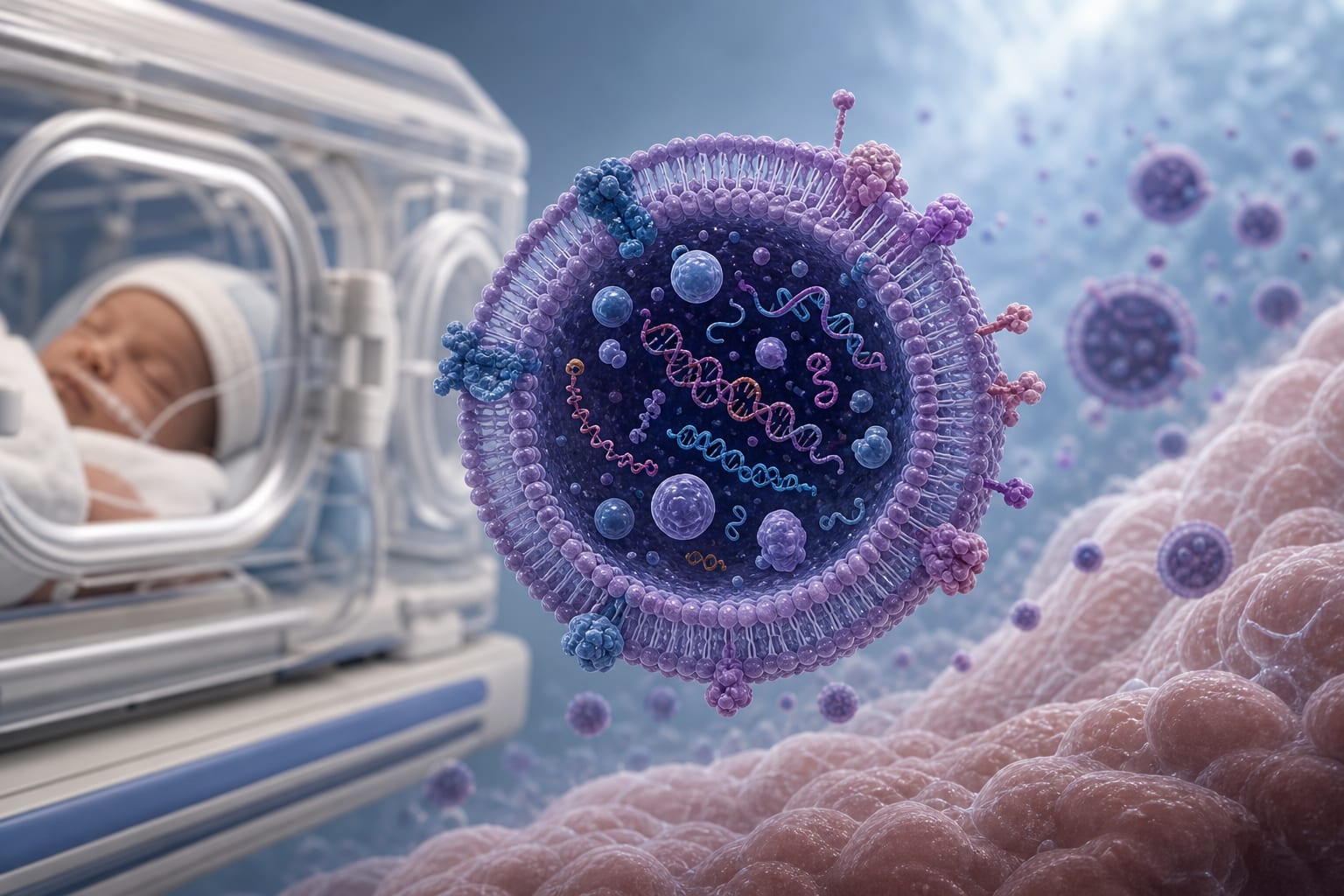
Tiny messengers, big impact: unlocking the power of extracellular vesicles in neonatal health and disease. a systematic review - Summary - MDSpire

Tiny messengers, big impact: unlocking the power of extracellular vesicles in neonatal health and disease. a systematic review

  • By

  • Alexandra Lianou

  • Andreas G. Tsantes

  • Sotirios P. Fortis

  • Effie G. Papageorgiou

  • Anastasios G. Kriebardis

  • Panagiotis G. Zoumpoulakis

  • Zoi Iliodromiti

  • Theodora Boutsikou

  • Evangelos Terpos

  • Maria Gavriatopoulou

  • Nicoletta Iacovidou

  • Rozeta Sokou

  • June 22, 2026

  • 0 min

Share

Objective:

To systematically collect and critically synthesize current evidence on extracellular vesicles (EVs) derived from neonatal biological fluids, focusing on their involvement in neonatal health and disease and their potential diagnostic and prognostic value.

Approach:
    Key Findings:
    • 43 predominantly observational studies were included, covering term and preterm neonates with small-to-moderate sample sizes.
    • EVs were isolated from various biological matrices, mainly umbilical cord and peripheral blood, with sampling primarily at birth or early postnatal life.
    • EVs consistently demonstrated biological activity across diverse neonatal conditions, indicating their potential role as pathophysiological mediators and candidate biomarkers.
    Interpretation:

    EVs actively participate in key neonatal processes, but the evidence is limited and methodologically heterogeneous, highlighting the need for further research.

    Limitations:
    • The number of studies on EVs in neonates is very limited compared to adults, which restricts comprehensive understanding.
    • Data from adult studies cannot be directly extrapolated to neonates, necessitating dedicated neonatal research.
    Conclusion:

    Larger, standardized studies are required to clarify the biological functions and clinical utility of EVs in neonates, addressing the current methodological limitations.

    Sources:

Original Source(s)

Related Content